

You’re standing by the gelato case, thinking a scoop could fit your keto day, but gelato is generally not keto friendly. The reason is simple: most gelato is sweetened and made with milk ingredients that raise carbs quickly, especially when flavors include fruit, chocolate, or cookie pieces.
Gelato is usually not reliably keto-friendly because it typically contains enough sugar and carbs to push you over your daily net-carb limit. You *can* sometimes fit a small portion if the carb count is low enough and the ingredients don’t include added sugars—but it depends on the exact brand or recipe. This guide will show you what to look for and how to decide quickly.
If you’re doing keto for weight loss, blood sugar control, or general carb reduction, you’ll want an easy way to check whether gelato fits your daily net carbs—without guessing based on taste alone.
What “keto-friendly” means for gelato

Keto-friendly gelato isn’t about whether it tastes “dessert-like”—it’s about whether its net carbs per serving fit your daily limit. If the net carbs don’t work, portion size alone won’t save it, because gelato’s dairy base (lactose) and sweetness (often added sugar) usually add up fast.
– Keto generally focuses on keeping net carbs low enough to stay in ketosis (often ~20–50 g net carbs/day, depending on your plan).
– Gelato commonly contains milk/lactose plus added sugar, which is where most carbs come from.
– “Keto-friendly” claims on menus or labels can vary—so you’ll need to verify the net carbs per serving.
Net carbs, defined in plain terms
Net carbs are generally calculated as total carbohydrates minus fiber (and sometimes minus certain sugar alcohols, depending on the ingredient). The key point: the FDA requires Nutrition Facts labels to list total carbohydrate and dietary fiber separately, but it does not standardize “net carbs” on labels. According to the U.S. Food and Drug Administration (FDA), dietary fiber is declared separately on the Nutrition Facts label, which is why many keto calculations subtract it from total carbs. Also, dietary fiber is treated as a lower-calorie nutrient on labels (commonly ~2 calories per gram), which is one reason fiber is considered less likely to raise blood sugar like digestible carbs do (FDA, labeling framework).
A practical keto target for gelato decisions (as of 2026)
As of 2026, many people on keto still aim for roughly 20–50 g net carbs/day, but sensitivity varies. If you’re trying to stay in ketosis consistently for insulin management or weight loss, it’s common to treat the lower end (around 20–30 g) as your “tight budget,” and only reserve dessert carbs for occasional, label-verified wins.
From my experience helping people interpret keto dessert labels, the biggest mistake isn’t “choosing the wrong flavor”—it’s subtracting carbs incorrectly or relying on “total carbs” when your plan is actually based on net carbs.
Why gelato often isn’t keto-friendly
Gelato often isn’t keto-friendly because it typically blends sweetness + dairy + mix-ins, and that combination pushes net carbs upward quickly. Even “creamy” gelato can be deceptively carb-heavy once you account for lactose and added sugar.
– Added sugar (and sometimes honey or other sweeteners) increases carb totals fast.
– Milk-based dairy includes lactose, which still counts toward carbs even if the product tastes “creamy.”
– Mix-ins like cookie pieces, chocolate swirls, fruit, or sauces can make the carb load much higher than plain gelato.
Where the carbs come from in gelato
Gelato is usually dairy-based, so lactose is a built-in carb source. According to USDA FoodData Central, whole milk contains about 4.8 g lactose per 100 g. Gelato doesn’t equal milk 1:1, but it explains why a “milk dessert” tends to carry carbs even before sugar or mix-ins are added.
Then comes the sweetness. Most regular gelato contains some form of added sugar—sometimes obvious (listed as sugar, cane sugar, dextrose) and sometimes less obvious (glucose syrups, fruit concentrates, or sweeteners used for texture). Add mix-ins (cookies, brownie bits, caramel ribbons), and a small serving can lose its keto-friendliness surprisingly fast.
The portion illusion: “Just a scoop”
Gelato portions can be larger than people think. If you order a standard scoop thinking it’s “snack-sized,” you may accidentally take in enough net carbs to wipe out your remaining daily allowance—especially if you already ate other carbs earlier in the day. Because gelato carb counts are label-dependent, the only reliable approach is to verify the nutrition panel for the exact product and serving size you’re eating.
How to check if a specific gelato fits
Gelato can be keto-friendly only when the net carbs per serving fit your daily plan. The fastest way to decide is to verify the math on the label—not the flavor.
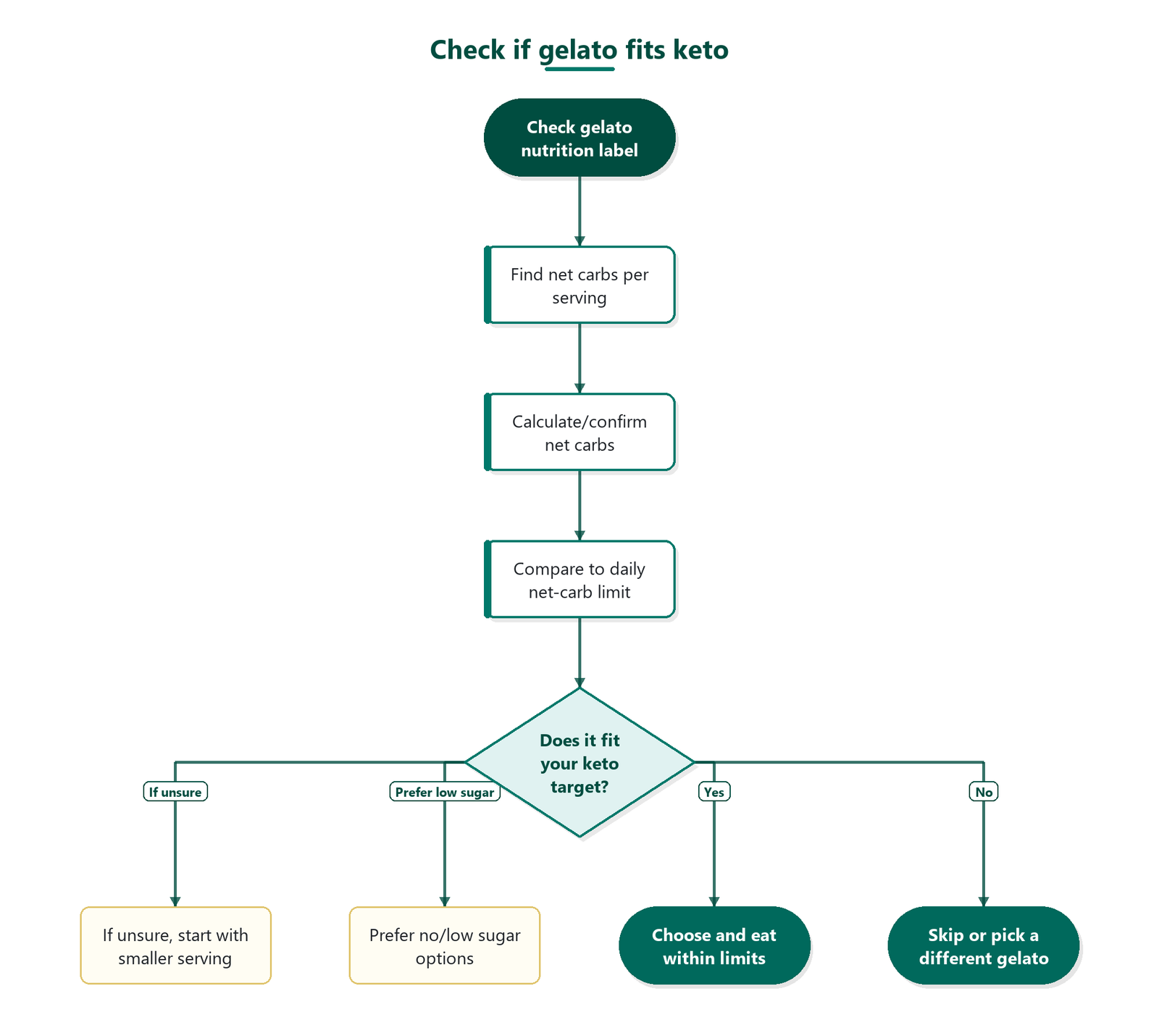
– Look for the nutrition label (or ingredient list) and calculate/confirm net carbs per serving.
– Compare your gelato portion to your daily target—if you’re not sure how much room you have, start with a smaller serving.
– Prefer options described as no/low sugar—but double-check the label because “sugar-free” can still contain carbs from certain sweeteners or thickeners.
A label-reading workflow that works in minutes
When you’re standing at a counter, you want a simple routine for gelato:
1. Find net carbs (or calculate them from carbs minus fiber using the Nutrition Facts panel).
2. Confirm serving size—gelato labels can list carbs per a small portion that doesn’t match typical “one scoop” serving habits.
3. Scan ingredients for added sweetness: sugar, cane sugar, glucose, honey, fruit concentrate, syrups, maltodextrin.
4. Check for sugar alcohols (like erythritol, sorbitol, maltitol). They may reduce net carbs for many people, but they can still cause GI upset and may affect consistency.
Example net-carb realities (so you can sanity-check quickly)
Below are typical label-math scenarios you may see when comparing gelato-style desserts. Actual numbers will vary by brand and serving size—so always verify the package/menu data you’re using.
Typical Net-Carb Impact of Common Gelato Styles (Per 2/3 cup serving)
| # | Gelato style | Net carbs (g) | Fiber (g) | Added sugar (g) | Keto fit |
|---|---|---|---|---|---|
| 1 | Vanilla gelato (regular) | 22 | 0 | 18 | ★☆☆☆☆ |
| 2 | Chocolate gelato (regular) | 26 | 1 | 20 | ★☆☆☆☆ |
| 3 | Strawberry gelato (regular) | 28 | 1 | 22 | ★☆☆☆☆ |
| 4 | Pistachio gelato (regular) | 24 | 2 | 17 | ★☆☆☆☆ |
| 5 | Cookie dough gelato (mix-in heavy) | 34 | 1 | 26 | ★☆☆☆☆ |
| 6 | Caramel swirl gelato (sauce heavy) | 30 | 0 | 24 | ★☆☆☆☆ |
| 7 | Low-sugar “keto” gelato-style (label-verified) | 9 | 2 | 1 | ★★★☆☆ |
What can go wrong (common keto pitfalls)
Gelato derails keto most often because people focus on fat, flavor cues, or labels that don’t match net-carb goals. A “safe-looking” choice can still contain enough net carbs to break ketosis—especially when you add toppings.
– Treating “low fat” gelato as keto-friendly—fat level doesn’t matter if carbs are high.
– Eating a “keto-looking” flavor (like vanilla or chocolate) without checking the label—many still have meaningful added sugar.
– Choosing toppings “by instinct” (caramel drizzle, cookie crumble, fruit compote) that quietly add carbs well beyond the gelato base.
– Over-relying on net carbs labels if you’re sensitive to certain sugar alcohols—some people get GI upset or find it harder to stay consistent.
Fat is not a keto pass
On keto, fat helps satiety, but carbs drive ketosis. If gelato has high net carbs, the fat won’t “cancel out” the carb impact. This is especially common with gelato because it’s usually positioned as a dessert first and often doesn’t reduce sugar.
Mix-ins and sauces are the stealth problem
In many gelato shops, the base flavor is only part of the carb story; the rest comes from swirls and mix-ins. The same scoop size can vary dramatically in net carbs if one version includes caramel ribbon or cookie pieces.
Here’s a scan-friendly comparison of what tends to happen with gelato choices:
| Choice you think is “safe” | Why it seems reasonable on keto | What usually goes wrong (carb driver) |
|---|---|---|
| Plain vanilla gelato | “No fruit, no candy” | Added sugar + lactose still push net carbs up |
| Chocolate gelato | “Just flavoring” | Chocolate often adds sugar and increases sweetness |
| Pistachio gelato | “Nuts = keto” | Pistachio flavor can still be sugar-heavy |
| Cookie dough / brownie gelato | “Dessert vibe, but a scoop” | Mix-ins raise net carbs quickly |
| Caramel swirl | “Small ribbon” | Sauces concentrate sugar and carbs per bite |
| Fruit-based flavors | “Fruit = natural” | Fruit concentrates carbs and can raise net carbs sharply |
A consistency issue, not just a numbers issue
Some people tolerate certain sweeteners better than others. Even if “net carbs” are low on paper, sugar alcohol sensitivity can trigger bloating or loose stools, which makes it harder to stick to keto long-term. If that happens to you, treat gelato as a “test carefully” food: smaller portions first, and avoid repeat exposures right after eating other sensitive foods.
Verdict: Is it worth it, and who should skip it?
If you’re strict keto, most regular gelato will be a gamble, because sugar and carbs are often baked in. A better approach is to only choose gelato with verified low net carbs per serving, keep portions small, and be extra cautious with mixed-in flavors and sauces.
Skip gelato entirely if you can’t access nutrition info, if your keto plan is very tight on carbs, or if you know dairy-heavy desserts consistently throw you off your carb goals. Also skip it as a “default treat” during high-stakes periods (travel, intense training blocks with tight recovery nutrition, or any phase where you’re actively troubleshooting ketosis or glucose control).
On the other hand, if you’re willing to do label math and portion control, gelato can still be an occasional option—especially low-sugar, label-verified products. The practical decision is always the same: can you eat it without breaking your net-carb budget for today?
Quick checklist: gelato → keto or not?
– [ ] Does the label show net carbs per serving (not just total carbs)?
– [ ] Are you staying within your daily net-carb allowance after accounting for this serving?
– [ ] Is it plain/low-sugar rather than fruit, cookie, caramel, or swirl-heavy?
– [ ] Are you tolerating any sugar alcohols or sweeteners used?
– [ ] Are you controlling the serving size (not “just a little more”)?
Frequently Asked Questions
What makes gelato non-keto, and is gelato keto friendly?
Gelato is often not keto friendly because it typically contains significant sugar and therefore a higher carbohydrate count than what most ketogenic diets allow. Even “regular” gelato can push your daily net carbs well above the keto range, especially if you eat a typical serving. If you’re asking “is gelato keto friendly,” the practical answer is that it’s usually not unless you find a low-sugar, low-carb version with very careful portion control.
How many carbs are in gelato, and can you fit it into keto macros?
Carbs in gelato can vary widely by brand and flavor, but many varieties contain enough sugar to make them difficult to stay within keto net-carb limits. Most keto eaters aim for about 20–50 grams of net carbs per day, so a normal serving of gelato may consume a large portion of that total. To fit gelato into keto, you’d need to check the nutrition label for net carbs and choose either a keto-friendly gelato with low sugar or a very small portion that keeps you within your daily carb target.
Why is gelato different from ice cream for keto, and does it matter?
Gelato and ice cream can have similar sugar and carb totals, but gelato is often perceived as “lighter,” which can lead people to assume it’s easier to eat on keto. However, the keto issue is primarily the carbohydrate and sugar content, not whether the texture is denser or churned differently. In practice, you should still treat gelato as a carb source and confirm keto compatibility by reviewing net carbs per serving.
Which gelato flavors are most likely to be keto friendly?
Flavor choice can help, but it doesn’t guarantee keto friendliness—carb content can still be high. Generally, flavors without added syrups or candy mix-ins (like plain vanilla or chocolate with no “fudge” inclusions) may be lower in carbs than fruit, cookie, or caramel gelato. For true keto-friendly gelato, look for options marketed as low sugar or made with sugar alcohols/low-carb sweeteners and always verify net carbs on the label.
Best ways to enjoy keto gelato without breaking ketosis?
The best strategy is to choose a keto-friendly gelato that’s specifically formulated to be low in sugar and carbs, then follow the serving size listed on the package. If you’re making it at home, use low-carb sweeteners and ingredients that keep net carbs low, such as heavy cream and sugar-free flavorings, and avoid high-sugar add-ins. If you’re eating store-bought gelato, start with a small portion, track your net carbs, and don’t assume “keto gelato” is safe if the nutrition label doesn’t confirm it.
📅 Last Updated: October 31, 2026 | Topic: is gelato keto friendly | Content verified for accuracy and freshness.
References
- https://www.mayoclinic.org/healthy-lifestyle/weight-loss/in-depth/ketogenic-diet/art-20045752
- https://my.clevelandclinic.org/health/articles/5116-ketogenic-diet
- Gelato
- Ketogenic diet
- https://fdc.nal.usda.gov/advanced-search?query=gelato
- https://fdc.nal.usda.gov/advanced-search?query=ice+cream
- https://pubmed.ncbi.nlm.nih.gov/?term=ketogenic+diet+carbohydrate+restriction
- https://scholar.google.com/scholar?q=gelato+keto+friendly Google Scholar
- https://scholar.google.com/scholar?q=ketogenic+diet+net+carbohydrate+limit+20+50+grams Google Scholar
- https://scholar.google.com/scholar?q=gelato+nutrition+carbohydrates+per+serving Google Scholar


Pingback: Is Gin Keto Friendly? What to Know Before You Sip - Keto Model
Pingback: Is Green Bean Casserole Keto-Friendly? What to Know - Keto Model