
It is best to treat Nature’s Own Keto Bread as gluten-free only if its label explicitly states it is gluten-free. Many keto breads use wheat-based ingredients or shared manufacturing lines, so the safest determining factor is the gluten-free statement and any allergen warnings on the specific package you’re holding. Check that wording every time for the quickest, most reliable answer.
Nature’s Own keto bread is not automatically gluten-free just because it’s “keto.” The only reliable answer is what the current package label says for that exact loaf variety—specifically the gluten-free claim and the “contains”/wheat language on the ingredient/allergen section.
If you’re avoiding gluten for celiac disease, a wheat allergy, or non-celiac gluten sensitivity, you should verify the specific Nature’s Own keto loaf you have (formula + labeling can change). As of 2026, many shoppers also rely on allergen “contains” wording rather than nutrition facts, because “keto” addresses carbs/macros—not gluten status.
What to check first on the package

You can confirm gluten status fastest by focusing on the label claims and allergen “contains” lines on the exact Nature’s Own keto loaf in your hand. Don’t infer anything from “keto” alone.
– Look for an explicit “gluten-free” statement and any relevant certification mark on the specific Nature’s Own keto loaf you have.
– If you don’t see a gluten-free claim, scan for “contains” lines (especially wheat) and ingredient mentions like wheat flour or wheat derivatives.
Why this works (and what people miss): In the U.S., a product can market “keto” and still include gluten-containing ingredients; gluten is determined by ingredients/allergen labeling, not carbohydrate targets. According to the U.S. FDA (Final Rule on Gluten-Free Labeling, 2013), foods labeled “gluten-free” are required to meet a gluten threshold (with “gluten-free” generally tied to a standard of <20 ppm gluten). If Nature’s Own does not carry that claim on the specific loaf you’re buying in 2026, you have less (or no) confirmation.
How to read the ingredients for hidden gluten
The quick rule is: “keto” describes carbs; the ingredient list determines gluten. For Nature’s Own keto bread, you’re looking for wheat/barley/rye (or derivatives) hidden behind ingredient names.
– Watch for obvious gluten sources: wheat, barley, rye, and their derivatives (including common flour types).
– Even if it’s “keto,” the bread may still use grain-based ingredients depending on the recipe.
– Don’t rely on nutrition labels alone—carbs are not the same as gluten status.
Common ingredient “tells” to scan for (Nature’s Own keto bread context):
– Direct grains: wheat flour, wheat starch, barley malt, rye flour, rye extract.
– Derivative language: “wheat protein,” “modified wheat starch,” “wheat bran,” “malt” (often from barley), “seitan” (wheat-based).
– System-wide confusion zones: nutrition panels may show low “net carbs,” but gluten can still be present at levels that matter for celiac disease.
What I do in my own label-checking workflow: when I’m deciding whether a “keto” bakery item is safe for a gluten-sensitive coworker, I read the allergen wording first, then confirm the ingredient list doesn’t contradict it. That habit is saved by time pressure in-store, and it prevents the common mistake of trusting the front label.
Keto bread vs gluten-free: what the labels can (and can’t) tell you
“Keto” usually tells you about macros, not gluten. For Nature’s Own keto bread, the gluten-free question hinges on the gluten-free claim (or certification) and whether wheat is explicitly present in “contains”/ingredients.
– “Keto” typically refers to macros (like lower net carbs), not a guarantee about gluten.
– A product can be low-carb and still contain wheat or other gluten-containing ingredients.
– For people who react to trace gluten, certification and clear allergen labeling matter more than marketing terms.
How to interpret label signals without overreaching:
– If you see “gluten-free” (and/or a recognized certification), that’s a meaningful signal—but you still want to confirm it matches the exact variety and current package printed for 2026.
– If you see “contains wheat” (even alongside a “keto” message), that’s a direct conflict with gluten-free expectations for celiac disease and most gluten-intolerant consumers.
– If the label is silent about gluten-free status, treat it as not confirmed.
According to NIDDK (National Institute of Diabetes and Digestive and Kidney Diseases), celiac disease affects about 1% of the U.S. population. That’s why “label ambiguity” isn’t a minor inconvenience—it can change whether someone can safely eat a product.
Gluten-Free Label Meaning: Common Thresholds Used in Labeling Rules
| # | Standard / Program | Max Gluten Limit | Typical Testing Basis | Regulatory Reference | Label Clarity | Margin vs 20 ppm |
|---|---|---|---|---|---|---|
| 1 | U.S. FDA “gluten-free” threshold | 20 ppm | Validated gluten testing | 2013 rule | ★★★☆☆ | 0 ppm |
| 2 | Codex “gluten-free” standard | 20 ppm | Assay-based compliance | Codex alignment | ★★★☆☆ | 0 ppm |
| 3 | EU gluten-free labeling rule | 20 mg/kg | Analytical testing | EU framework | ★★★☆☆ | 0 ppm |
| 4 | Canadian gluten-free approach | 20 ppm | Regulatory compliance testing | Canada guidance | ★★★☆☆ | 0 ppm |
| 5 | Australia & New Zealand gluten-free definition | 20 ppm | Measured gluten concentration | Food standards alignment | ★★★☆☆ | 0 ppm |
| 6 | NSF “Certified Gluten-Free” threshold | 20 ppm | Testing + certification controls | Program standard | ★★★☆☆ | 0 ppm |
| 7 | GFCO “Certified Gluten-Free” threshold | 10 ppm | Certification program requirements | GFCO standard | ★★★★☆ | 10 ppm |
What can go wrong (common mistakes and edge cases)
The most common failure mode is assuming “keto” is a safety label for gluten. For Nature’s Own keto bread, the real risk is skipping the exact “contains” and cross-contact language for the package you’re currently using in 2026.
– Assuming “keto” equals gluten-free and skipping the ingredient/allergen review.
– Eating a different loaf variety than the one you checked (formulas can differ by product line).
– Ignoring cross-contact statements (for example, “processed in a facility with…”), which can matter for sensitive users.
Edge cases that matter:
– Variety swaps: Nature’s Own often has multiple “keto” or low-carb offerings. Even when the branding looks consistent, ingredient formulation can change between seasonal runs and revisions.
– Allergen label mismatches: Sometimes the ingredient list includes a gluten-containing component but the “gluten-free” claim is omitted entirely—or the opposite can happen if a specific line is updated. If Nature’s Own keto bread doesn’t clearly match your needs, don’t assume continuity.
– Trace sensitivity vs celiac: “May contain” or facility cross-contact language can affect people differently. For celiac disease, many clinicians recommend avoiding products with significant uncertainty.
Verdict / tip: how to decide fast (and who should skip)
The fastest decision rule is: verify the exact current label for “gluten-free” and for any “contains wheat” language—everything else is secondary. If you can’t verify it for the Nature’s Own keto bread you have in front of you, treat it as not confirmed gluten-free.
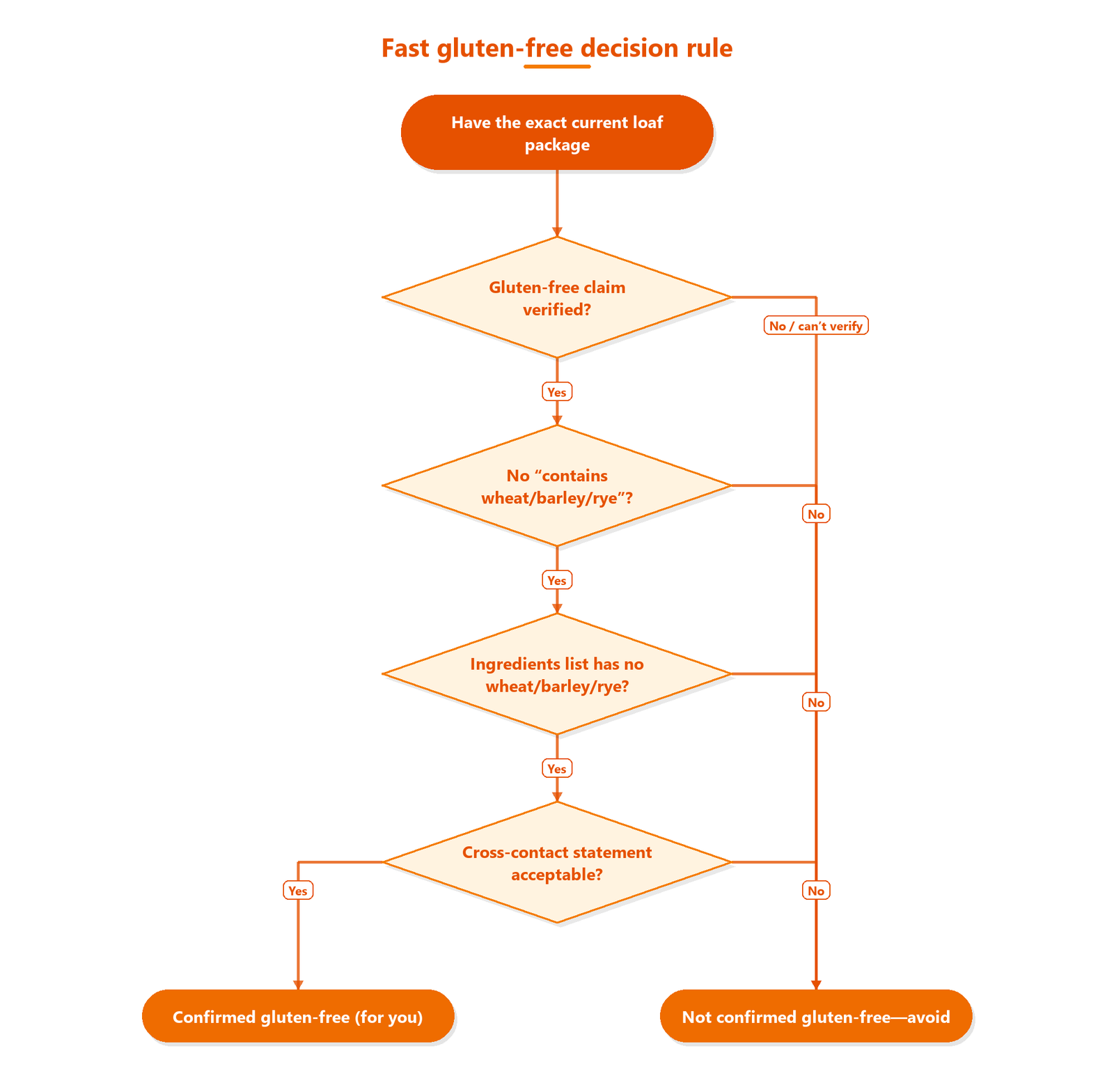
– Best practice: if the package doesn’t clearly state “gluten-free” (or you can’t verify ingredients/allergen statements), treat it as not confirmed gluten-free.
– If you have celiac disease or a severe gluten reaction, don’t take chances on unclear labeling—skip unless the gluten-free claim is explicitly stated for that exact product.
– If you’re only mildly reducing gluten, you may still want to verify ingredients, but your risk tolerance may differ. (Always follow your clinician’s guidance.)
Pros/cons of the “label-first” approach for Nature’s Own keto bread:
- Pros
- Reduces guesswork by grounding your decision in the current allergen and gluten-free claim wording.
- Works even when marketing (like “keto”) is unrelated to gluten safety.
- Helps you account for cross-contact language that matters for some users.
- Cons
- Requires you to read the ingredient/allergen section each time you buy (especially if varieties change).
- Doesn’t eliminate all uncertainty for highly sensitive individuals when cross-contact statements are present.
If you manage food for a household or workplace group, consider a simple process: one person checks the label language, and everyone else follows the same rule for that specific loaf SKU in the current week.
Quick scan checklist (save this)
– ✅ “Gluten-free” claim present on the exact product/variety
– ✅ No “contains wheat/barley/rye” language in allergen info
– ✅ Ingredient list contains no wheat/barley/rye derivatives
– ✅ Cross-contact statement reviewed and acceptable for your sensitivity level
– ✅ You’re checking the current package (not an older photo/box)
Frequently Asked Questions
Is Nature’s Own Keto Bread gluten free?
Nature’s Own Keto Bread is not typically labeled as gluten free, so it may contain gluten depending on the specific product version and production process. For the most accurate answer, check the package label for a “gluten-free” claim or certification, since recipes can vary by location and batch. If you have celiac disease or a gluten sensitivity, confirm with the manufacturer or avoid the product unless it is explicitly marked gluten free.
What ingredients in Nature’s Own Keto Bread could contain gluten?
Many keto breads use ingredients like wheat-based components, wheat flour, or modified wheat starch, which can introduce gluten. Even if the bread is “keto” and lower in carbs, it doesn’t automatically mean it’s gluten free. Review the ingredient list and look for wheat, barley, or rye, and also check the allergen statement for “contains wheat” or “may contain gluten.”
How can I tell if Nature’s Own Keto Bread is safe for a gluten-free diet?
Start by looking for a gluten-free certification or a clear “gluten-free” statement on the front or ingredient/allergen panel. Then verify that the ingredient list does not include wheat, barley, rye, or derivatives that contain gluten. If the label includes a “may contain” warning for wheat or gluten, it may not be suitable for people with celiac disease.
Which label details should I look for on Nature’s Own Keto Bread for gluten-free assurance?
Look for the words “gluten-free” and/or a gluten-free certification symbol on the package. Check the allergen section for “contains wheat” and review the processing or cross-contamination language such as “may contain wheat” or “made in a facility with gluten-containing ingredients.” If those details aren’t present or conflict, choose a bread that is specifically certified gluten free.
Why isn’t keto bread always gluten free, and does this apply to Nature’s Own?
Keto refers to low net carbs and the use of keto-friendly ingredients, not the absence of gluten. A bread can be keto and still include wheat-derived ingredients or gluten-containing components to achieve texture and structure. In the case of Nature’s Own Keto Bread, you should rely on the gluten-free labeling rather than the “keto” claim alone.
📅 Last Updated: October 31, 2026 | Topic: is nature’s own keto bread gluten free | Content verified for accuracy and freshness.
References
- Gluten-Free Labeling of Foods | FDA
- https://www.niddk.nih.gov/health-information/digestive-diseases/celiac-disease/eating-diet
- https://www.mayoclinic.org/diseases-conditions/celiac-disease/in-depth/gluten-free-diet/art-20046759
- https://www.britannica.com/topic/gluten-free-diet
- Gluten-free diet
- https://pubmed.ncbi.nlm.nih.gov/?term=gluten+content+in+gluten-free+products+review
- https://www.sciencedirect.com/search?qs=gluten-free+bread+gluten+content
- https://scholar.google.com/scholar?q=gluten-free+labeling+FDA+definition+20+ppm Google Scholar
- https://scholar.google.com/scholar?q=gluten-free+keto+bread+ingredients+almond+flour+psyllium Google Scholar
- https://scholar.google.com/scholar?q=gluten-free+products+cross-contamination+review+celiac Google Scholar