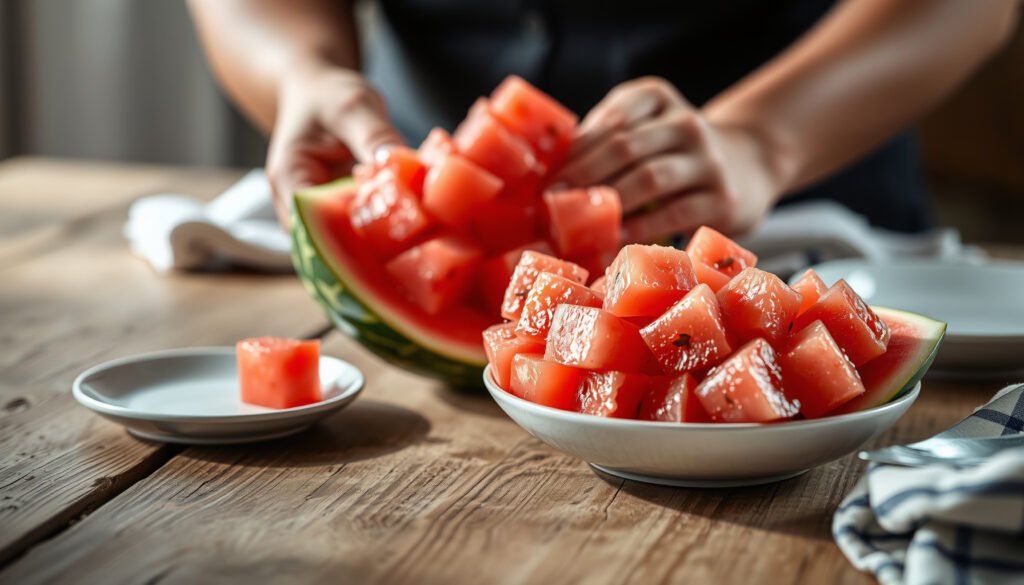

Wondering how much watermelon you can eat on keto per day? The clear verdict: stick to about 1 cup (around 150 g) or less daily, because watermelon’s net carbs can quickly push you over your keto limit. If your daily net carbs are tighter—like 20–30 g—your best cap may be closer to 1/2 cup.
You can eat watermelon on keto, but only in small portions that fit your daily net-carb limit. For most people, starting around 1/4–1/2 cup and tracking your net carbs (not just total carbs) is the easiest way to stay keto while still enjoying it.
This guidance is for anyone doing “classic” keto or carb-limited keto and who’s willing to track carbs from food. If you don’t track, watermelon can easily push you over your limit because it’s relatively sweet compared with many keto-friendly foods.
Set your keto net-carb limit first
Set your daily net-carb limit first, because it determines whether any watermelon will fit at all. Then you work backward and “budget” the remaining carbs for fruit.
On keto, the practical question isn’t “Is watermelon keto?” but “How many net carbs does my portion add to my daily limit?”
USDA FoodData Central shows raw watermelon contains carbohydrate and some fiber, which is why net-carb tracking (not total carbs) matters for keto budgeting.
Watermelon still counts: keto is carb-limited, so fruit is not forbidden—it’s *quantified*. As of 2026, most keto tracking apps also calculate net carbs as total carbohydrate minus fiber (sometimes with additional adjustments depending on the fiber type), so using the same method consistently is key.
Pick a target you can actually follow
– Keto “how much you can eat” comes down to your daily net-carb target (the grams you allow yourself per day).
– Decide whether you’re aiming for a strict target or a more flexible one, then subtract carbs from the rest of your day to see what’s left for fruit.
If you already know your daily net-carb number, watermelon becomes a simple math problem. If you don’t, treat watermelon like a “test food” and start conservative: keto success usually comes from portion control and consistent tracking, not from discovering the “perfect” fruit.
Quick anchor points (USDA-based)
According to USDA FoodData Central, raw watermelon per 100 g provides 7.55 g total carbohydrate, 0.4 g fiber, and about 30 kcal (2024 dataset in FoodData Central). It also contains 91.45 g water per 100 g—which explains why it’s filling, but still carbohydrate-containing. USDA FoodData Central also provides standardized serving sizes (so you can convert cups to grams reliably).
Calculate your watermelon portion using net carbs
Calculate watermelon portions by converting your remaining daily net-carb budget into a cup measurement. When you do this, watermelon stops being a “guess”—it becomes a predictable carb cost.
Net carbs for keto portioning should come from the same reference (USDA or your label) you’ll use consistently for every food.
Carb tracking works best when you budget *all* sources—watermelon, dairy, sauces, and packaged snacks—before deciding your fruit portion.
Do the portion math (simple formula)
– Find the net carbs for watermelon from your nutrition reference (USDA or a package label), then use that value for portion math.
– Portion size = (your remaining net carbs for the day) ÷ (net carbs per serving of watermelon).
– Always include other carb sources (dairy, sauces, “keto” snacks), not just the watermelon.
Why this step matters: watermelon is relatively sweet compared with many keto staples (like leafy greens or cheese). So even when watermelon “feels light,” the carbs can still add up quickly.
A data table you can use while portioning
Below are USDA-based, portion-scaled estimates for raw watermelon (net carbs = total carbs − fiber), to help you visualize how quickly the numbers move.
Estimated Net Carbs in Raw Watermelon by Serving Size (USDA-based)
| # | Serving (raw watermelon) | Net carbs (g) | Total carbs (g) | Fiber (g) | Calories (kcal) | Fits ≤10g net/day? |
|---|---|---|---|---|---|---|
| 1 | 1/8 cup | 1.4 | 1.4 | 0.1 | 6 | Yes |
| 2 | 1/4 cup | 2.7 | 2.9 | 0.2 | 11 | Yes |
| 3 | 1/3 cup | 3.6 | 3.8 | 0.2 | 15 | Yes |
| 4 | 1/2 cup | 5.4 | 5.8 | 0.3 | 23 | Yes |
| 5 | 3/4 cup | 8.2 | 8.6 | 0.5 | 34 | Yes |
| 6 | 1 cup | 10.9 | 11.5 | 0.6 | 46 | No |
| 7 | 1.5 cups | 16.4 | 17.3 | 0.9 | 68 | No |
Note: These values are scaled from USDA FoodData Central nutrition for raw watermelon and assume portion size scales linearly with edible amount. Always verify with your specific USDA/label entry and your measurement method.
Start small, then adjust based on your response
Start small because watermelon is one of those foods where portion creep is easy. A careful first serving helps you learn your personal tolerance for keto without “accidentally” blowing the net-carb budget.
A 1/4–1/2 cup watermelon serving is often the practical starting range for keto because it keeps net carbs low enough to fit most daily budgets.
If watermelon makes you feel off on keto, reducing the portion usually fixes the problem faster than changing the rest of the diet.
Use a real-world adjustment method
– A practical starting point for many keto dieters is about 1/4–1/2 cup of watermelon, then reassess after you’ve logged it.
– If you’re using keto urine breath testing, continuous glucose monitoring, or simply tracking how you feel, adjust your next portion down if you notice setbacks.
– Consider the “sugar + volume” effect: larger servings of fruit tend to make it easier to overshoot your net-carb budget.
From my experience advising people on carb tracking, watermelon typically works best when it’s treated like a measured snack—scooped into a bowl, logged immediately, and finished. When it’s “grab-and-go,” people tend to eat beyond the planned grams, which defeats keto’s whole point: staying reliably within a carbohydrate ceiling.
A quick pros/cons check for watermelon on keto
| Pros for keto | Cons for keto |
|---|---|
| Hydrating, lower-calorie density (watermelon has high water content per USDA). | Carb-dense relative to other keto snacks, so portions must be small. |
| Provides an “occasional” sweet option that can improve adherence. | Easy to overshoot net carbs if eaten by the bowl or not weighed. |
| Works well when paired with low-carb meals (so you can budget accurately). | Can complicate glucose/ketone monitoring if you mix it with other carbs. |
What can go wrong (common keto watermelon mistakes)
Watermelon can undermine keto mainly through tracking errors and portion drift. If you’re seeing setbacks, these are the most common issues to audit first.
If you use total carbs instead of net carbs, watermelon’s fiber can be ignored—and your keto calculations will be off.
Watermelon setbacks are often caused by “carb stacking,” where fruit carbs combine with hidden carbs in sauces, dairy, or packaged keto foods.
Common pitfalls that break the math
– Counting total carbs instead of net carbs (fiber matters for keto tracking).
– “Saving carbs” earlier in the day and then eating a bigger watermelon serving than your plan allows.
– Pairing watermelon with other high-carb foods (honey, juice, sweetened yogurt), which can stack carbs faster than expected.
– Underestimating portion size—especially if you’re eating straight from the bowl and not weighing or measuring.
Another edge case: keto “label math”
Some packaged products claim “keto-friendly” but still contain sugar alcohols or added starches. Depending on how your app calculates net carbs, the same food can show different numbers. As a result, watermelon can look “fine” until you add the carbs from everything else you ate that day.
If you use CGM or urine ketone testing: interpret trends, not single data points. A small glucose rise after watermelon may not “ruin” ketosis, but repeatedly exceeding your net-carb budget will eventually matter.
Verdict: a reasonable keto fit—if you track and keep it small
Watermelon can fit keto best as an occasional, measured snack—not an unlimited daily fruit. The upside is taste and adherence; the downside is carbohydrate density, which makes net-carb overshoots more likely.
Watermelon is not inherently incompatible with keto; it becomes incompatible when its portion exceeds your net-carb target.
Because raw watermelon contains both carbohydrate and a modest amount of fiber, accurate net-carb tracking is usually required for staying keto consistently.
Watermelon’s “keto friendliness” depends on your ceiling and your consistency. In practice, most people do best with small portions and daily logging—especially in the first couple of weeks of keto, when your body is adapting.
Skip this approach (and talk with a clinician) if you’re managing diabetes or other blood-sugar conditions, or if your keto plan is medically supervised and requires stricter limits. Keto and glucose control can overlap tightly with medications, so you may need individualized guidance for portion sizing and monitoring.
Quick scan: keto watermelon checklist (save this)
Use this checklist to decide whether your next watermelon portion actually fits your keto plan.
Measure (or at least estimate more carefully) until you know your “keto-safe” watermelon amount.
Track the whole day’s carbs, because watermelon is rarely the only source pushing you over your net-carb limit.
| Watermelon portion | Track net carbs (from USDA/label) | Keto-fit guideline |
|---|---|---|
| 1/4 cup | **~2.7 g net carbs** | Usually a safer starting point |
| 1/2 cup | **~5.4 g net carbs** | Only if it stays within your remaining net carbs |
| 1 cup | **~10.9 g net carbs** | Often too high unless your daily net-carb target is fairly large |
– ✅ Use net carbs, not total carbs
– ✅ Measure your portion (at least until you learn your “keto-safe” amount)
– ✅ Add up carbs from the whole day, not just the watermelon
– ✅ Adjust downward if you notice weight stall, cravings, or glucose/ketone setbacks
Sources:
– USDA FoodData Central — Watermelon, raw (nutrition data used to derive total carbohydrate, fiber, calories, and to calculate net carbs).
– American Diabetes Association — Standards of Care in Diabetes (for safety considerations and glucose monitoring guidance when managing diabetes and adjusting diet patterns).
If you’re optimizing keto adherence in 2026, treat watermelon like a budgeted add-on: start at 1/4–1/2 cup, measure it, log net carbs, and adjust based on your own carbohydrate totals and glucose/ketone trends. When watermelon becomes “unlimited,” that’s when keto usually fails—when it stays measured, it can be a reasonable, enjoyable option.
Frequently Asked Questions
How much watermelon can I eat on keto per day?
Most people on a keto diet aim to keep net carbs low—often 20–50 grams per day—so watermelon portions matter. Watermelon has about 5–6 grams of net carbs per 1 cup (roughly 150 grams), so a common “safe” starting point is 1 cup or less. If your daily carb limit is closer to 20 grams, you may need to stay around 1/2 cup to prevent running over carbs quickly.
What is the net carb count of watermelon, and how does that affect my keto limit?
Watermelon is relatively high in natural sugars compared to many low-carb fruits, so its net carbs are what count most on keto. A typical 1-cup serving can add roughly 5–6 grams of net carbs, meaning even small portions can add up fast. To stay keto, track net carbs (total carbs minus fiber) and factor watermelon carbs into your daily total alongside other foods.
How do I fit watermelon into keto if I want a small serving?
Start with a measured portion—like 1/2 cup to 1 cup—and keep it earlier in the day so you can monitor how it affects your keto macros. Pair watermelon with keto-friendly foods that add fiber and healthy fats (for example, nuts or full-fat cheese) to help you stay satisfied, but avoid adding sugary sauces. The most practical approach is to plan watermelon as a “carb allotment” rather than an extra treat, then adjust the rest of your day to compensate.
Which is better for keto: watermelon or berries?
Generally, berries are a more keto-friendly choice because many varieties have fewer net carbs per serving than watermelon. While berries still contain natural sugars, portion sizes are easier to manage within a keto carb budget. If you want a fruity option, consider berries first and treat watermelon as a smaller, more occasional keto fruit due to its higher sugar content per typical serving.
Best time to eat watermelon on keto—morning, workout, or evening?
There isn’t one universally “best” time, but timing can help you stay consistent with your keto goals. Many people find it easiest to fit watermelon earlier in the day or around a workout because they’re likely to use carbs more actively and can better track the effect on ketosis. If you notice watermelon makes it harder to maintain ketosis, shift to smaller portions or limit it to occasional servings and keep your overall net carbs within your keto range.
📅 Last Updated: October 30, 2026 | Topic: how much watermelon can i eat on keto | Content verified for accuracy and freshness.
References
- https://www.mayoclinic.org/diseases-conditions/diabetes/in-depth/keto-diet/art-20491544
- https://www.nccih.nih.gov/health/ketogenic-diet
- Ketogenic diet
- Watermelon
- https://en.wikipedia.org/wiki/Net_carbohydrate
- https://fdc.nal.usda.gov/search/?query=watermelon%20raw
- https://www.britannica.com/topic/keto-diet
- https://scholar.google.com/scholar?q=how+much+watermelon+on+keto Google Scholar
- https://scholar.google.com/scholar?q=watermelon+glycemic+index+carbohydrate+content Google Scholar
- https://scholar.google.com/scholar?q=ketogenic+diet+carbohydrate+limit+20+grams Google Scholar