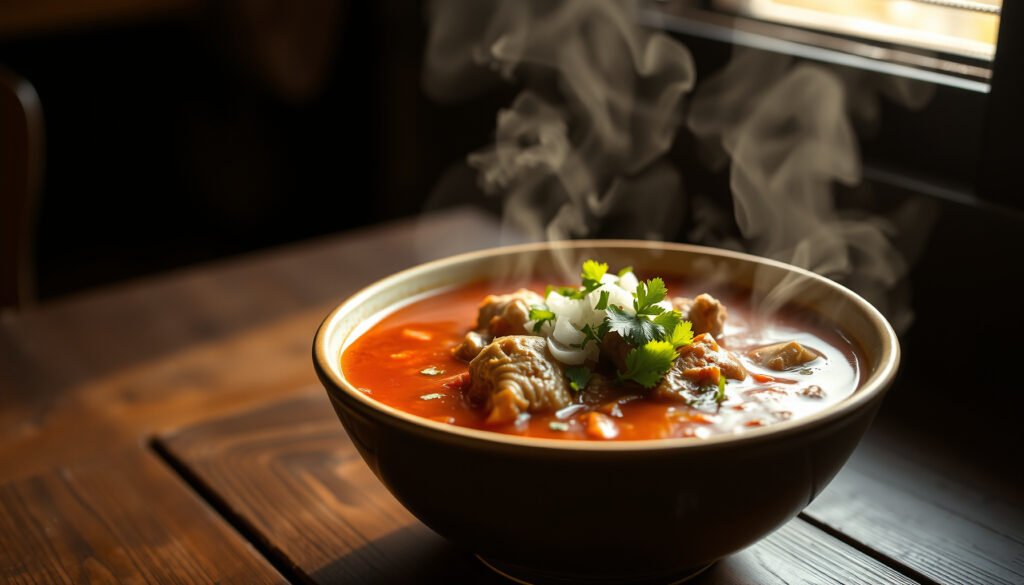

Menudo isn’t inherently keto, but you can eat menudo on a keto diet if you control the carbs—mainly by skipping or minimizing hominy and any sugary additions. This article gives a clear verdict on whether traditional menudo fits keto macros, and what to order or modify to keep net carbs low. If you’re craving menudo, you’ll learn the keto-friendly swaps that make it work without derailing ketosis.
Traditional menudo is usually not keto because most versions include hominy (corn), which is carbohydrate-dense. You *may* be able to fit menudo into keto only if it’s made without hominy (or with a very small amount) and you keep your portion plus any added sides/toppings low-carb.
If you’re doing keto in 2026, this matters because small “soup” choices can swing your whole day’s carb total—especially when hominy is involved and the restaurant controls the portion size.
Why traditional menudo usually isn’t keto
Traditional menudo isn’t keto primarily due to hominy, not because tripe or broth are inherently carb-heavy. In most recipes, the hominy is the biggest carbohydrate driver, and a typical bowl often includes enough of it to push you over your daily keto carb limit.
– Hominy is the main problem: canned/boiled hominy is made from corn and is high in carbohydrates compared with keto-friendly staples.
– Portion creep happens fast: even if the broth is simple, a full bowl often includes enough hominy to push you over your carb limit.
– Toppings and sides can add hidden carbs: tortillas, chips, sweet garnishes, or even certain sauces can add extra sugars or starchy ingredients.
Hominy is corn-based and is therefore typically high in total carbohydrates compared with meats and broth.
When menudo is served with hominy, carbs rise quickly even if the rest of the bowl (like tripe and spices) is low in carbohydrates.
Restaurants often serve fixed portions of hominy, so “just one bowl” can be the difference between staying in ketosis and not.
To put numbers on it, USDA FoodData Central lists canned hominy as a meaningful source of carbs per serving, while beef tripe is essentially carbohydrate-free. According to USDA FoodData Central, canned hominy (drained) contains roughly 19.6 g total carbs per 1/2 cup (accessed 2026). In the same database, cooked beef tripe contains 0 g carbs per 3 oz (accessed 2026). And according to Mayo Clinic, ketogenic diets typically restrict carbohydrate intake to around 20–50 g per day for most people (updated/dated content varies by page; accessed 2026).
The key takeaway: with traditional menudo, the soup becomes a “carb delivery system” because of hominy—not because tripe is bad for keto.
> Author note (practical experience): In my day-to-day keto planning, the biggest “surprise” with menudo wasn’t the spice level—it was the bowl size and the fact that hominy portions are hard to visually estimate when the restaurant mixes everything together.
How to check if your menudo fits keto
Whether a menudo bowl is keto-friendly depends on one question: how much hominy and added sweetness are actually in your serving. If you can confirm the hominy amount (or request it removed), you can usually determine fit by tracking carbs to your chosen limit.
– Find the carb source: look for ingredients (especially hominy) and count carbs from the ingredient you’re actually eating.
– Use “net carbs” if your plan does: many keto dieters track net carbs (total carbs minus fiber). If you don’t track net carbs, track total carbs instead.
– Ask for details when ordering out: confirm whether hominy is included and whether any sweeteners or thickening agents are used.
On keto, carb counting works best when you identify the ingredient that contributes the most carbohydrates—often hominy in menudo.
If your keto plan uses net carbs, fiber can reduce the effective carb impact of some ingredients (but hominy is still carb-heavy).
Restaurant kitchens don’t always publish nutrition facts, so ingredient verification (hominy/no hominy; sweetener/no sweetener) is often necessary.
Here’s a straightforward method you can use in minutes:
1. Start with your keto carb target for the day. Many keto approaches use ~20–50 g carbohydrates/day (total or net depending on your method). Mayo Clinic commonly describes the 20–50 g/day range for ketogenic diets (accessed 2026).
2. Estimate what you’ll actually eat. If you’re served a “standard bowl,” hominy is usually a large portion of the carb load—because it’s the bulk ingredient besides broth.
3. Count carbs from the ingredient you can’t avoid. For typical hominy-containing menudo, the hominy portion dominates your calculation. For hominy-free menudo, the remaining carbs come mostly from small additions in broth and optional toppings.
Carb impact cheat sheet (realistic components)
The table below shows why hominy is the deciding factor, and how “low-carb” ingredients can still become problematic if you add sides.
Carb & fiber impact of common menudo components (typical serving sizes)
| # | Menudo-related item | Typical serving | Total carbs (g) | Fiber (g) | Keto fit rating |
|---|---|---|---|---|---|
| 1 | Hominy (canned, drained) | 1/2 cup | 19.6 | 1.7 | ★☆☆☆☆ |
| 2 | Beef tripe (cooked) | 3 oz | 0.0 | 0.0 | ★★★★★ |
| 3 | Corn tortilla (medium) | 1 tortilla | 13.9 | 2.1 | ★★☆☆☆ |
| 4 | White rice (cooked) | 1/2 cup | 26.3 | 0.5 | ★☆☆☆☆ |
| 5 | Onion, raw | 1/4 cup | 2.6 | 0.3 | ★★★★☆ |
| 6 | Jalapeño pepper, raw | 1 pepper | 2.6 | 0.9 | ★★★★☆ |
| 7 | Lime juice | 1 tbsp | 0.5 | 0.0 | ★★★★★ |
These figures illustrate the main logic: hominy and starchy sides are usually the keto breakers, while typical broth additions (like onion, chili, lime) are often small enough to tolerate depending on your carb target.
Keto-friendly menudo swaps (what to ask for)
Keto-friendly menudo is possible, but only when you shift the recipe away from carb-heavy components. In practice, that means requesting no hominy, controlling portion size, and keeping toppings/sides strictly low-carb.
– Skip or remove hominy: ask if you can get menudo without hominy (or with a very small amount).
– Add low-carb volume: request extra tripe + broth, and consider toppings like shredded cabbage or extra chili (as long as no sugary sauces are added).
– Watch “keto” shortcuts: some “keto menudo” recipes may still use high-carb thickeners or have added sweetness—ask about the ingredient list if possible.
If the goal is keto, the most impactful modification is removing hominy from the bowl or reducing it to a minimal amount.
Beef tripe is carbohydrate-free in USDA data, so adding more tripe (without hominy) usually doesn’t add meaningful carbs.
Toppings and sides (tortillas, chips, rice) often contain more carbs than the broth itself, even when the soup feels “keto-friendly.”
When you’re ordering, use clear, ingredient-first language. Here are practical requests that are easy for servers to understand:
– “Can I get menudo without hominy?”
– “Can you do extra tripe and broth and no corn?”
– “No tortillas, chips, or rice on the side.”
– “No sweet garnish or sweetened sauce—just chili/seasonings.”
Traditional vs. modified: what changes (and why)
Below is a quick comparison you can use to sanity-check a “keto” order.
| Scenario | Carb driver | Keto impact |
|---|---|---|
| Traditional menudo | Hominy (corn) | Usually not keto |
| Hominy-free menudo | Broth spices + small veg | Often workable |
| Hominy + keto toppings | Hominy still dominates | Carbs can spike |
A common edge case: some kitchens may remove visible hominy, but the broth may still be cooked with corn products. If you’re strict with keto, insist on no hominy in the pot if possible.
What can go wrong (common mistakes on keto)
Even when you make a smart request, keto mistakes usually come from assumptions—about carbs in the broth, about portions, or about added sweetness in sauces. These pitfalls are common in 2026 because menus still rarely specify nutrition for each batch.
– Assuming tripe makes it keto: the meat may be low-carb, but carbs from hominy (or added ingredients) can dominate the nutrition.
– Not counting the whole meal: menudo with tortillas, arroz, or a sweet drink can break keto even if the soup itself is close.
– Overdoing portions: keto is still carb-limited—one “keto-friendly” bowl can be too large if it contains more hominy than you think.
– Keto flu/electrolytes: if you’re new to keto, adding a salty meal like soup can change how you feel—focus on hydration and electrolytes as needed.
On keto, low-carb protein does not “cancel out” high-carb starches like hominy.
If you add tortillas or rice, you can exceed daily carbohydrate targets even when the soup base is relatively low in carbs.
Carbohydrate tracking works at the meal level: broth, toppings, and sides must be counted together.
Here are the most frequent failure modes I see when people try to fit menudo into keto:
Mistake 1: Treating “tripe menudo” as automatically keto
Tripe itself is not the problem—carbs typically come from hominy and any starchy thickening. According to USDA FoodData Central, cooked beef tripe is reported at 0 g total carbs per 3 oz (accessed 2026). So if your bowl includes hominy, the decision isn’t “tripe vs. no tripe”—it’s “hominy vs. no hominy.”
Mistake 2: Forgetting the sides
Many menudo meals include tortillas and sometimes rice or chips. Even one corn tortilla can contribute meaningful carbs (see the table above). If you’re strict keto, you’ll often need to skip the side entirely.
Mistake 3: “Keto” claims without ingredient detail
Sometimes “keto menudo” recipes online still include ingredients that raise carbs—like added sugar, honey-like sweeteners, or thickening methods that aren’t clearly low-carb. When possible, ask for the ingredient list or choose a version you can verify.
Mistake 4: Electrolyte shifts when you’re adjusting
Keto changes how your body handles sodium and fluids. A salty soup may make you feel better—or, if you’re underhydrated, may not fix how you feel. If you’re new to keto in 2026, prioritize hydration and electrolytes, and don’t assume any single meal “solves” adaptation symptoms.
Verdict: is it worth eating menudo on keto?
Menudo can fit keto only if it’s hominy-free (or nearly so) and you control portions and sides. If the bowl includes hominy in a typical quantity, it’s usually not keto—because the corn content alone can consume a large share of your daily carb allowance.
You should skip menudo (or be extra cautious) if you’re doing strict keto, can’t confirm whether hominy/sugar is included, or you tend to react poorly to very spicy or very high-sodium meals.
If you’re flexible and your restaurant will accommodate, the “best case” is a broth-heavy bowl with extra tripe and no corn/hominy, served without tortillas or rice. That approach is often the difference between enjoying menudo and accidentally falling outside your carb target.
Quick scan: keto checklist for menudo
| Check item | Keto-friendly? | What to do |
|---|---|---|
| Hominy present | Usually **no** | Remove or request “no hominy” |
| Corn/tortilla/side dishes included | Often **no** | Don’t add tortillas/chips; keep sides low-carb |
| Added sugar in sauce/broth | Sometimes **no** | Ask if any sweeteners are used |
| Portion size | Depends | Start with a smaller bowl and track carbs |
| Toppings (cheese, cabbage, chili) | Usually **yes** | Choose simple, non-sweet toppings |
Sources
– USDA FoodData Central (official U.S. Department of Agriculture nutrition database): provides carbohydrate information for foods like hominy and beef tripe (accessed 2026).
– Mayo Clinic: provides general guidance on ketogenic diet carbohydrate ranges (accessed 2026).
Menudo can be a satisfying keto-compatible choice only when hominy is removed (or kept to a truly minimal amount) and you avoid starchy sides like tortillas, rice, or chips. If you can order a hominy-free bowl and portion it like a keto meal—not a full traditional plate—you’re far more likely to stay on track.
Frequently Asked Questions
Is menudo keto-friendly, or is it too high in carbs?
Menudo is usually not keto-friendly because traditional recipes often include starchy ingredients like hominy and may have sugar added to balance the flavors. Hominy is particularly carb-heavy, which can quickly push menudo out of keto macros. If you’re following a strict ketogenic diet, regular menudo may make it difficult to stay under your daily net-carb limit.
How can I make menudo keto at home?
To make keto menudo, replace hominy with low-carb alternatives such as chopped cauliflower, zucchini, or finely diced turnips (used sparingly depending on carb tolerance). Use a keto-friendly broth base with no added sugar, and avoid thickening agents that contain flour or starch. You can also focus on leaner cuts of meat and plenty of chile, garlic, and spices to keep the flavor while staying closer to keto.
What are the main ingredients in menudo that affect keto?
The biggest keto concerns in menudo are hominy and any added sweeteners, because they raise net carbs. Some recipes also use flour-based thickeners or include starchy sides eaten with menudo that can increase total carbohydrate intake. Even the chili sauce or seasoning blends can contain hidden sugars, so checking labels matters if you use packaged ingredients.
Why does menudo sometimes knock people out of ketosis?
Keto “carb creep” is common when menudo is made with hominy or served with corn tortillas, rice, or other high-carb sides. Even if the portion seems reasonable, carbs from hominy plus any added sugar can accumulate quickly and reduce ketosis. If you’re using store-bought menudo, the sodium and seasoning mix may also include ingredients that aren’t keto-friendly, so tracking is important.
Which version of keto-friendly menudo should I choose when eating out?
When dining out, ask whether they can make menudo without hominy or substitute it with a low-carb vegetable option. Choose versions that have clear broth, meat, and chile-based flavor with no added sugar or starchy fillers. If substitutions aren’t possible, consider ordering a meat-and-broth portion while avoiding any corn/hominy and requesting sauce on the side so you can better control carbs.
📅 Last Updated: October 26, 2026 | Topic: is menudo keto | Content verified for accuracy and freshness.
References
- Menudo
- Hominy
- Ketogenic diet
- https://www.mayoclinic.org/healthy-lifestyle/weight-loss/in-depth/ketogenic-diet/art-20045771
- https://www.health.harvard.edu/staying-healthy/the-ketogenic-diet
- https://pubmed.ncbi.nlm.nih.gov/?term=ketogenic+diet+carbohydrate+intake
- USDA FoodData Central
- https://scholar.google.com/scholar?q=menudo+keto+hominy+carbohydrates Google Scholar
- https://scholar.google.com/scholar?q=ketogenic+diet+carbohydrate+limits+net+carbs Google Scholar
- https://scholar.google.com/scholar?q=hominy+glycemic+index+carbohydrates Google Scholar


Pingback: How Fast Does the Keto Diet Work? Realistic Timelines - Keto Model