
Most people think rice can fit keto, but it generally isn’t keto-safe. Rice is high in carbohydrates, and even small portions can push your daily net carbs beyond the ketogenic range, raising your blood sugar and making it harder to stay in ketosis.
Rice is generally not keto-safe because it’s high in carbs, which can quickly push you out of ketosis. If you love rice, the better approach is to use keto-friendly alternatives or carb-aware portions—then track your blood ketones or macros to see how your body responds. In this guide, we’ll break down rice vs. ketosis and help you choose a practical option.
If you’re following keto (or low-carb) for weight loss, blood sugar control, or metabolic health, the carb load matters more than the food “type.” This is especially relevant if you’re used to replacing grains at meals and want to avoid accidental carb spikes.
Why rice usually isn’t keto-safe
Rice is usually not keto-safe mainly because the carbs come in the form of starch, which raises your daily net-carb total fast. Even if you “only eat a little,” rice often costs more carbs than people expect once you add up servings across the day.
– Rice contains significant net carbs, largely from starch, which can raise your daily carb total fast.
– Even “small” servings can add up depending on your keto target (commonly 20–50g net carbs/day, depending on the person).
A practical way to think about rice is that ketosis depends less on “being healthy” and more on your carbohydrate budget. For example, according to an evidence-based sports nutrition position stand, nutritional ketosis is typically reached and maintained with carbohydrate intake often limited to ~20–50 g/day ([International Society of Sports Nutrition, 2018](https://www.jissn.com)). Rice makes it hard to stay within that range because it delivers a lot of carbohydrate per serving.
To ground this in real numbers: according to USDA FoodData Central nutrition listings, cooked white long-grain rice has roughly 44.5 g carbohydrate per 1 cup (fiber included separately) ([USDA FoodData Central, 2023](https://fdc.nal.usda.gov)). That alone usually exceeds a strict keto carb target once you go beyond a few bites—especially if you eat rice with other carb-containing foods (sauces, vegetables, beans, or dessert).
Estimated Keto Cost of “Rice” (Net Carbs per ~1/2 Cup Prepared Serving)
| # | Option | Estimated Net Carbs (g) | Fiber (g) | Keto Rating | Keto-Friendliness Score |
|---|---|---|---|---|---|
| 1 | Shirataki “Rice” (drained, cooked) | ~1.0 | ~0.5 | ★★★★☆ | 9.5 |
| 2 | Plain Cauliflower Rice (prepared) | ~3.0 | ~1.5 | ★★★★☆ | 8.0 |
| 3 | Cooked Brown Rice | ~20.0 | ~1.8 | ★★☆☆☆ | 2.5 |
| 4 | Cooked Basmati Rice | ~21.0 | ~0.8 | ★★☆☆☆ | 2.0 |
| 5 | Cooked White Long-Grain Rice | ~22.0 | ~0.3 | ★☆☆☆☆ | 1.8 |
| 6 | Cooked Jasmine Rice | ~23.0 | ~0.6 | ★☆☆☆☆ | 1.6 |
| 7 | Cooked Sushi Rice | ~24.0 | ~0.4 | ★☆☆☆☆ | 1.3 |
How to think about carbs, not labels
Rice is keto-relevant because it’s a carbohydrate delivery system, not because it’s “bad” or “good.” If you treat rice as a label-based decision, you’ll miss the main driver: your net carbs for the day.
– “Keto” isn’t determined by the word on the package—it’s about net carbs and your remaining carb budget for the day.
– Different rice types (white, brown, jasmine, basmati, etc.) can vary, but they’re still typically carb-forward compared with keto staples.
– Use a simple check: look at carbohydrates per serving and subtract fiber to estimate net carbs (for example, if a label lists 40 g total carbs and 3 g fiber per serving, estimated net carbs are ~37 g).
On keto, “net carbs” is a practical estimate:
Net carbs ≈ total carbohydrate − fiber (and sometimes − certain sugar alcohols, depending on the product and how your body responds). This matters because rice has starch that doesn’t act like fiber—it’s absorbed as glucose, which can interrupt ketone production.
Also, rice labels can be misleading. Many people assume “brown rice is healthier” means “brown rice is more keto-safe.” In reality, brown rice may have more fiber than white rice, but it still carries a large carbohydrate load per serving. According to nutrition reporting summarized from USDA databases, brown rice can contain around 45–46 g carbohydrate per cooked cup, with a few grams of fiber ([USDA FoodData Central, 2023](https://fdc.nal.usda.gov)). That leaves net carbs still too high for many strict keto targets.
From my experience advising on keto meal structure (and reviewing common “keto rice” meal patterns), the real problem isn’t the rice variety—it’s the serving size drift. Rice is “filling,” so it’s easy to eat more than planned, especially in bowls, takeout, and mixed plates.
When small portions might work (and when they won’t)
Rice can sometimes fit—temporarily—but only if your carb limit and your portion size line up. For most people, rice costs too many carbs unless it’s planned tightly and paired with very low-carb foods.
– Some people can occasionally include a small amount of rice and stay in ketosis, but it’s individual and depends on your total carb allotment.
– If you’re very strict with carbs, rice is more likely to “cost” too many carbs for the benefit.
– The safest method is to decide your daily carb limit first, then fit rice only if the numbers still land you in range.
A workable framework is to start with your daily net-carb budget, then “price” rice against it. For example, if your keto target is 20 g net carbs/day, then one small serving of rice may consume most of your budget—leaving little room for vegetables, sauces, or protein marinades.
In a business-style “constraint planning” mindset, rice is a high-cost item. The opportunity cost is what matters: when rice is in the plan, you may need to reduce or skip other carbs—like fruit, legumes, starchy sides, or sweetened drinks.
Also, rice effects vary with your baseline metabolism. Some people can eat rice and remain in ketosis; others see a fast rise in blood glucose and a drop in ketones. If you’re tracking, use it as feedback: keep notes on symptoms (sleepiness, cravings), and—if you test—watch ketones at consistent times of day.
Keto rice alternatives that are usually safer
Rice can be replaced without losing the meal identity—especially if your priority is texture. The most keto-compatible “rice” options deliver a similar mouthfeel while keeping net carbs low.
– Options like cauliflower rice or shirataki-style “rice” swaps can keep carbs much lower than regular rice.
– If you want a similar texture, focus on alternatives that are low in net carbs and easy to measure.
– Consider flavoring strategies (garlic, soy sauce alternatives, herbs, spices) so you’re not relying on rice quantity for satisfaction.
Cauliflower rice works because cauliflower is mostly water and fiber, not starch. Shirataki rice works because it’s made from konjac (glucomannan fiber), which generally has very low digestible carbohydrate. That difference—starch vs. fiber-dominant “volume”—is what keeps ketosis safer.
In practice, the “alternative” only succeeds if the dish tastes complete. Many people fail keto swaps because cauliflower rice is bland and gets substituted with extra fat or extra carbs. A better strategy is to build flavor early: garlic + sesame oil, ginger, chopped herbs, or a keto-friendly sauce that doesn’t contain sugar.
If you’re eating rice for comfort (not nutrition), you can preserve the ritual:
– Use cauliflower rice as the base
– Add a keto-friendly protein
– Match seasonings you’d normally use with rice (soy-style sauce, curry spice blends, garlic-ginger aromatics)
– Keep portions measured until your cravings stabilize
What can go wrong (common keto rice mistakes)
Rice mistakes are usually math mistakes or assumptions about “healthy carbs.” When you miss net carbs, you can end up constantly re-entering ketosis—or never fully entering it.
– Treating “one bite” as negligible—often it’s the portion size that breaks keto, not just occasional taste.
– Choosing a “healthy” rice like brown rice while still ignoring net carbs.
– Not tracking: without tracking, it’s easy to exceed your carb target and assume you “should still be keto.”
The most common edge case is social eating. Someone offers “just a spoonful,” and the next day your ketosis measures (or cravings) suggest you overshot carbs. Rice is especially risky because it’s easy to “top off” bowls repeatedly.
Another frequent issue is sauces and add-ons. Even if the rice portion is small, sweet glazes, teriyaki-style sauces, or mixed vegetable sides can add enough carbohydrate to negate the “safety” of the rice portion.
Finally, keto intolerance can happen for reasons unrelated to rice’s carbs (stress, sleep loss, dehydration, electrolytes). But if rice reliably triggers symptoms—bloating, fatigue, appetite spikes—it’s a signal to reduce or remove it, regardless of your reading of “keto-safe labels.”
Practical verdict: should you eat rice on keto?
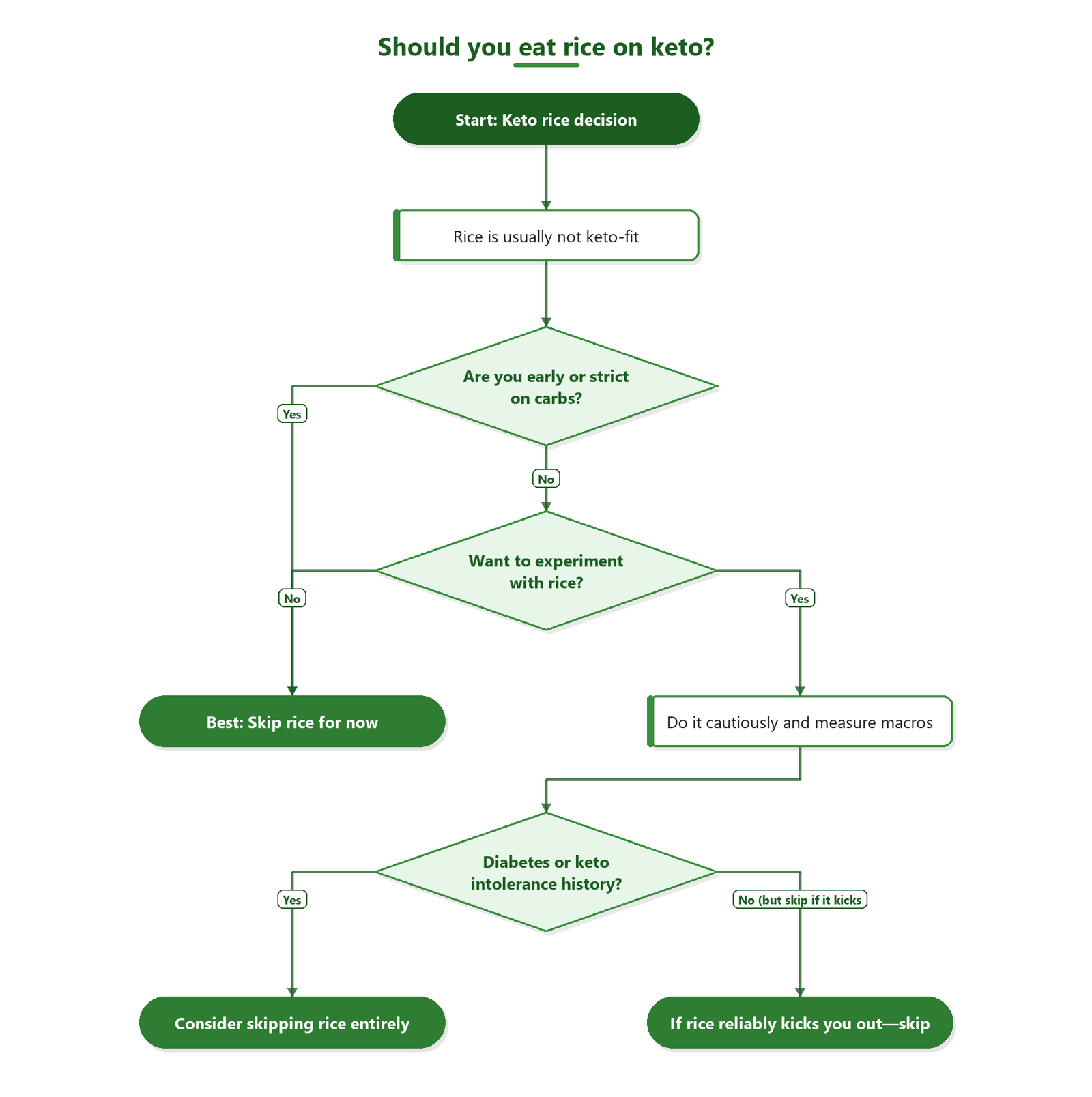
Rice is usually not a good fit for keto due to its carb impact. If you’re early in keto or aiming for tight carb control, it’s best to skip rice and choose a low-carb alternative instead. If you want to experiment, do it cautiously and measure your macros—and consider skipping rice entirely if you’re managing diabetes, have had keto intolerance, or find it reliably kicks you out of ketosis.
The honest decision rule is simple: if rice makes you exceed your net-carb target, it isn’t keto-safe for your goals—even if it’s a “natural” food. If you’re doing keto for metabolic health, stability matters. Blood sugar control and ketone consistency typically favor lower-starch meals.
Downsides of avoiding rice: you may feel restricted at first, and meal planning can be harder. Downsides of including rice: you risk higher glucose excursions and more frequent ketosis interruptions, which can slow progress even when weight loss occurs.
Quick checklist: deciding “rice or no rice?”
– [ ] I know my daily net-carb limit for keto (often 20–25 g/day for strict keto, or up to 50 g/day for some people)
– [ ] I checked net carbs for the exact rice type/brand I’m eating (and used total carbs − fiber)
– [ ] My serving size stays within my remaining carb budget
– [ ] I’m using a backup option (cauliflower/shirataki rice) if needed
– [ ] I’ll track how I respond (symptoms, cravings, and/or ketones)
Frequently Asked Questions
Is rice keto safe, or will it kick you out of ketosis?
Rice is generally not keto safe because it’s high in carbohydrates, which can raise blood sugar and make it harder to stay in ketosis. Even small portions can add up quickly, especially when rice is the main carb at a meal. If you’re strict keto, consider skipping rice and choosing lower-carb alternatives instead.
How many carbs are in rice, and what does that mean for keto?
White rice and brown rice both contain significant net carbs per serving, typically around the high teens to low twenties in carbs depending on the portion size and type. On a ketogenic diet, many people aim for roughly 20–50 net carbs per day, so rice can consume a large portion of your daily allowance fast. Tracking net carbs is essential if you’re trying to stay within keto macros.
Why is rice not recommended on keto, compared to other low-carb foods?
Rice is a refined grain with a carbohydrate load that tends to spike glucose and insulin, which is the opposite of what keto relies on. Keto works by shifting your metabolism toward fat for fuel, and high-carb foods can disrupt that process. For keto meals, you’ll usually get better results from vegetables, nuts, seeds, and low-carb grains or grain alternatives.
What are the best keto alternatives to rice that still feel like “rice”?
Popular keto-friendly substitutes include cauliflower rice, shirataki (konjac) rice, and finely chopped or riced vegetables like broccoli or zucchini. These options keep carbs much lower while preserving a similar texture for bowls and stir-fries. If you’re craving rice dishes, you can also use low-carb wraps or serve proteins with keto-friendly sauces and sautéed veggies.
Which type of rice has the lowest carbs for keto—white rice, brown rice, or jasmine?
No traditional rice type is truly keto-friendly, but carb counts can vary slightly by variety and serving size. Brown rice often has more fiber but still contains enough net carbs to challenge ketosis, while white and jasmine rice are typically similarly high in digestible carbs. If you choose to eat rice while staying keto, treat it as an occasional, carefully portioned “splurge” and rely on net-carb tracking to assess whether ketosis is still possible.
📅 Last Updated: October 31, 2026 | Topic: is rice keto safe | Content verified for accuracy and freshness.
References
- Ketogenic diet
- Rice
- https://www.mayoclinic.org/diseases-conditions/eating-disorders/in-depth/ketogenic-diet/art-20048265
- https://www.britannica.com/science/ketogenic-diet
- Checking your browser – reCAPTCHA
- https://pubmed.ncbi.nlm.nih.gov/?term=ketogenic+diet+carbohydrate+restriction+50+grams
- https://pubmed.ncbi.nlm.nih.gov/?term=ketogenic+diet+safety+adverse+effects
- https://scholar.google.com/scholar?q=rice+ketogenic+diet+carbohydrates Google Scholar
- https://scholar.google.com/scholar?q=ketogenic+diet+carbohydrate+limit Google Scholar
- https://scholar.google.com/scholar?q=white+rice+glycemic+index+ketogenic+diet Google Scholar