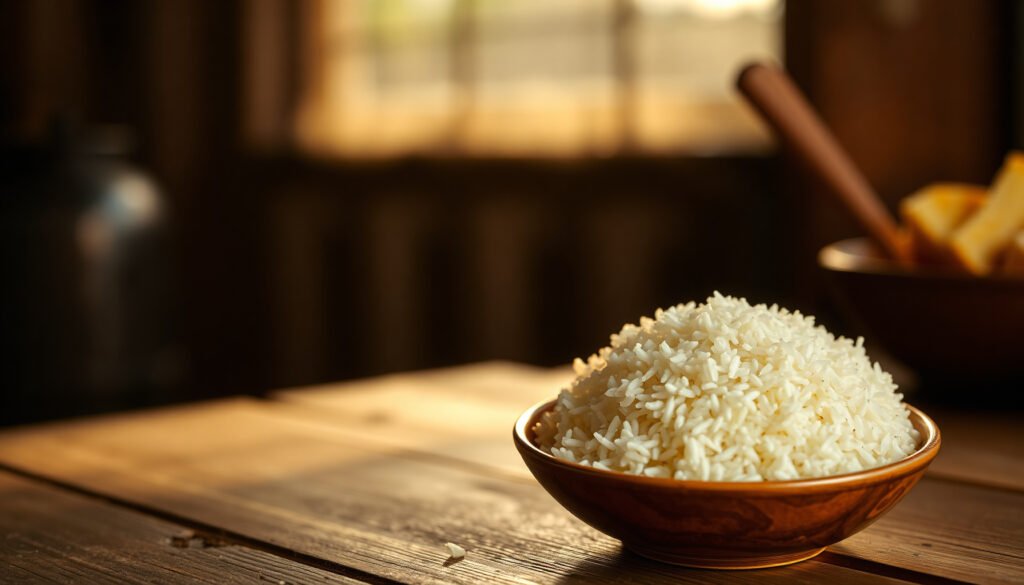

White rice is a starchy grain, so it is predominantly carbohydrates rather than fat. That makes it generally not keto-approved, because keto depends on keeping net carbs very low to stay in ketosis. Some low-carb alternatives can fit better if you want a rice-like side.
Rice is generally not keto-approved because it’s high in digestible carbs (starch) that can quickly push you over your daily net-carb limit. It doesn’t mean “one bite always ruins keto,” but for most people trying to stay in ketosis, rice is a frequent problem food—especially when you’re doing strict or consistent keto in 2025–2026.
This matters most if you’re doing strict or consistent keto (tracking carbs, aiming for ketosis, or feeling symptoms when you go off-plan). If you’re doing a more flexible low-carb approach, the answer may be less absolute—but rice still isn’t a “free” keto staple.
Is Rice Keto Approved?
Rice is usually not keto-approved because the carbs in rice are highly digestible and convert into glucose during digestion. Here’s the practical takeaway: even if rice fits on paper occasionally, it’s rarely easy to keep it low enough to protect ketosis without crowding out other nutrient-dense foods.
– Rice is mostly starch, which turns into glucose during digestion and adds carbs fast.
– Even when rice is “portion-controlled,” it can be hard to keep the amount small enough for keto without replacing it with something else.
– Many keto eaters treat rice as off-limits because it tends to be calorie- and carb-dense for the volume you get.
From a keto-carb math perspective, rice is often the limiting factor. For example, cooked white rice contains enough total carbohydrates that a “normal” portion becomes a large fraction of typical keto targets. According to USDA nutrient data, cooked long-grain white rice is about 44.5 g total carbs per 1 cup (with fiber around 0.6 g)—meaning most of those carbs are net carbs you’ll feel at the end of the day. USDA National Nutrient Database (legacy SR), cooked white rice values (2016)
Carbs in White, Brown, and Jasmine Rice (What to Check)
Rice can be “keto” only in the narrow sense that you can sometimes fit a small serving into your carb budget. The label math matters more than the word “keto,” because different rice types vary—but all share the same core issue: carbohydrates dominate the nutrition.
– The deciding factor isn’t the brand—it’s the net carbs per serving shown on the nutrition label (or calculated from total carbs minus fiber).
– Different rice types vary, but they still share the same core issue: carbohydrates dominate the nutrition.
– If you want a practical rule, look up your specific rice’s label and compare it to your daily net-carb limit:
– White rice (cooked), 1/2 cup: ~22 g net carbs
– Brown rice (cooked), 1/2 cup: ~21 g net carbs
(These figures come from USDA-style nutrition math using total carbs minus fiber for typical cooked portions; always confirm your exact product label.)
To put that into context, many ketogenic approaches aim for ~20–50 g net carbs per day depending on goals and tolerance. According to clinical dietary overviews of ketogenic and “very low carbohydrate” diets, restricting carbs into this range is what’s commonly used to promote ketosis. Nutrients review on ketogenic diets and carbohydrate restriction (2019)
As of 2025–2026, the biggest mistake people make is assuming that because brown rice has more fiber, it’s automatically “keto-friendly.” Fiber helps, but brown rice still carries a substantial starch load—and rice calories and net carbs scale quickly with portion size.
How 1/2 Cup Cooked White Rice Uses Keto Net-Carb Budgets
| # | Typical Keto Net-Carb Target | Remaining Net Carbs After 1/2 Cup Cooked White Rice | Keto-Fit Rating |
|---|---|---|---|
| 1 | 20 g/day | -2 g | ★ ☆ ☆ |
| 2 | 25 g/day | 3 g | ★ ★ ☆ |
| 3 | 30 g/day | 8 g | ★ ★ ★ |
| 4 | 35 g/day | 13 g | ★ ★ ★ ★ |
| 5 | 40 g/day | 18 g | ★ ★ ★ ★ ★ |
| 6 | 45 g/day | 23 g | ★ ★ ★ ★ ★ |
| 7 | 50 g/day | 28 g | ★ ★ ★ ★ ★ |
Why this table matters: if your daily net-carb target is on the lower end, 1/2 cup cooked white rice (~22 g net carbs) can consume so much of your budget that the rest of your day becomes difficult to keep keto-friendly.
Keto-Friendly Ways to Get the “Rice” Experience
If you want the texture and the “rice base” role in meals, the keto-friendly answer is to swap rice for low-carb alternatives that keep net carbs much lower. These options can help you avoid the starch-heavy carb spike that rice brings to the table.
– Cauliflower rice is the most common swap: similar texture for many meals, with far fewer carbs.
– Shirataki “rice” (konjac noodles) can work well for people who want a rice-like base; check labels for added carbs/sugar.
– If you still want a grain element, consider other low-carb options used in keto cooking (or simply build your meal around proteins + vegetables rather than a carb base).
Here’s a quick rice-versus-swap comparison you can use while planning meals in 2025–2026:
| Option | Why People Use It on Keto | Main Limitation |
|---|---|---|
| Cauliflower rice | Much lower net carbs than starchy grains, easy to portion like rice. | Flavor depends heavily on seasoning and cooking method. |
| Shirataki “rice” | Very low net carbs; works for burrito bowls, stir-fries, and toppings. | Label variation (added ingredients) and possible digestive sensitivity. |
| No-rice bowls (protein + veg) | The most reliable way to keep carbs low and reduce “portion creep.” | Requires changing habits about what “fills” the plate. |
In my label-first approach to keto meal planning (checking net carbs and fiber like a spreadsheet), rice consistently shows up as the ingredient that forces the smallest portion sizes—or the most “budget math.” That’s why swaps tend to feel easier than trying to “make rice work.”
What Can Go Wrong With Keto and Rice?
Rice doesn’t just create carb math problems—it also creates behavior patterns that can make keto feel harder than it needs to be. When people get frustrated, it’s usually because rice is a double hit: starch carbs plus easy-to-overeat portions.
– Portion creep: Rice looks small on a plate, but cooked portions add up quickly—especially with second helpings.
– Sauce and add-ons: Even if you keep rice minimal, sweet sauces, sugary marinades, and even “keto” seasonings can add carbs.
– Misjudging “net carbs”: Some labels handle fiber differently, and different rice products can vary by processing.
– Relying on “it fit last time”: Carb tolerance can change with activity level, sleep, and how strict you are day-to-day.
A useful way to think about this: carbohydrate provides 4 kcal per gram. If a serving of rice brings in ~20+ grams of net carbs, you’re not just changing calories—you’re changing the metabolic signal your body receives. According to the U.S. FDA nutrition labeling framework, carbohydrates are standardized at 4 calories per gram. U.S. Food and Drug Administration (2016 nutrition labeling guidance)
Also, “keto tolerance” isn’t static. As of 2025–2026, even with the same rice portion, day-to-day factors (sleep quality, stress, workout volume) can shift how quickly someone transitions into and out of ketosis. Rice makes those shifts more noticeable because it’s dense in digestible starch.
Verdict: Should You Eat Rice on Keto?
Rice is not typically keto-approved, especially if you’re aiming to stay consistently in ketosis. If you want the rice experience, the most reliable path in 2025–2026 is to use a low-carb replacement rather than treat rice as a regular keto component.
Downsides to keep in mind:
– Rice tends to make carb control harder than it needs to be, which can stall progress for some people.
– If you’re sensitive to carb changes, rice can trigger cravings or lead to “keto fatigue” symptoms.
Who should skip rice entirely:
– If you’re strict keto and tracking carbs closely
– If you’ve noticed you fall out of ketosis when you eat rice
– If you’re using rice to “stretch” meals while still trying to limit carbs (you’ll often overshoot)
One more reality check: “net carbs” are not a universal scientific constant. Different labels and brands calculate fiber and ingredients differently, and rice product variations can change the number you’re actually eating. So if rice has made your keto inconsistent, consider it a high-variance food for your personal plan—even if it sometimes fits on paper.
Quick Checklist: Keto Rice Rules
| Question | If the answer is… | What to do |
|---|---|---|
| Does your rice have high net carbs for your planned portion? | Yes | Treat it as non-keto and swap it out |
| Can you keep the serving truly small without missing your meal? | No | Use cauliflower rice or shirataki instead |
| Are sauces/marinades adding extra sugar or starch? | Yes | Re-check labels and simplify the toppings |
| Are you consistent with your daily net-carb limit? | No | Avoid rice until you’re stable again |
| Do you feel cravings or symptoms after rice? | Yes | Skip rice and keep experimenting with swaps |
Frequently Asked Questions
Is rice keto approved for a ketogenic diet?
Rice is not considered keto approved because it’s high in carbohydrates, which can quickly raise your blood sugar and knock you out of ketosis. Most types of rice contain far more net carbs than the small carb allowance typical on keto. If you’re strict keto, you’ll usually need to avoid rice and choose lower-carb alternatives.
How many carbs are in cooked rice, and why does that affect ketosis?
Cooked white rice typically has around 35 grams of carbs (and roughly 30+ grams of net carbs) per cup, depending on the brand and serving size. Brown rice is also relatively carb-heavy, often coming in similarly high net carb ranges per serving. On keto, those carb amounts make it difficult to stay under daily net-carb limits, so rice usually isn’t compatible.
Why is cauliflower rice or konjac rice considered a better keto alternative than regular rice?
Cauliflower rice and konjac rice are designed to be much lower in net carbs than traditional grains like white or brown rice. Because they don’t raise your carb intake as sharply, they’re easier to fit into a ketogenic meal plan while still providing a rice-like texture. For keto, these options can help you enjoy “rice bowls” without sacrificing ketosis.
Which types of rice (white, brown, basmati) are lowest in carbs for keto?
If you’re asking which rice is “best” for keto, the honest answer is that none are truly keto friendly in normal portions because all rice varieties are carb-dense. Even “lower-carb” rice options still typically exceed keto-friendly net-carb thresholds when measured in typical serving sizes. If you want a keto-friendly approach, look for alternatives like cauliflower rice, shirataki (konjac) rice, or other low-carb grain substitutes.
What’s the best way to eat rice on keto without breaking your carb limit?
For most people, the best strategy is to avoid regular rice entirely and use keto substitutes to stay within your net-carb goal. If you’re determined to include “rice,” keep it to a very small taste serving and track net carbs carefully, but it’s still challenging to remain in ketosis. In practice, swapping to cauliflower rice or konjac rice is the easiest way to enjoy the flavor and texture while keeping keto approved eating consistent.
📅 Last Updated: November 03, 2026 | Topic: is rice keto approved | Content verified for accuracy and freshness.
References
- Ketogenic diet
- Rice
- https://www.nccih.nih.gov/health/ketogenic-diet
- https://www.ninds.nih.gov/health-information/disorders/epilepsy/ketogenic-diet
- https://www.epilepsy.com/treatment/alternative-complementary/ketogenic-diet
- https://www.britannica.com/topic/keto-diet
- https://scholar.google.com/scholar?q=ketogenic+diet+carbohydrate+limit+50+grams+per+day Google Scholar
- https://scholar.google.com/scholar?q=keto+diet+foods+to+avoid+rice Google Scholar
- https://scholar.google.com/scholar?q=glycemic+index+rice+ketogenic+diet Google Scholar