

Plain yogurt is not automatically keto-friendly, even when it’s labeled “plain.” Most people assume that plain equals carb-free, but the deciding factor is the net carbs per serving, driven by natural lactose and any added sugar. Check the label and choose a plain yogurt that stays within your daily carb limit.
Plain yogurt can fit a keto diet, but only if it’s plain and low in carbs (often unsweetened, full-fat versions work best). The key is checking the nutrition label for total carbs per serving and choosing one that stays within your daily carb limit. In this post, you’ll learn what to look for in plain yogurt, how much is usually “keto-friendly,” and when it’s not.
If you’re new to keto—or you’re trying to add yogurt back into your routine—you’re probably wondering whether “plain” automatically means “low carb.” This is for anyone tracking net carbs/total carbs, watching for hidden sugars, or trying to figure out which yogurt types won’t knock them out of ketosis (especially as of 2026, when more “keto-friendly” labels are appearing on crowded dairy shelves).
What makes plain yogurt keto (or not)?

Plain yogurt is keto-compatible when the carbohydrate load per serving stays low enough for your ketogenic carb target. “Plain” tells you what flavors were added, not how many grams of carbohydrate you’re actually consuming.
– Keto-friendly yogurt is usually unsweetened and low in carbs, not just “plain” in name.
– The difference comes down to the carbohydrate count on the label (total carbs and/or “net carbs,” depending on how you track).
The important nuance is that yogurt carbs primarily come from lactose (milk sugar), not from “added sugar.” That’s why some plain yogurts can still add up quickly—especially if you eat a larger portion than the label assumes, or if you choose a variety that tends to be higher in carbs due to processing and added ingredients (even when it’s not sweet-tasting).
As of 2026, a lot of keto confusion still comes from how people track carbs. Using the total-carb method means you count all carbs on the label. Using the net-carbs method means you typically subtract fiber (and sometimes sugar alcohols, when present) from total carbs—though brands don’t always apply this consistently on their nutrition panels, and yogurt usually has little to no fiber to “buffer” your net-carb count.
How to read the label correctly
Plain yogurt can be keto, but only if the label numbers support it for your portion size. This is where most people succeed—or accidentally overshoot their keto carb budget—because serving size and carbohydrate math matter more than marketing words.
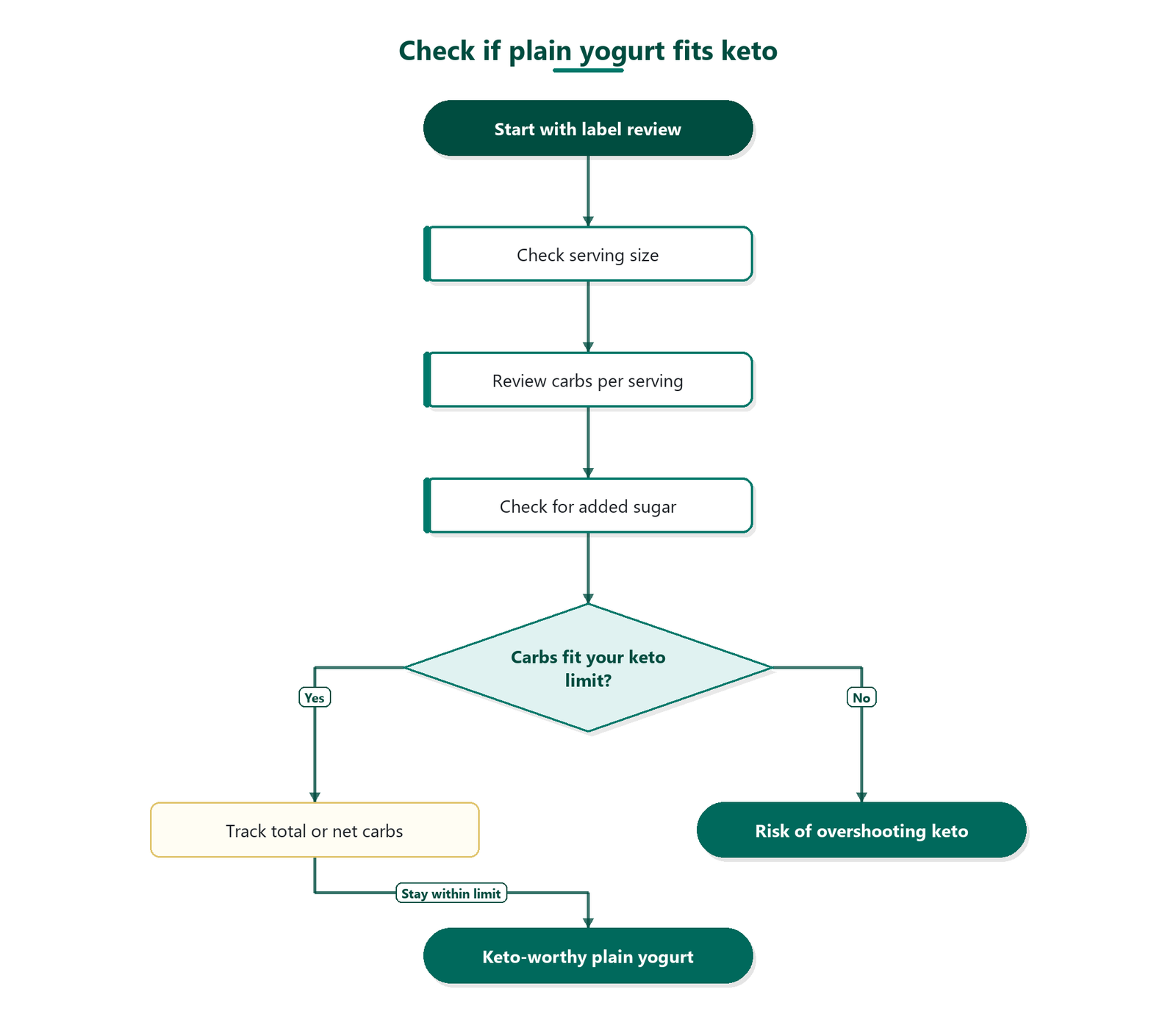
– Check serving size first—yogurts can list carbs per a smaller portion than you might eat.
– Look at the carbs per serving (and watch for ingredients like added sugar, honey, or fruit concentrates).
In my day-to-day approach to keto-friendly shopping, I’ve found it’s not enough to look at the front-of-pack claim “plain.” The ingredient list often reveals whether anything sweet or carbohydrate-adding was added after fermentation. From there, I focus on the label’s math: carbs per serving plus how many grams you plan to eat. If your bowl is double the serving size, your carbs are almost certainly double too.
For real-world anchoring, USDA FoodData Central shows that plain yogurt varieties commonly sit in a narrow carb band per 100 g. According to USDA FoodData Central, plain whole-milk yogurt has about 4.7 g carbohydrates per 100 g (2026), plain Greek whole-milk yogurt is about 3.6 g per 100 g (2026), and plain skyr is about 4.0 g per 100 g (2026). Those differences can look small on paper, but they matter when you stack multiple foods in a single day.
Carb Load of Common Unsweetened Plain Yogurt Types (Estimated)
| # | Plain yogurt type | Total carbs (g) / 100 g | Est. carbs (g) / ~170 g | Remaining carbs vs 20 g/day |
|---|---|---|---|---|
| 1 | Plain whole-milk yogurt (regular) | 4.7 | 8.0 | 12.0 g left ★★★★☆ |
| 2 | Plain low-fat yogurt (2%) | 4.9 | 8.3 | 11.7 g left ★★★★☆ |
| 3 | Plain nonfat yogurt | 5.0 | 8.5 | 11.5 g left ★★★★☆ |
| 4 | Plain Greek yogurt (whole milk, strained) | 3.6 | 6.1 | 13.9 g left ★★★★★ |
| 5 | Plain Greek yogurt (nonfat, strained) | 3.7 | 6.3 | 13.7 g left ★★★★★ |
| 6 | Plain skyr (unsweetened) | 4.0 | 6.8 | 13.2 g left ★★★★★ |
| 7 | Plain lactose-free whole-milk yogurt | 4.7 | 8.0 | 12.0 g left ★★★★☆ |
Best types of plain yogurt for keto
The best plain yogurt for keto is typically unsweetened and low enough in carbs that you can fit it into your daily total without adding sweet toppings. If you’re choosing between styles, fat level and ingredient simplicity tend to matter as much as the “plain” wording.
– Choose plain, unsweetened, full-fat yogurt when possible, since it’s more likely to stay lower in carbs than low-fat varieties.
– Avoid “plain” yogurts that are technically flavored/fortified with added sugars or sweeteners in the ingredients list.
Full-fat plain yogurt often helps keto in a practical way: it tends to be more filling, which reduces the chance of portion creep. But fat is not a magic keto pass—it’s the carbs that decide whether you stay in ketosis. Still, when the label shows “plain” plus a short ingredient list, that’s usually a good starting signal.
If you track with net carbs, remember that yogurt is rarely high in fiber—so net carbs may closely mirror total carbs. As of 2026, many keto guides cite carb targets in the ~20–50 grams net carbs per day range (varies by person and goal), and your yogurt needs to fit inside that total. The Charlie Foundation notes ketogenic diets often target net carbs around 20–50 g/day (2026). If your daily target is lower (for example, a strict 20 g/day approach), “keto-friendly” portions must be smaller than many people assume.
What can go wrong on keto with yogurt
Plain yogurt can still derail keto if the serving size grows, if the product isn’t truly unsweetened, or if your tracking method is inconsistent. Most “yogurt failures” come from carbs that were there all along—just not noticed early enough.
– “Plain” but still high-carb: some brands use thicker texture or sweetness enhancers that raise carbs.
– Portion creep: keto can be undone by eating a bigger serving than the label assumes.
– Confusing tracking: if you track net carbs, fiber and sugar alcohols can matter—but they’re not consistent across brands.
Here’s a comparison you can use to decide whether plain yogurt is worth it on a given day:
- Plain yogurt can be keto-friendly when:
- It is truly unsweetened, the nutrition facts show low carbs per serving, and you measure your portion instead of free-pouring.
- Plain yogurt is risky when:
- You’re combining it with sweet add-ins (honey, granola, fruit concentrates) or you’re stacking multiple carb sources at once.
- Plain yogurt is “technically possible” but not ideal when:
- You have a very strict carb target today and you’re already close to it from other foods.
Also watch for “keto traps” that aren’t obvious at first glance: yogurt labeled “plain” can be paired with fruit at breakfast, or it can be marketed as “Greek” or “strained” while still using added starches or sweeteners to improve mouthfeel. From my experience reading labels for clients in dietary programs, the fastest way to prevent mistakes is to decide up front whether you’ll use total carbs or net carbs, then stay consistent for every product you track.
Verdict: Is plain yogurt keto-worthy for most people?
Plain yogurt can be a solid keto option if you pick an unsweetened version and keep carbs within your personal limit. Downsides: some yogurts are higher-carb than they look, and portion size matters more than many people expect—so it’s easy to overdo it without realizing.
Skip it (or be extra cautious) if you can’t reliably read labels, have a strong trigger for eating “just a little more,” or if the carbs per serving consistently exceed your daily target. As of 2026, the “plain” category is still broad: keto success depends on verifying carbs and ingredients for each specific brand and serving size, not on relying on the word “plain” alone.
Quick scan checklist (save this)
– [ ] Yogurt is plain / unsweetened
– [ ] Ingredients list has no added sugar (watch for sweeteners)
– [ ] Carbs per serving are low enough for your keto target
– [ ] Serving size matches how much you plan to eat
– [ ] You can track it consistently (total carbs or net carbs—whichever you use)
Frequently Asked Questions
Is plain yogurt keto-friendly?
Plain yogurt can be keto-friendly if it’s low in net carbs and made without added sugar. Most plain, unsweetened Greek yogurt tends to work better than regular yogurt because it’s often higher in protein and lower in carbs. Always check the nutrition label for carbs and aim for a low net carb serving size to stay within your daily keto limits.
How many carbs are in plain yogurt for keto?
Carb counts vary by brand and whether it’s regular or Greek yogurt, so the nutrition label matters most. For keto, focus on net carbs (total carbs minus fiber), and keep your portion small enough to fit your macros. As a practical guide, many people choose plain yogurt options with roughly 5 grams of net carbs or less per serving, but your personal keto target may differ.
Why does plain yogurt sometimes kick people out of ketosis?
Some plain yogurts contain more lactose (milk sugar) and higher carbohydrate content than people expect, especially regular or larger-portion servings. Even if it’s “plain” and “unsweetened,” the carbs can still add up quickly, affecting ketosis for sensitive individuals. Portion size is often the deciding factor—staying mindful of net carbs helps prevent unwanted carb intake.
Which type of plain yogurt is best for keto—Greek or regular?
Greek yogurt is usually the better choice for keto because it’s typically lower in carbs and higher in protein than regular yogurt. Look for “plain” and “unsweetened,” and prefer brands that list lower total carbs per serving. If you choose regular plain yogurt, you may need to reduce the serving size to keep net carbs within your keto goals.
What’s the best way to eat plain yogurt on keto without added sugar?
Choose plain, unsweetened yogurt and add keto-friendly toppings like chia seeds, cinnamon, unsweetened cocoa powder, or a few berries depending on your carb budget. If you want extra creaminess, you can stir in heavy cream or full-fat sour cream for fat without adding sugar. This approach helps you keep plain yogurt keto-friendly while boosting flavor and satiety without spiking carbs.
📅 Last Updated: October 31, 2026 | Topic: is plain yogurt keto | Content verified for accuracy and freshness.
References
- Ketogenic diet
- Yogurt
- https://www.mayoclinic.org/healthy-lifestyle/weight-loss/in-depth/keto-diet/art-20198030
- https://my.clevelandclinic.org/health/diseases/22134-ketogenic-diet-keto-diet
- https://pubmed.ncbi.nlm.nih.gov/?term=ketogenic+diet+carbohydrate+intake
- https://pubmed.ncbi.nlm.nih.gov/?term=plain+yogurt+carbohydrates+nutrition
- https://pubmed.ncbi.nlm.nih.gov/?term=yogurt+glycemic+index+glycemic+load
- https://scholar.google.com/scholar?q=is+plain+yogurt+keto Google Scholar
- https://scholar.google.com/scholar?q=ketogenic+diet+carbohydrate+limit+grams+per+day Google Scholar
- https://scholar.google.com/scholar?q=yogurt+glycemic+index+carbohydrates+keto Google Scholar