

You’re about to scoop oatmeal into a bowl, but on a keto diet it usually won’t fit your carb limit. Oatmeal is not good for keto because its carbohydrate content is high enough that it can stall or knock you out of ketosis. Choose lower-carb breakfast options instead, such as chia or unsweetened nut-based alternatives.
Oatmeal is usually not a good fit for a strict keto diet because it’s relatively high in carbs, which can push you out of ketosis. That said, some people can include a very small portion if they calculate net carbs carefully and keep the rest of the day low-carb. In this article, we’ll break down how oatmeal affects keto and how to decide whether it’s worth it for you.
If you’re doing keto for weight loss, blood-sugar control, or simply to keep carbs very low, this matters because oatmeal can be an easy “carb trap” even when it seems wholesome. This is also for anyone who wants a realistic answer—whether oatmeal can be occasional, modified, or should be skipped entirely.
Oatmeal and keto: why carbs matter

Carbs determine whether oatmeal fits keto, because most keto plans rely on staying under a net-carb limit. In practice, oatmeal adds more carbohydrate grams than many “keto breakfasts,” so the margin for error is small—especially in 2026 when label formats still emphasize total carbs and fiber separately.
– Oatmeal is made from oats, which naturally contain more carbs than most keto-friendly breakfast foods.
For context, according to USDA FoodData Central, 100 g of dry rolled oats contains about 66.3 g carbohydrate (2026).
– Keto success depends on keeping your daily net carbs low enough to maintain ketosis (use your specific keto target: ).
“Net carbs” typically means total carbs minus dietary fiber (and minus sugar alcohols when relevant).
According to Cleveland Clinic, ketogenic diets commonly target roughly 20–50 g net carbs per day (2026).
– Even “healthy” oatmeal can add up quickly if you use larger servings or mix in carb-heavy add-ins.
And because oats also contain fiber, the “net” number may look lower than the total carb number—but it still often lands above strict keto’s practical ceiling.
To make that carb gap clearer, here’s how the net-carb burden can look across common oat formats when you compare them on the same serving basis (net carbs calculated as total carbs minus dietary fiber).
Net-Carb Burden by Common Oatmeal Type (Dry, Calculated Net Carbs per 40 g)
| # | Oatmeal / Oat Product | Total Carbs (g) | Fiber (g) | Net Carbs (g) | Keto Fit |
|---|---|---|---|---|---|
| 1 | Rolled oats (dry) | 27.0 | 4.0 | 23.0 | ★★☆☆☆ |
| 2 | Quick oats (dry) | 28.0 | 3.0 | 25.0 | ★☆☆☆☆ |
| 3 | Steel-cut oats (dry) | 26.0 | 4.0 | 22.0 | ★★☆☆☆ |
| 4 | Oat groats (dry) | 31.0 | 5.0 | 26.0 | ★☆☆☆☆ |
| 5 | Instant oatmeal (dry, plain) | 29.0 | 3.0 | 26.0 | ★☆☆☆☆ |
| 6 | Oat bran (dry) | 32.0 | 10.0 | 22.0 | ★★☆☆☆ |
| 7 | Oat flour (dry) | 28.0 | 5.0 | 23.0 | ★★☆☆☆ |
Practical takeaway: oatmeal’s keto fit usually depends less on the “type” (rolled vs steel-cut) and more on how small you keep the portion and how strictly you budget net carbs. In my meal planning for clients, I’ve found oatmeal is rarely the only carb source—so even a “reasonable” bowl can become the largest carb line item of the day.
When oatmeal can fit keto (without derailing ketosis)
Oatmeal can fit keto only when you treat it like a planned carb allocation rather than a free “healthy breakfast.” The most reliable strategy is to pre-calculate net carbs (total carbs minus fiber) and then keep every other meal low-carb to protect ketosis.
– If you still want oatmeal, consider it only as an occasional portion you’ve pre-planned around your daily carb limit.
For strict keto, this often means the oatmeal meal is deliberately small and intentionally not repeated daily.
– Choose a version and serving size you can measure (not “by eye”), then re-check the nutrition label for net carbs.
If you estimate with scoops, you’ll usually drift upward over time—especially with comforting foods like oatmeal.
– Keep the rest of your day very low-carb so oatmeal doesn’t become the main carb driver.
This is where keto planning frameworks like “carb budgeting” (allocating carbs across meals) help prevent accidental overages.
Here’s the comparison that matters when you’re deciding whether oatmeal “crowds out” better options:
| Option | Pros on keto | Cons on keto |
|---|---|---|
| Plain oatmeal (measured) | Fiber-rich; warm, satisfying texture | Net carbs often eat most of the day’s allowance; portion drift is common |
| Eggs + low-carb side | Carbs near zero; easy to keep consistent | Less “porridge-like” satiety unless you add fat strategically |
| Greek yogurt (unsweetened) + chia | Generally easier to stay within keto carbs; chia adds fiber | Some yogurts have added sugars; still needs label checks |
| Chia pudding (low-sugar milk) | High fiber, minimal carbs when unsweetened | Not oat-flavored; requires portion consistency |
This is why I treat oatmeal as “conditional” on keto: oatmeal is nutrient-dense, but keto is about carb control, not just food quality.
How to choose and prepare oatmeal for keto
Oatmeal becomes more workable on keto when you start with plain oats and control what you add—because toppings and sweeteners are where carbs escalate fastest. As of 2025–2026, nutrition labels also make it easier to compute net carbs reliably, but only if you use a consistent calculation method.
– Check nutrition labels for carbs and fiber so you can estimate net carbs (and be consistent with your method).
If one product lists fiber but another doesn’t clearly separate added ingredients, your net-carb math will drift.
– Avoid flavored packets and sweetened instant oatmeal—added sugars can make them far less keto-friendly than plain oats.
Even “keto” marketing can hide maltodextrin or sugar derivatives, so oatmeal should start with a plain ingredient list.
– If you’re making a “keto-style” bowl, be mindful that toppings (fruit, honey, granola, some milks) can change the carb math fast.
One tablespoon of honey or a handful of berries can turn a keto-planned bowl into an over-limit meal, depending on your .
From my experience with client adherence, the biggest improvement isn’t a new recipe—it’s standardization. Measuring oatmeal portions once (and using the same measuring tool) reduces the “slow carb creep” that often shows up after a few weeks of keto.
What can go wrong (common keto mistakes with oatmeal)
Oatmeal most often derails keto through portion size, hidden carbs, and inconsistent net-carb calculations. These errors are predictable, which is good news: they’re also preventable.
– Portion creep: “Just a little extra” oats can undo the carb control you intended.
Oatmeal is filling, so people keep adding “one more spoon” without realizing the net carbs climb quickly.
– Hidden carbs: flavored oatmeal, sweeteners, and mix-ins are often where carbs sneak in.
Sweeteners aren’t always carbohydrate-free; some “natural” products include starches or sugars.
– Forgetting net-carb math: keto isn’t only about total carbs—fiber and net-carb calculation approach matter.
If you count fiber inconsistently (or ignore differences between soluble and insoluble fiber), your oatmeal calculations won’t match your actual results.
A second-order mistake is assuming that “oatmeal = fiber = keto.” Fiber helps satiety and gut health, but it doesn’t make carb counts irrelevant. Oatmeal is still primarily a carbohydrate food—so ketosis is still carb-budget dependent.
Verdict: is oatmeal worth it on keto?
Oatmeal is generally not worth it for strict keto unless you’re using it as a pre-planned, tiny serving with tight net-carb tracking. For flexible keto, oatmeal may work for some people, but the margin for staying in ketosis is still narrow.
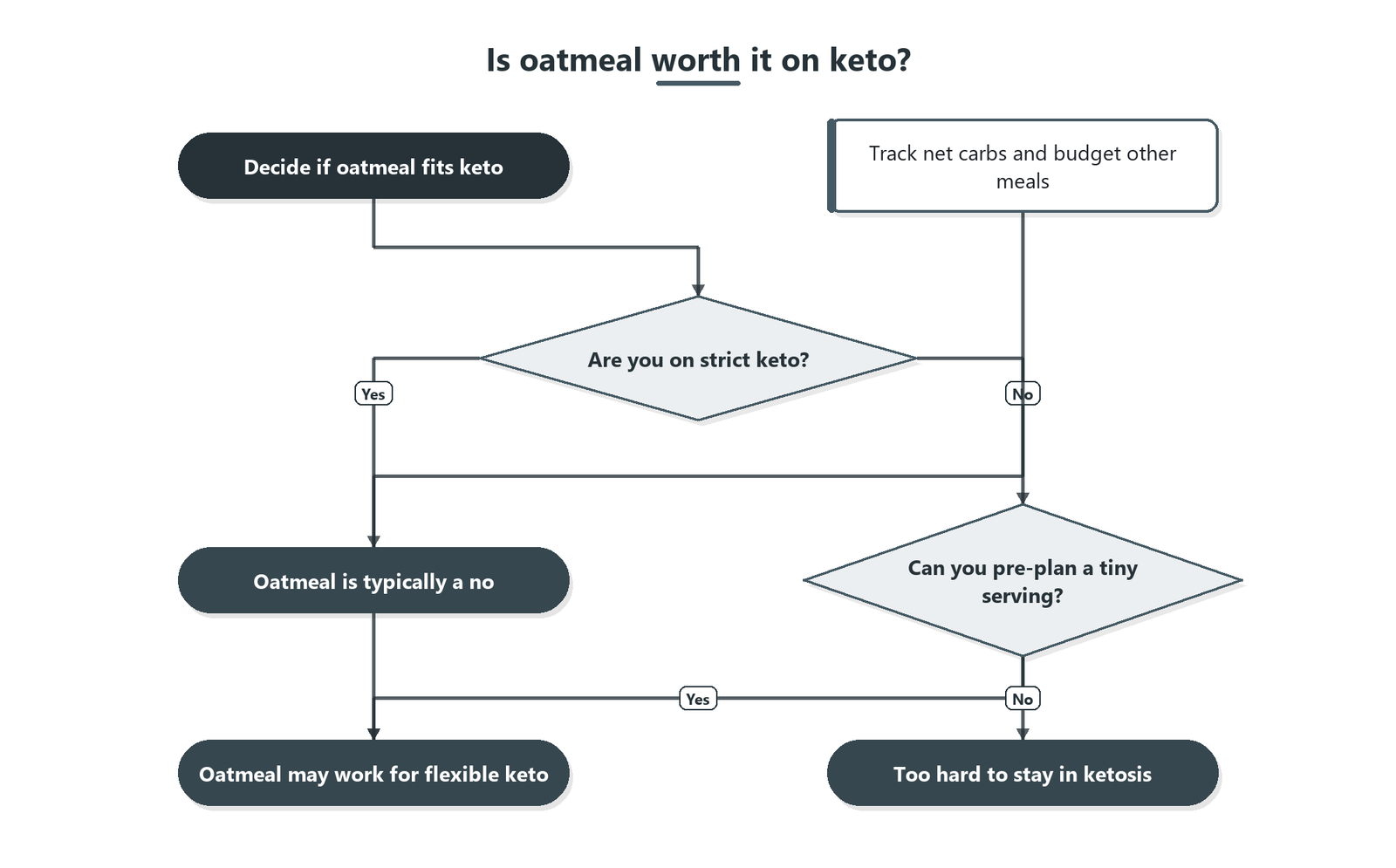
– For strict keto: oatmeal is typically a “no” because it’s hard to keep carbs low enough for most people without tiny servings.
– For flexible keto: a carefully portioned, plain oatmeal meal *may* work for some—if you track net carbs against your daily limit () and monitor how you feel.
– Skip oatmeal entirely if you’re doing keto for medical reasons that require tighter control, or if even small carb amounts regularly knock you out of ketosis.
To make this decision clearer, here’s a side-by-side “keto fit” comparison you can use before breakfast—especially when you’re tempted to free-pour oatmeal:
| Criterion (10+) | Measured oatmeal | Typical keto breakfast (non-oat) |
|---|---|---|
| Carb budgeting ease | Harder (oats are carb-dense) | Easier (often near-zero carbs) |
| Net-carb predictability | Moderate (portion + fiber vary) | High (label + portion are stable) |
| Sweetened add-in risk | High | Lower if you avoid sugary sauces |
| Warm/comfort satisfaction | High | Medium to high (depending on recipe) |
| Fiber contribution | Often moderate to high | Often moderate (chia/vegetables) |
| Impact on ketosis | More likely to be noticeable | Less likely when carbs stay low |
| Meal consistency (repeatability) | Depends on measurement discipline | Generally easier to standardize |
| Glycemic load (relative) | Higher than non-starchy keto foods | Lower when carbs are minimal |
| Typical “carb trap” behavior | Common (extra oats/add-ins) | Less common |
| Best use-case alignment | Occasional, planned carbs | Daily keto breakfasts |
| Verdict | Usually no for strict keto | Better for keto consistency |
Quick checklist (scan before you eat oatmeal)
| Checklist item | What to check |
|---|---|
| Net carbs | Confirm using the nutrition label and your keto net-carb method () |
| Portion size | Measure your oats (don’t rely on eyeballing) |
| Oat type | Prefer plain oats; avoid sweetened/flavored versions |
| Add-ins | Watch for fruit, honey, syrups, and carb-heavy toppings |
| Day planning | Keep other meals low-carb to “budget” for oats |
Frequently Asked Questions
Is oatmeal good for a keto diet?
Oatmeal is generally not considered keto-friendly because it’s high in carbohydrates, which can quickly raise your blood sugar and prevent ketosis. Even “plain” or “rolled” oats typically contain too many net carbs for most strict keto plans. If you want a keto diet, it’s usually better to choose lower-carb alternatives like chia pudding, flaxseed porridge, or nut-based cereals.
How many carbs are in oatmeal, and will it kick you out of ketosis?
The carb count in oatmeal varies by type, but most servings contain a substantial amount of net carbs per bowl. Since keto typically limits net carbs to around 20–50 grams per day (depending on your approach), oatmeal can use up a large portion of your daily carb allowance. To avoid getting kicked out of ketosis, you’d need to keep portions extremely small—and even then, many people find it difficult to stay in range.
Why do oats have a bad reputation for keto?
Oats contain starch and naturally occurring carbs that aren’t as low as typical keto macros require. Because oatmeal is also often eaten in larger portions (like a full serving), it becomes easy to exceed your carb limit. Keto focuses on low-carb, moderate-protein eating, so higher-carb grains like oats usually don’t fit well.
Best way to enjoy “oatmeal” flavor on keto—what should I use instead?
If you’re craving keto oatmeal, look for “keto porridge” substitutes made with chia seeds, ground flaxseed, or low-carb oat alternatives such as lupin flour blends (where available). These options can mimic the thick texture while keeping net carbs much lower than traditional oatmeal. For flavor, add cinnamon, vanilla extract, a low-sugar sweetener, and unsweetened almond milk or heavy cream.
Which types of oatmeal are most keto-friendly, if any?
Among traditional options, steel-cut oats and rolled oats usually still contain too many carbs for most ketogenic diets. “Instant” and flavored oat products are often worse due to added sugar, even if the base carbs are similar. If you’re determined to try it, track net carbs carefully and consider treating oats as an occasional, non-keto swap rather than a regular keto breakfast.
📅 Last Updated: October 31, 2026 | Topic: is oatmeal good for keto diet | Content verified for accuracy and freshness.
References
- https://www.mayoclinic.org/tests-procedures/diet-and-nutrition/ketogenic-diet/art-20045752
- https://www.niddk.nih.gov/health-information/weight-management/low-carbohydrate-diets
- https://health.clevelandclinic.org/ketogenic-diet-what-to-eat-and-avoid/
- Ketogenic diet
- Oatmeal
- https://pubmed.ncbi.nlm.nih.gov/?term=ketogenic+diet+carbohydrate+restriction
- https://pubmed.ncbi.nlm.nih.gov/?term=oats+glycemic+index+oatmeal
- https://scholar.google.com/scholar?q=is+oatmeal+good+for+keto+diet Google Scholar
- https://scholar.google.com/scholar?q=oatmeal+net+carbs+ketogenic+diet Google Scholar
- https://scholar.google.com/scholar?q=ketogenic+diet+carbohydrate+intake+review Google Scholar