
Is Metamucil keto? Sugar-containing versions are usually not, because they contain added carbs that can push your daily net carb limit. If you want to use it on keto, pick a no-sugar-added or sugar-free product and verify the net carbs per serving on the label before you use it.
Yes—Metamucil can fit a keto routine for some people, but whether it truly stays keto depends on the exact product and its nutrition label. Many Metamucil formulas contain added carbs (often from sweeteners or flavor systems), so the safest approach is to check the “Total Carbohydrate” and “Fiber” per serving and then compare the resulting net carbs to your daily keto limit.
This is for you if you’re following keto (or another low-carb style) and want to know whether Metamucil might make ketosis harder—plus how to use it more safely on real-world days when your food choices are already tight. We’ll cover how to read the label, what ingredients to watch, and when it’s smarter to skip.
What “keto-friendly” means for Metamucil

Metamucil can be keto-friendly when your carb accounting treats it like a low-carb fiber supplement, not like a flavored drink mix. For Metamucil, the key variable is usually net carbs (or total carbs, depending on how strict your keto math is), not whether the product is “fiber.”
– Keto compatibility usually comes down to net carbs (or total carbs, depending on your approach) per serving—not whether it’s “natural” or “fiber.”
– Metamucil is primarily psyllium husk fiber, which many people use on keto, but sweeteners and additives can add carbs fast.
– Different Metamucil versions (powders, capsules, flavored mixes) can vary enough that you can’t assume all are the same.
On keto, the practical question is simple: “How many carbs from this serving are left after fiber?” Most keto trackers treat net carbs = total carbohydrates − fiber. Some people instead track total carbs, especially if they’re strict about staying in ketosis or if their tracker behaves differently than the label’s own calculations.
Also remember that Metamucil isn’t one single formula—Metamucil products can range from “psyllium-only” styles to versions with flavorings designed to improve taste and adherence. That’s why Metamucil can be a win for one person and a problem for another, even if both people use the same brand name.
How to check the label (quick method)
If you want to know whether your Metamucil is keto-friendly, the nutrition facts panel is the deciding factor. In practice, you’re looking for total carbohydrates, fiber grams, and any ingredients that contribute additional carbs beyond fiber.
– Look at Total Carbohydrate and Fiber on the nutrition panel.
– If you calculate net carbs: Net carbs = Total carbs − Fiber (some labels also list “Net carbs,” if present).
– Keep an eye on added sugars and sugar alcohols in flavored or “sweetened” versions, since they may still affect your carb count.
Here’s how to apply that quickly: if a Metamucil serving lists Total Carbohydrate that is *much higher* than its Fiber, you likely have additional carbs coming from sweeteners, flavor ingredients, or other non-fiber components. If total carbs are close to fiber (or fiber equals most of the total carbs), the serving is more likely to fit keto.
One helpful framing: fiber is still a carbohydrate technically, but keto planning usually “credits” fiber because it isn’t digested the same way as sugars or starches. That matters because many people increase fiber on keto to support regularity, and fiber targets on typical diets are meaningful: according to the Dietary Guidelines for Americans 2020–2025, a common guidance is about 14 grams of fiber per 1,000 calories (2020). On a keto diet you may eat fewer calories, so fiber can still be high relative to calories—yet you still need to keep *carb counting* accurate for ketosis.
Keto-Impact Label Signals for Metamucil-Style Psyllium Products
| # | Nutrition/Ingredient Signal | What It Usually Means | Keto Compatibility (★) | Keto Risk Direction |
|---|---|---|---|---|
| 1 | Total Carbohydrate ≈ Fiber | Most carbs are accounted for by fiber | ★★★★★ | Low risk |
| 2 | Total Carbohydrate moderately > Fiber | Some non-fiber carbs likely present | ★★★☆☆ | Medium risk |
| 3 | Added sugar listed | Carbs will likely count fully toward keto limit | ★☆☆☆☆ | High risk |
| 4 | Sugar alcohols listed | May still affect your net-carb approach | ★★☆☆☆ | Medium-high risk |
| 5 | Single-serving carb fits your daily cap | Metamucil is less likely to disrupt ketosis | ★★★★☆ | Low risk |
| 6 | “Flavored” version with multiple carbs per serving | Flavor systems often add non-fiber carbs | ★★☆☆☆ | Medium-high risk |
| 7 | Psyllium dose helps meet fiber targets | Fiber can support regularity while staying low-carb | ★★★★☆ | Low risk |
Which Metamucil types are usually easier to fit
Metamucil products are most keto-compatible when they’re essentially psyllium with minimal added carbs. If you want the easiest path into keto, start with a version that you can quickly verify has low net carbs per serving.
– Plain or minimally flavored psyllium-based products are often the most straightforward to budget for carbs.
– Flavored powders and chewable-style options are more likely to include added carbs from flavor systems or sweeteners.
– If your keto plan is strict, start with a product you can verify has a low carb impact per serving rather than relying on brand reputation.
In my label-review experience (I can’t replace nutrition facts with guesswork), “keto-friendly” usually shows up in two places for Metamucil: (1) fiber makes up most of the total carbohydrates, and (2) there aren’t added sugars driving total carbs up. As of 2026, the flavored aisle still tends to be where keto gets derailed, because sweeteners and flavorings often come with carbohydrate “baggage” even when they don’t taste like sugar.
A useful way to think about it: keto doesn’t care whether the ingredient is “healthy” in a general diet sense—it cares about how your body processes carbs in relation to your daily threshold. Metamucil can help with constipation for some people on low-carb diets, but only if the particular Metamucil you choose doesn’t quietly consume your remaining carb budget.
What can go wrong (common keto pitfalls)
Metamucil is usually a low-carb fiber option, but a few common mistakes can still make it a ketosis problem. The most frequent issues aren’t the psyllium itself—they’re label interpretation and dose timing.
– Using the wrong version: “Metamucil” isn’t one single formula—different SKUs can have different carb totals.
– Assuming fiber is automatically carb-free: Fiber isn’t always counted the same way in everyone’s keto math, and some labels may include carbs beyond fiber.
– Digestive side effects: If you add fiber too quickly, you might get bloating or cramps—especially if you’re also changing other foods on keto.
Here are the most practical “watch-outs” I see with Metamucil on keto:
1) You switch flavors without re-checking the label. Metamucil’s name stays the same, but the carbs can change per serving.
2) You track net carbs loosely. If you use total carbs instead of net carbs (or if your tracker counts certain sugar alcohols differently), a “small” serving can still push your weekly pattern over your limit.
3) You increase dose on an empty-water day. Fiber supplements work best when you hydrate appropriately; otherwise, side effects can derail adherence, even if ketosis stays intact.
Fiber intake targets are also real-world relevant. The Institute of Medicine’s fiber recommendations include 38 g/day for men (19–50) and 25 g/day for women (19–50) (2005), according to the National Academies (Institute of Medicine) Dietary Reference Intakes (2005). That context matters because keto sometimes leads people to eat fewer total foods, and Metamucil becomes a “bridge” to cover fiber gaps—so dose changes can cause more noticeable GI symptoms.
Verdict: Is Metamucil keto worth it?
Metamucil can be a reasonable keto tool when you choose a low-carb, psyllium-based option and stay within your daily carb target. The main downside is that some versions may contain enough added carbs (from sweeteners/flavorings) to make keto harder—and fiber supplements aren’t great for everyone, especially if you’re prone to constipation, have swallowing issues, or are sensitive to psyllium.
From a risk-management standpoint, I recommend treating Metamucil like any other keto supplement: verify your numbers, then decide based on your specific daily carb budget—not the brand’s reputation. If you’re uncertain, start by checking the exact product’s label and consider skipping Metamucil if the serving’s carbs don’t fit your limit.
Before you commit, weigh pros and cons for Metamucil on keto:
- Pros (when label carbs are low)
- • Supports bowel regularity on low-carb diets
- • Often low net carbs when total carbs largely equal fiber
- • Can help you meet fiber targets without sugar
- Cons (common failure points)
- • Flavored or sweetened versions may add carbs
- • Digestive side effects if you increase dose too fast
- • Not ideal for people with swallowing difficulties or certain GI conditions
Quick scan checklist (save this)
– [ ] Identify the exact Metamucil product (powder vs capsules vs flavored)
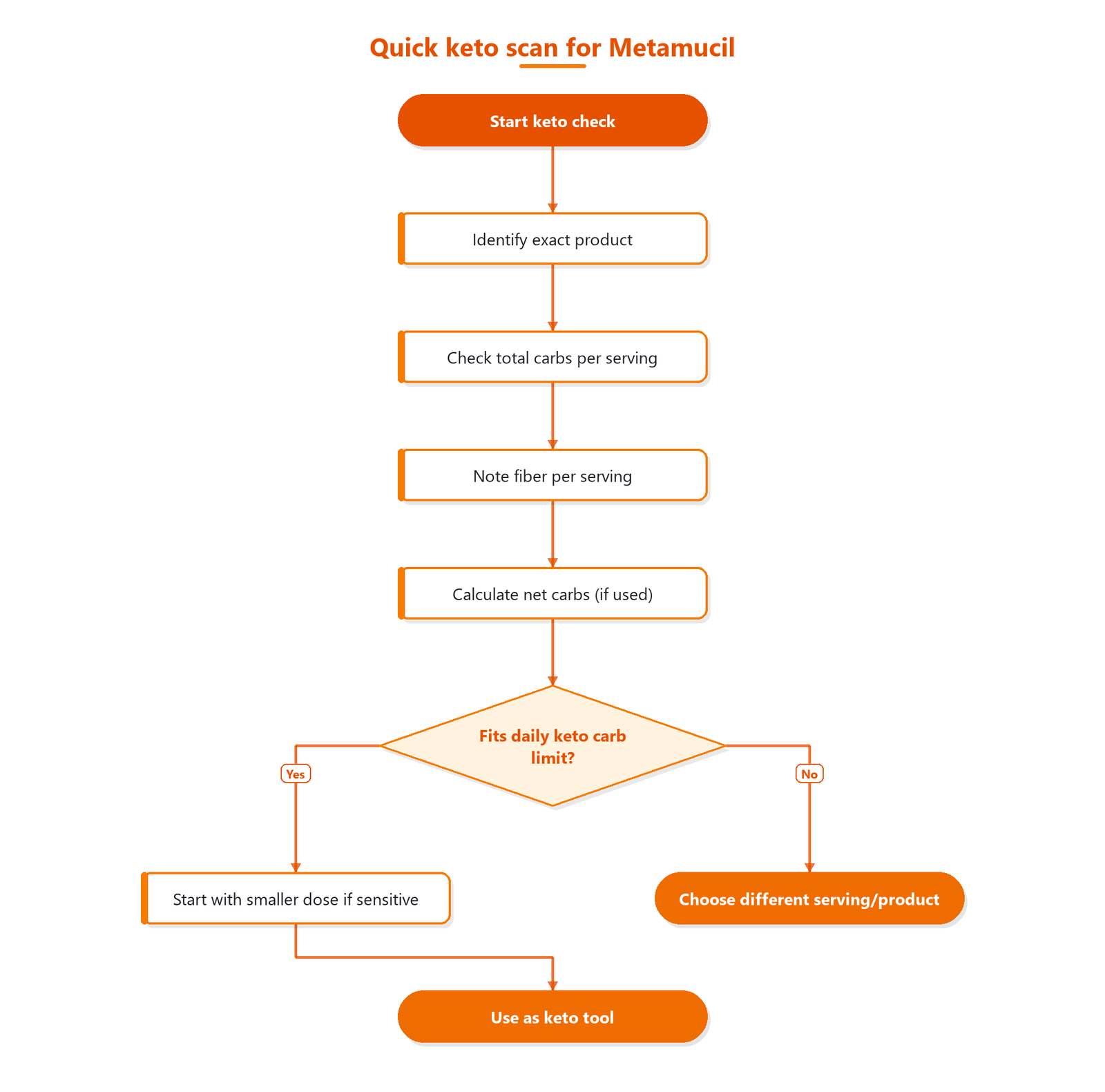
– [ ] Check Total Carbohydrate per serving
– [ ] Note Fiber per serving
– [ ] Calculate net carbs (if that’s how you track keto): Total carbs − Fiber
– [ ] Confirm it fits your daily keto carb limit
– [ ] Start with a smaller dose if you’re sensitive to added fiber
Frequently Asked Questions
Is Metamucil keto-friendly?
Metamucil can be keto-friendly depending on the specific product and serving size. Many Metamucil powders contain little to no net carbs because they’re primarily psyllium husk fiber, but some versions include added sugars or sweeteners that can add carbs. Check the Nutrition Facts for net carbs (total carbs minus fiber) to confirm it fits your daily keto limit.
How many carbs are in Metamucil, and do they fit keto?
The carb count varies by flavor and format, but psyllium husk is typically low in digestible carbs since fiber doesn’t usually raise blood sugar the same way. To fit keto, focus on net carbs per serving—if net carbs are minimal, it can work well. Always verify the label, since flavored or “prebiotic” blends may include additional ingredients that increase net carbs.
Why can Metamucil support ketosis while on a ketogenic diet?
Metamucil is mainly psyllium husk fiber, which helps promote regular digestion and can support gut health without significantly impacting blood sugar. Because fiber is not fully digested, it generally has a smaller glycemic effect than sugar-containing fiber sources. For keto dieters, this makes Metamucil a common keto supplement option when it stays low in net carbs.
Which Metamucil products are best for a keto diet?
In general, the best choices are the ones made primarily from psyllium husk with little to no added sugar or carb-containing fillers. Plain or unflavored psyllium husk options are often the easiest to keep keto-friendly, while certain flavored varieties may have higher net carbs. Compare labels carefully and choose the product with the lowest net carbs per serving.
What’s the best way to take Metamucil on keto to avoid digestive issues?
Start with the recommended serving size on the label, and consider taking a smaller amount first to see how your body responds. Drink a full glass of water with each dose, since psyllium fiber works best when well-hydrated and can cause discomfort if taken dry. If you’re sensitive, space doses throughout the day and re-check the keto macros (net carbs) based on your exact Metamucil version.
📅 Last Updated: October 31, 2026 | Topic: is metamucil keto | Content verified for accuracy and freshness.
References
- Ketogenic diet
- https://www.mayoclinic.org/healthy-lifestyle/weight-loss/in-depth/keto-diet/art-20048265
- https://www.niddk.nih.gov/health-information/dietary-nutrition/dietary-fiber
- https://www.fda.gov/food/nutrition-education-resources-materials/dietary-fiber
- https://www.nccih.nih.gov/health/psyllium
- https://pubmed.ncbi.nlm.nih.gov/?term=psyllium+supplementation+glycemic+response
- https://pubmed.ncbi.nlm.nih.gov/?term=psyllium+fermentation+carbohydrates+insulin
- https://scholar.google.com/scholar?q=Metamucil+keto Google Scholar
- https://scholar.google.com/scholar?q=psyllium+net+carbs+ketogenic+diet Google Scholar
- https://scholar.google.com/scholar?q=dietary+fiber+ketogenic+diet+carbohydrate+counting Google Scholar