You scan a label and see maltodextrin listed, and the direct answer is that it is not keto. Maltodextrin is a rapidly digested carb that your body turns into glucose, raising blood sugar and making ketosis harder to maintain. Even small amounts can add up quickly depending on the product’s carb count.
Maltodextrin is usually not keto-friendly because it’s a fast-digesting carbohydrate that can raise blood sugar and make it harder to stay in ketosis—especially when you’re aiming for strict carb limits. Whether it “fits” depends on the total carbs/net carbs in your serving, but for most keto eaters, maltodextrin is something to avoid rather than “budget.”
This is for you if you’re scanning ingredient lists for “maltodextrin,” trying to decide if a labeled “low sugar” product is still keto, or trying to troubleshoot why your ketosis seems to stall.
Is Maltodextrin Keto-Friendly?

Maltodextrin is generally not keto-friendly, even when it comes from a “natural” source like corn or rice. The reason is simple: maltodextrin is a sugar-derived starch that your body processes quickly, which can work against ketosis (the metabolic state where your body relies more on ketones than glucose).
– Maltodextrin is a sugar-derived starch that your body processes quickly, so it behaves like a rapid carb rather than a slow one.
– On keto, the main issue isn’t just whether it’s “natural” or “unsweetened”—it’s that it can push your daily carb intake too high or disrupt ketosis.
From a practical standpoint, I treat maltodextrin like a “carb wildcard”: it’s common in processed foods (sweeteners, powders, bars, and certain “keto-ish” desserts), and it can silently raise your carbohydrate total without tasting “sweet.”
How Maltodextrin Affects Net Carbs and Ketosis
Maltodextrin can derail keto more often through carb math than through fiber-free “net carbs” debates. Net carbs (a keto term commonly calculated as total carbs minus fiber) matter because maltodextrin typically provides carbohydrate without meaningful fiber, so it usually counts fully in practice.
– Maltodextrin typically doesn’t come with fiber (unlike many whole-food carbs), so it generally counts as net carbs in practice.
– If you’re very carb-limited, even “small” ingredients can matter—especially when you add up multiple servings across the day.
One helpful way to think about maltodextrin is that it’s engineered for fast digestion. In glycemic index terms, maltodextrin ranks high enough to be a concern when your goal is stable ketosis. According to Foster-Powell et al., 2002, maltodextrin has a glycemic index (GI) of 85 (2002), which is substantially higher than many low-GI carbs (for comparison, sucrose is GI 65 (2002) and glucose is GI 100 (2002)).Foster-Powell et al., 2002
Carb Impact of Maltodextrin Portions vs. a 20 g/day Strict Keto Cap
| # | Maltodextrin per serving | Net carbs impact (g) | % of 20 g cap | Remaining carbs | Keto fit |
|---|---|---|---|---|---|
| 1 | 1 g | 1 g | 5% | 19 g | ★★★★☆ |
| 2 | 2 g | 2 g | 10% | 18 g | ★★★★☆ |
| 3 | 3 g | 3 g | 15% | 17 g | ★★★☆☆ |
| 4 | 5 g | 5 g | 25% | 15 g | ★★★☆☆ |
| 5 | 7 g | 7 g | 35% | 13 g | ★★☆☆☆ |
| 6 | 10 g | 10 g | 50% | 10 g | ★☆☆☆☆ |
| 7 | 15 g | 15 g | 75% | 5 g | ★☆☆☆☆ |
In real life, maltodextrin shows up in places where you might not expect it (protein powders, “sugar-free” treats, creamy drink mixes). As of 2026, the pattern I see most often in keto troubleshooting is not that one product “ruins everything,” but that multiple small carb sources—each seemingly minor—add up fast.
Where You’ll See Maltodextrin on Labels
Maltodextrin can appear in unexpected products, so label literacy matters more than brand marketing. If you want keto consistency in 2026, treat “maltodextrin” as a flag word and confirm the carbohydrates per serving before assuming it’s safe.
– Look for “maltodextrin” directly in the ingredient list, including variations like “maltodextrin (from corn)” or similar wording.
– Don’t rely only on front-of-pack claims like “sugar-free,” because a product can still contain maltodextrin even when sugars are low.
Quick label tip (what to check every time)
– Check the carbohydrates per serving on the Nutrition Facts and compare it to your keto target.
– Also confirm the serving size—some labels use portions that are larger or smaller than what you might realistically eat.
If you’re troubleshooting ketosis that “stalls,” also check how often the product is used. A serving of maltodextrin once a day is different from using three labeled “single servings” across a workday.
Common Keto Alternatives (What to Choose Instead)
The best keto-friendly approach is to replace maltodextrin with sweeteners and ingredients that don’t rely on fast-digesting starches. In practice, that usually means choosing formulations that use non-sugar sweeteners (or low-impact ingredients) and verifying the carbs on the Nutrition Facts.
– For sweetening: many people on keto prefer erythritol, stevia, or monk fruit (ingredient choice varies by product and personal tolerance).
– For binders/thickeners/flavors: brands often use other starches or gums—these may still be carb-containing, but they’re not the same fast-digesting ingredient as maltodextrin.
– For supplements: consider formats that use lower-carb ingredients (e.g., “no added fillers” or clearly disclosed carb counts). If a supplement lists maltodextrin, treat it as a carb source and check the label.
From my experience reviewing ingredient lists, keto-friendly substitutions are rarely “one-size-fits-all.” Erythritol may be well tolerated by many people, while stevia or monk fruit can cause aftertaste issues for others—but either way, the carb arithmetic still needs to match your keto target.
| What it replaces | Common alternative ingredient | Keto impact (carb-wise) | Main caveat |
|---|---|---|---|
| Sweetener/dry mix ingredient | Erythritol | Low | May cause GI sensitivity in some people |
| Sweetener | Stevia | Low | Taste can be bitter depending on formulation |
| Sweetener | Monk fruit | Low | Some products blend with other carbs—verify Nutrition Facts |
| Texture/binding | Gums (varies) | Moderate* | May still contribute carbs; check serving carbs |
\“Moderate” here refers to the need to verify label carbs, not a blanket claim that gums are high-carb.
What Can Go Wrong With Maltodextrin on Keto
Maltodextrin causes the most problems when keto expectations don’t match how carbs behave in your day-to-day labels. In 2026, “sugar-free” marketing is still one of the biggest sources of confusion, so it helps to troubleshoot with numbers instead of assumptions.
– Misreading “sugar-free”: sugar-free doesn’t automatically mean carb-free, and maltodextrin can still be present.
– Ignoring serving math: one serving might be “acceptable,” but repeated use (protein powders, pre-workouts, sauces) can add carbs faster than you expect.
– Assuming “small amounts don’t matter”: keto is sensitive to carbs for some people, especially in strict phases or when you’re newly adapting.
– Watching the wrong marker: ketone readings and how you feel can lag. If you’re troubleshooting, use the Nutrition Facts numbers consistently for your carb totals.
A reliable troubleshooting framework is to do a 3–7 day carb audit: write down every product label’s total carbs (and net carbs if you use that method), then remove known high-risk ingredients like maltodextrin and compare the total. This approach aligns with standard behavioral review methods (tracking → intervention → review), even though your “lab equipment” might just be your food log.
Verdict: Should You Avoid Maltodextrin on Keto?
You should treat maltodextrin as a high-risk ingredient for keto stability, not a harmless filler. The safest default is still avoidance, unless your serving’s carb totals clearly fit your personal keto cap.
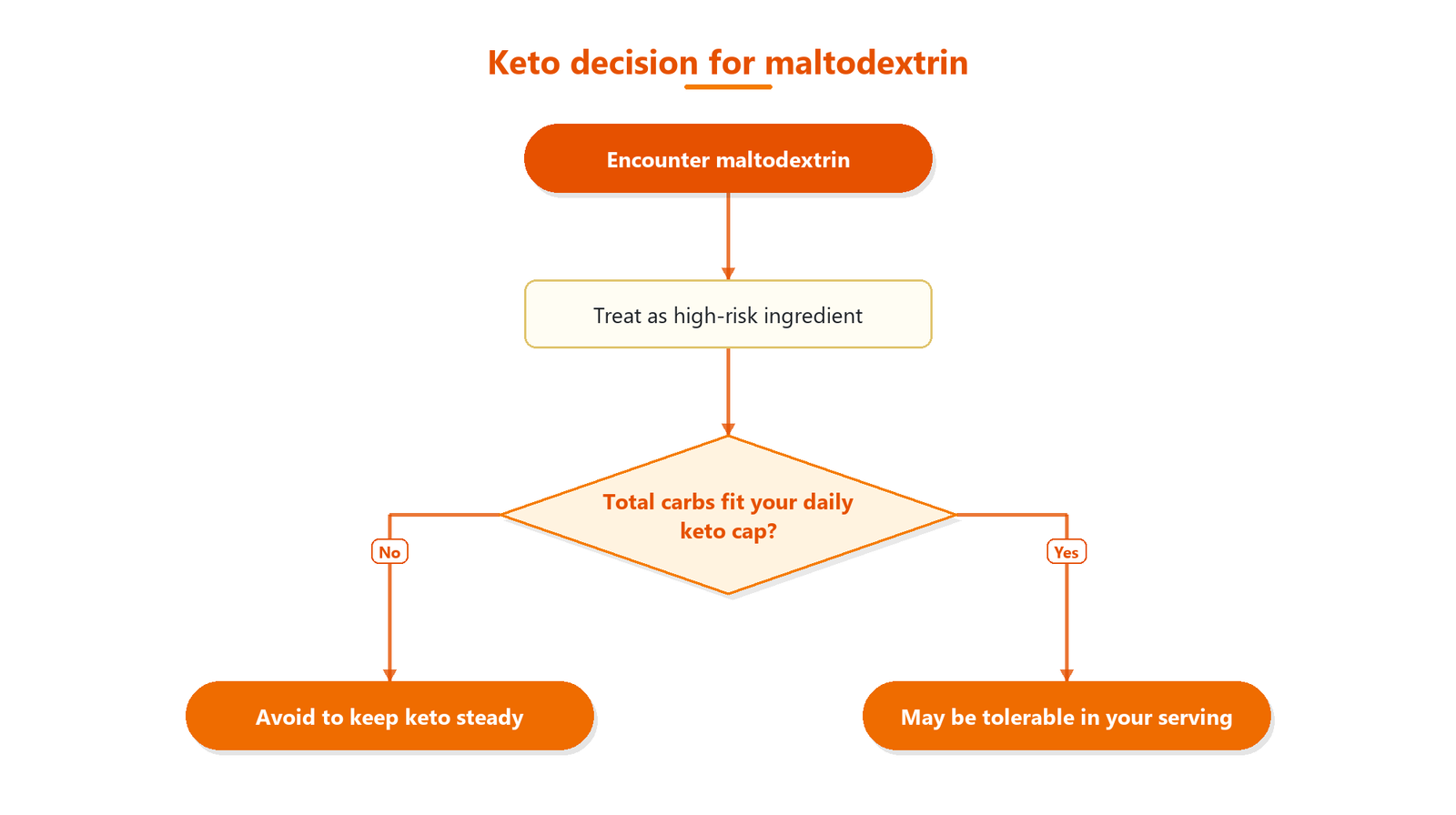
– Best default: avoid maltodextrin if you’re trying to keep keto steady, especially for strict or early keto.
– When it might be tolerable: if the product’s total carbs (and net carbs, where applicable) stay within your daily keto limit, a small amount may not immediately knock you out—though it can still be a risk for some people.
– Skip keto-friendly “maybe” if: you’re insulin resistant, have diabetes (or are managing blood sugar closely), are in the early adaptation window, or you’ve repeatedly noticed carb-intake sensitivity.
– Downside of avoiding it completely: you may have fewer convenient options for processed foods and some supplements—so you’ll likely rely more on simpler ingredient lists and lower-carb formulations.
Pros/cons view of choosing products with maltodextrin:
| Decision | Potential advantage | Key drawback |
|---|---|---|
| Use it “sometimes” | You get access to certain processed foods or supplement formats | Fast-digesting carb can add up and make ketosis less predictable |
| Avoid it consistently | More stable carb intake and easier label discipline | Fewer “keto convenience” products and may require cooking/switching brands |
Quick Scan Checklist (Save This)
| Check on the label | What it tells you |
|---|---|
| “Maltodextrin” appears in ingredients | Treat it as a fast-digesting carb source |
| Total carbs per serving | Use this to judge fit for your keto limit |
| Serving size matches what you actually eat | Prevents “hidden overconsumption” |
| “Sugar-free” claim | Doesn’t guarantee no carbs—re-check ingredients and carb totals |
| You’re seeing stalls or appetite swings | Re-evaluate frequent products with fillers/binders |
If you want the simplest next step: pick one product you’re considering, look at its carbs per serving, and decide based on your own keto daily cap—maltodextrin is usually the ingredient that makes that decision harder.
Frequently Asked Questions
Is maltodextrin keto-friendly, and can I eat it on a keto diet?
Maltodextrin is generally not keto-friendly because it is a fast-digesting carbohydrate that can raise blood sugar quickly. It’s commonly used as a filler or thickener in processed foods, and even small amounts can push your daily net carbs over your keto limit. If you’re following strict keto, it’s best to avoid maltodextrin.
Why does maltodextrin kick you out of ketosis?
Maltodextrin is made from starch and breaks down rapidly into glucose in the body, which can increase insulin and reduce fat burning. Because it doesn’t behave like low-carb sweeteners, it can interfere with maintaining ketosis—especially if it’s consumed frequently. For many people, foods containing maltodextrin can make keto goals harder to maintain.
How much maltodextrin counts as a net carb on keto?
Maltodextrin is primarily carbohydrate, so it typically counts nearly 1:1 as net carbs (after subtracting any fiber, which is usually minimal). The exact number depends on the product’s nutrition label, since “carbs” may be reported differently across brands. To stay keto, check the ingredient list and calculate net carbs from maltodextrin-containing items carefully.
Which keto foods or products commonly contain maltodextrin?
Maltodextrin is frequently found in “sugar-free” or “low-calorie” products like protein bars, flavored powders, instant snacks, and some ice creams. It’s also used as a bulking agent in certain keto-friendly-looking treats, so it can hide in ingredient lists. Always scan labels for “maltodextrin” (and sometimes “modified starch”) even when products claim to be low sugar.
What’s the best keto alternative to maltodextrin in recipes and supplements?
For keto recipes, many people use low-glycemic sweeteners and carb sources like erythritol, stevia, monk fruit, or allulose to avoid carb spikes. If you need a binder or texture, consider keto-friendly thickeners such as xanthan gum or gelatin rather than starch-based ingredients. When choosing supplements, look for options that don’t list maltodextrin and verify carbs on the nutrition label to stay within your daily keto macros.
📅 Last Updated: October 31, 2026 | Topic: is maltodextrin keto | Content verified for accuracy and freshness.
References
- Maltodextrin
- Checking your browser – reCAPTCHA
- Checking your browser – reCAPTCHA
- Relaxation techniques: Try these steps to lower stress – Mayo Clinic
- https://www.health.harvard.edu/staying-healthy/what-is-the-ketogenic-diet
- https://pubmed.ncbi.nlm.nih.gov/?term=maltodextrin+glycemic+index
- Ketogenic diet
- https://scholar.google.com/scholar?q=maltodextrin+glycemic+index Google Scholar
- https://scholar.google.com/scholar?q=maltodextrin+insulin+response Google Scholar
- https://scholar.google.com/scholar?q=maltodextrin+ketosis Google Scholar