To figure out your keto macros, you need to calculate your daily caloric intake and then adjust the ratio of fats, proteins, and carbs to fit the ketogenic diet. This guide will walk you through step-by-step calculations and considerations to ensure you achieve your keto goals. By understanding how to determine your macronutrient ratios, you can create a personalized plan that will lead to successful weight management and improved energy levels while following a ketogenic lifestyle.
Understanding Keto Macros Basics

Macronutrients, commonly referred to as macros, are the three essential components of your diet: fats, proteins, and carbohydrates. In the context of the ketogenic diet, the focus is primarily on a high-fat intake, moderate protein consumption, and very low carbohydrate consumption. The typical keto macro ratio is approximately 70-75% fats, 20-25% protein, and 5-10% carbohydrates. This specific distribution helps your body enter a state of ketosis, where it burns fat for fuel instead of carbohydrates, leading to effective weight loss and improved metabolic health. Understanding these basics is crucial for anyone looking to achieve success on the keto diet.
Calculating Your Daily Caloric Needs
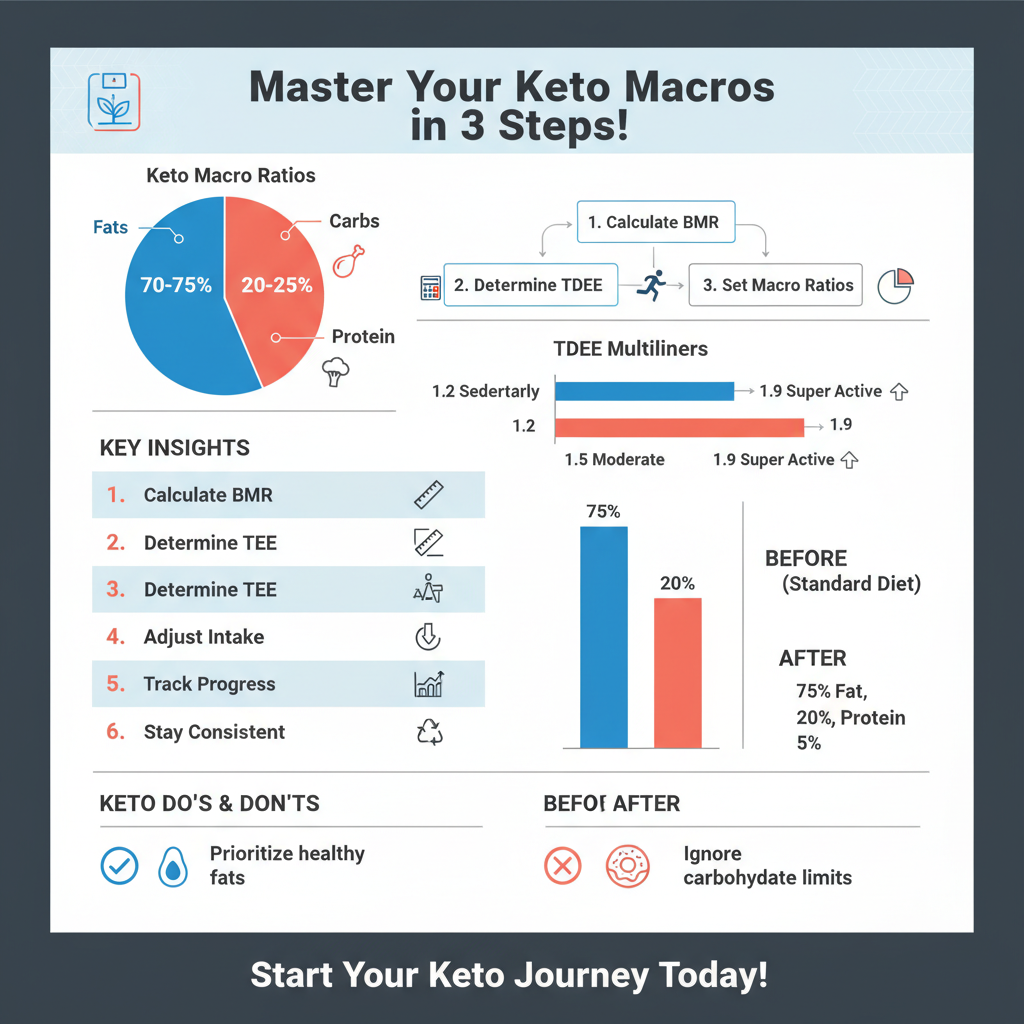

To determine your keto macros accurately, you first need to calculate your daily caloric needs. This involves understanding two key concepts: Basal Metabolic Rate (BMR) and Total Daily Energy Expenditure (TDEE).
BMR is the number of calories your body needs to maintain basic physiological functions at rest, while TDEE accounts for your activity level throughout the day.
To calculate your BMR, you can use the Mifflin-St Jeor equation:
– For men: BMR = 10 weight (kg) + 6.25 height (cm) – 5 age (years) + 5
– For women: BMR = 10 weight (kg) + 6.25 height (cm) – 5 age (years) – 161
Once you have your BMR, multiply it by an activity factor to find your TDEE:
– Sedentary (little to no exercise): BMR x 1.2
– Lightly active (light exercise/sports 1-3 days a week): BMR x 1.375
– Moderately active (moderate exercise/sports 3-5 days a week): BMR x 1.55
– Very active (hard exercise/sports 6-7 days a week): BMR x 1.725
– Super active (very hard exercise, physical job, or training): BMR x 1.9
This calculation will give you a clearer understanding of how many calories you should aim to consume daily to maintain your current weight, from which you can make adjustments based on your weight loss or maintenance goals.
Determining Your Keto Macro Ratios
Once you have established your daily caloric needs, the next step is to convert those calories into specific macro ratios that align with the ketogenic diet.
To do this, use the following method based on your TDEE:
1. Calculate your fat intake: Multiply your total caloric intake by 0.75 (for 75% fat) or 0.70 (for 70% fat). Since fats contain 9 calories per gram, divide the result by 9 to determine your daily fat grams.
2. Calculate your protein intake: Multiply your total caloric intake by 0.25 (for 25% protein) or 0.20 (for 20% protein). Proteins contain 4 calories per gram, so divide by 4 to find your daily protein grams.
3. Calculate your carbohydrate intake: Use the remaining calories for carbohydrates. Carbs also contain 4 calories per gram, so divide the remaining calories by 4 to find your daily carb grams.
For example, if your TDEE is 2000 calories:
– Fat: 2000 x 0.75 = 1500 calories / 9 = 167 grams of fat
– Protein: 2000 x 0.20 = 400 calories / 4 = 100 grams of protein
– Carbohydrates: Remaining calories = 2000 – (1500 + 400) = 100 calories / 4 = 25 grams of carbs
By following these calculations, you can create a tailored macro plan that fits your dietary needs while promoting ketosis.
Tools and Resources for Tracking Macros
To make tracking your macros easier and more efficient, numerous apps and websites can assist you in monitoring your food intake. Some of the most popular include:
– MyFitnessPal: This app offers an extensive food database, allowing users to log meals easily and track macro intake.
– Cronometer: Particularly useful for those who want to track micronutrients alongside macros, Cronometer provides a comprehensive breakdown of nutritional data.
– Carb Manager: Specifically designed for low-carb and ketogenic diets, this app helps users stay within their carb limits while tracking fats and proteins.
Accuracy in measuring food portions is paramount for success on the keto diet. It is advisable to invest in a digital kitchen scale to weigh your food, as this helps ensure that you are adhering to your macro goals without overestimating or underestimating your intake.
Adjusting Macros Based on Progress
As you embark on your keto journey, it’s important to be flexible with your macro ratios based on your progress and overall well-being. If you experience a weight loss stall or notice a drop in energy levels, consider adjusting your macros.
For instance, increasing your fat intake can help reignite your body’s ketosis process, while slightly decreasing protein may enhance fat oxidation. Additionally, if you find yourself feeling fatigued, it may be wise to increase your carbohydrate intake temporarily, especially if you lead an active lifestyle.
Listening to your body and making small adjustments to your macros can ensure sustainable progress tailored to your personal preferences and activity levels.
Common Mistakes to Avoid
When calculating or tracking macros, many individuals fall into common pitfalls that can hinder their success on the keto diet. Here are some frequent mistakes to avoid:
1. Over-restriction of calories: Consuming too few calories can slow your metabolism and cause energy dips, making it harder to maintain the diet.
2. Neglecting micronutrients: Focusing solely on macros without considering vitamins and minerals can lead to deficiencies. Incorporate a variety of low-carb vegetables and supplements as needed.
3. Inaccurate portion sizes: Estimating food portions can lead to miscalculations. Use kitchen scales and measuring cups to improve accuracy.
By being aware of these pitfalls and implementing strategies to overcome them, you can enhance your keto experience and achieve better results.
Staying Motivated and Committed
Staying motivated on a keto diet can be challenging, especially when faced with cravings or social situations involving food. Here are some strategies to maintain your commitment:
– Set realistic goals: Aim for achievable milestones rather than drastic changes. Celebrate small victories to keep motivation high.
– Join a community: Engage with online forums, local groups, or social media communities dedicated to the ketogenic lifestyle. Sharing experiences and tips can provide support and encouragement.
– Experiment with recipes: Keep your meals exciting by trying out new keto recipes. This not only maintains variety but also reduces the likelihood of feeling deprived.
Maintaining a sense of community and finding enjoyment in the dietary changes can significantly enhance your experience and adherence to the ketogenic lifestyle.
Understanding and calculating your keto macros is essential for success on the ketogenic diet. By following the steps outlined in this guide, you can effectively determine your macro needs and adjust them as necessary. Remember to leverage tracking tools, stay flexible with your approach, and avoid common mistakes to maximize your results. Start tracking today for a healthier, more successful keto journey!
Frequently Asked Questions
What are keto macros and why are they important for a ketogenic diet?
Keto macros refer to the macronutrient ratios that individuals on a ketogenic diet should follow to achieve and maintain ketosis. Typically, this involves consuming approximately 70-75% of your daily calories from fats, 20-25% from protein, and only 5-10% from carbohydrates. Understanding and tracking these macros is crucial because it helps your body shift from burning glucose for fuel to burning fat, maximizing the benefits of the ketogenic lifestyle.
How do I calculate my keto macros based on my weight and goals?
To calculate your keto macros, first determine your daily caloric needs using an online calculator or the Mifflin-St Jeor equation, which factors in your age, gender, weight, height, and activity level. Once you have your total calorie intake, multiply that number by the appropriate macro percentages for a ketogenic diet: fat (70-75%), protein (20-25%), and carbohydrates (5-10%). For example, if your daily intake is 2000 calories, you would consume about 155-167 grams of fat, 100-125 grams of protein, and 25-50 grams of carbohydrates.
Which tools or apps can help me track my keto macros effectively?
There are several apps designed to help you track your keto macros easily and accurately. Popular options include MyFitnessPal, Cronometer, and Carb Manager, which allow you to log your food intake, monitor your macro ratios, and provide nutritional insights. These tools often feature extensive food databases and barcode scanning capabilities, making it convenient to stay on track with your ketogenic diet.
Why do my keto macros seem off, and how can I adjust them?
If your keto macros seem off, it may be due to inaccurate tracking or miscalculating your caloric needs. To adjust them, revisit your daily caloric intake calculations and ensure you’re accurately logging all foods consumed. Additionally, consider your activity level and weight loss goals; if you’re not seeing the desired results, you may need to tweak your fat and protein ratios or reduce your total calorie intake.
What is the best way to maintain my keto macros while dining out or traveling?
Maintaining your keto macros while dining out or traveling involves careful planning and making informed food choices. Before heading out, look up the menu online to identify keto-friendly options. When ordering, don’t hesitate to customize your meal by substituting high-carb sides with vegetables or asking for dressings and sauces on the side. Additionally, consider packing keto snacks like nuts or cheese to keep your macro intake in check while on the go.
References
- https://www.healthline.com/nutrition/keto-diet-macros
- https://www.ncbi.nlm.nih.gov/pmc/articles/PMC6520708/
- https://www.examine.com/nutrition/keto-diet-macros/
- https://www.mayoclinic.org/healthy-lifestyle/nutrition-and-healthy-eating/in-depth/keto-diet/art-20459694
- https://www.hsph.harvard.edu/nutritionsource/keto-diet/