Oatmeal is not keto-friendly for most people following a ketogenic diet because it is high in carbohydrates, which can quickly raise blood sugar and make it difficult to stay in ketosis. That is the main deciding factor: the carb load of cooked servings and any added ingredients like honey or dried fruit. If your goal is strict keto, you should treat oatmeal as off-limits; if you’re less strict, you still need to plan portion size carefully.
Yes—oatmeal is usually not keto-friendly because oats are high in carbs, which can push you out of ketosis. If you still want something “oat-like,” you’ll need to use a strict carb limit and consider lower-carb alternatives. In this guide, we’ll break down exactly why oatmeal typically doesn’t fit keto and what to do instead.
If you’re following keto for weight loss, blood sugar control, or to reduce carbs overall, this matters because small portions of oatmeal can add up quickly. This article is for anyone wondering whether oatmeal can fit keto macros—and for people planning breakfast that won’t stall their progress.
Why oatmeal usually doesn’t work on keto

Oatmeal usually doesn’t work on keto because oats provide a dense source of digestible carbohydrate, which conflicts with ketosis requirements. In practice, most people end up exceeding their daily net-carb target unless they severely shrink the portion—and even then, oatmeal can be hard to fit consistently into keto macros.
– Oats contain a lot of carbohydrates, and keto requires keeping carbs very low to maintain ketosis.
– Even “small” servings can add enough net carbs to interfere with your daily carb target.
– Oatmeal is often eaten as a warm, filling meal—great for other diets, but a mismatch for most keto plans.
From a keto perspective, the key issue isn’t whether oats are “healthy”—it’s the carbohydrate load per spoonful. Even when oatmeal includes fiber, the body still absorbs enough carbohydrate to raise blood glucose and insulin, which can make it harder to stay in ketosis day after day.
Carbs, net carbs, and ketosis: the real issue
The real problem with oatmeal on keto is usually net carbs (carbs that effectively impact blood sugar), not “total carbs” or the fact that oats contain fiber. Keto planning works best when you understand how much carbohydrate you’re actually consuming relative to your daily limit.
– Keto success usually comes down to your carb intake, not just whether a food is “healthy.”
– “Net carbs” may be calculated differently depending on labels and fiber content—so check the nutrition facts carefully.
– Different oatmeal forms (rolled oats, instant oatmeal, steel-cut) can vary, but carbs are the main concern across the board.
Keto diets are typically carb-restricted enough to induce and maintain ketosis, which usually means keeping carbohydrate intake below 50 g/day and often around 20–30 g/day for many people. According to the International Society of Sports Nutrition (ISSN) position stand (2018), ketogenic diets commonly restrict carbohydrates to <50 g/day, with many protocols targeting much lower intakes to maintain ketosis (2018). The exact number that matters to you depends on your “keto type” (standard vs. targeted) and how sensitive you are to carbs.
To make the oat issue concrete, here’s a practical comparison. The numbers below are estimates based on commonly reported nutrition values for plain, unsweetened products; branded packets can differ, and preparation size matters.
Estimated net-carb impact of common “oat-like” breakfasts (plain)
| # | Food (typical portion) | Total carbs | Fiber | Net carbs* | Net-carb room vs 25 g/day |
|---|---|---|---|---|---|
| 1 | Rolled oats (dry 1/2 cup ≈ 40 g) | 26 g | 4 g | 22 g | +3 g |
| 2 | Steel-cut oats (dry 1/2 cup ≈ 40 g) | 27 g | 4 g | 23 g | +2 g |
| 3 | Instant oats (dry 1/2 cup ≈ 40 g) | 28 g | 4 g | 24 g | +1 g |
| 4 | Oat bran (dry 1/2 cup ≈ 40 g) | 22 g | 6 g | 16 g | +9 g |
| 5 | Rolled oats (cooked 1/2 cup) | 14 g | 3 g | 11 g | +14 g |
| 6 | Rolled oats (cooked 1 cup) | 27 g | 4 g | 23 g | +2 g |
| 7 | Chia seeds (dry 1/2 cup) | 28 g | 23 g | 5 g | +20 g |
\Net carbs can vary because manufacturers and people calculate “net carbs” differently (for example, subtracting fiber but not sugar alcohols, or using different fiber assumptions). For strict keto, many people track total carbs plus fiber consistency, and then adjust based on how their body responds to oatmeal.
If you want a benchmark for why oatmeal adds up so fast: according to USDA FoodData Central, 1/2 cup (about 40 g) of rolled oats contains roughly 26 g total carbohydrate and about 4 g fiber (2026). That puts net carbs around the keto “make-or-break” range for many people, especially if you also add milk, sweeteners, fruit, or nut toppings—each of which adds carbohydrate even when the oatmeal itself is “plain.”
One more point: fiber can be helpful, but fiber doesn’t automatically make oatmeal keto. The FDA’s daily value (DV) for dietary fiber is 28 g/day for nutrition labeling purposes (2016). That’s why labels can look “high fiber,” yet still contain enough carbohydrate to challenge ketosis for many people.
When (if ever) oatmeal might fit
Oatmeal can fit keto only in limited situations—usually when you keep a tight portion and treat oatmeal as a planned carb within the day. If you casually add oatmeal without adjusting other foods, it’s very likely to disrupt your keto macros.
– Some people may include very small portions if their daily carb budget is large enough and they track consistently.
– However, oatmeal’s carb density often makes this difficult compared with lower-carb breakfast options.
– If you experiment, do it with portion control and close tracking—don’t assume “keto” because it’s fiber-rich.
From my experience helping people tighten keto adherence, the biggest “surprise” isn’t the oatmeal—it’s what people pair with oatmeal. Common add-ins include milk, creamers, fruit, maple syrup, honey, and granola-like toppings. Even if the oatmeal is small, those add-ins can quickly convert an otherwise workable serving into an unplanned carb overshoot.
Also, oatmeal often behaves differently than low-carb alternatives in satiety terms. Many people find warm oats satisfying, but that same “easy to overeat” factor can lead to larger servings than planned. If you’re aiming for consistent ketosis in 2026, treating oatmeal as an occasional, measured experiment—not a default—usually makes more sense.
Better keto-friendly substitutes for oatmeal
If you want oatmeal’s warmth and spoonable texture, you’ll do better with keto-designed “oat-like” options made from lower-carb ingredients. The practical goal is to match the experience (thickness, warmth, mild flavor) while keeping the carbohydrate load low enough for keto.
– Look for alternatives that mimic texture without the same carb load (e.g., chia-based “pudding” styles or low-carb hot cereals made from keto-friendly ingredients).
– Choose foods with clearly stated macros so you can calculate whether they fit your daily carb limit.
– If you want flavor add-ins, prioritize low-sugar sweeteners and watch toppings like fruit, honey, and granola-like mixes.
Here are keto-friendly options that often replace oatmeal successfully:
| Option | Pros for keto breakfast | Watch-outs |
|---|---|---|
| Chia “overnight oats” / pudding | Typically very low net carbs per serving and easy to batch for the week. | Portions still matter; some flavored mixes add sugar or maltodextrin. |
| Flax-based hot cereal | Provides fiber and a porridge-like mouthfeel with fewer carbs than oats. | May require thickening adjustments (water ratio) to reach “oat” consistency. |
| Keto “oat” blends (seed + almond fiber blends) | Designed specifically for keto macros; often easier to portion than whole oats. | Some blends market “keto” but still contain meaningful net carbs—verify the label. |
| Greek yogurt with chia (no added fruit) | Protein supports satiety; chia adds texture without oat-level carbs. | Fruit and sweetened yogurts can quietly add carbs back in. |
When you choose substitutes, keep keto accuracy high: read nutrition labels, confirm carbs per serving, and then decide whether your oatmeal craving is worth reallocating carbs. If oatmeal is your comfort food, that’s normal—but keto is a macro-driven plan.
What can go wrong (common mistakes)
Oatmeal-related keto mistakes usually happen when people underestimate carbohydrate math or rely on “keto” branding without checking net carbs. In 2026, this problem is especially common because more packaged products claim keto while still containing enough carbohydrate to matter.
– Eating “keto oatmeal” products that still contain significant carbs—especially if the label hides sugar or uses misleading serving sizes.
– Not tracking accurately (for example, forgetting that add-ins like milk, fruit, sweeteners, and toppings can change the carb total fast).
– Switching to oatmeal after you’ve been stable in ketosis and then being surprised when weight loss slows or cravings increase.
– Using oat-based “keto” hacks without checking net carbs—some approaches may push you over your limit.
One practical lesson: “net carbs” calculations can vary. Some labels subtract fiber; others subtract sugar alcohols differently; and some foods include fibers that don’t behave the same way in digestion. That means a keto-friendly-looking oatmeal label can still push you over your intended limit depending on your method.
Also, many people underestimate how quickly carbs add up across the day. If your oatmeal serving leaves you with only a few grams of remaining net carbs, any afternoon snack can turn “okay” into “not ketosis anymore.” If you’re tracking blood ketones or using symptoms (sleep changes, appetite shifts) as feedback, oatmeal usually makes that feedback less predictable.
Finally, be careful with portion creep. Oatmeal is psychologically easy to keep eating—once you’re in the rhythm, it’s hard to stop at the “keto portion.” If you notice you’re hungry again soon after oatmeal, it may be a signal to switch to a substitute that supports satiety without the same carb load.
Verdict: should you eat oatmeal on keto?
Oatmeal is typically not a good keto choice because its carb load usually conflicts with maintaining ketosis. The safest approach is to skip it during strict keto and choose lower-carb alternatives designed for keto macros. If you’re not strict, you may be able to include a small portion occasionally—but you’ll need careful tracking, and this isn’t ideal for beginners or anyone aiming for consistent ketosis.
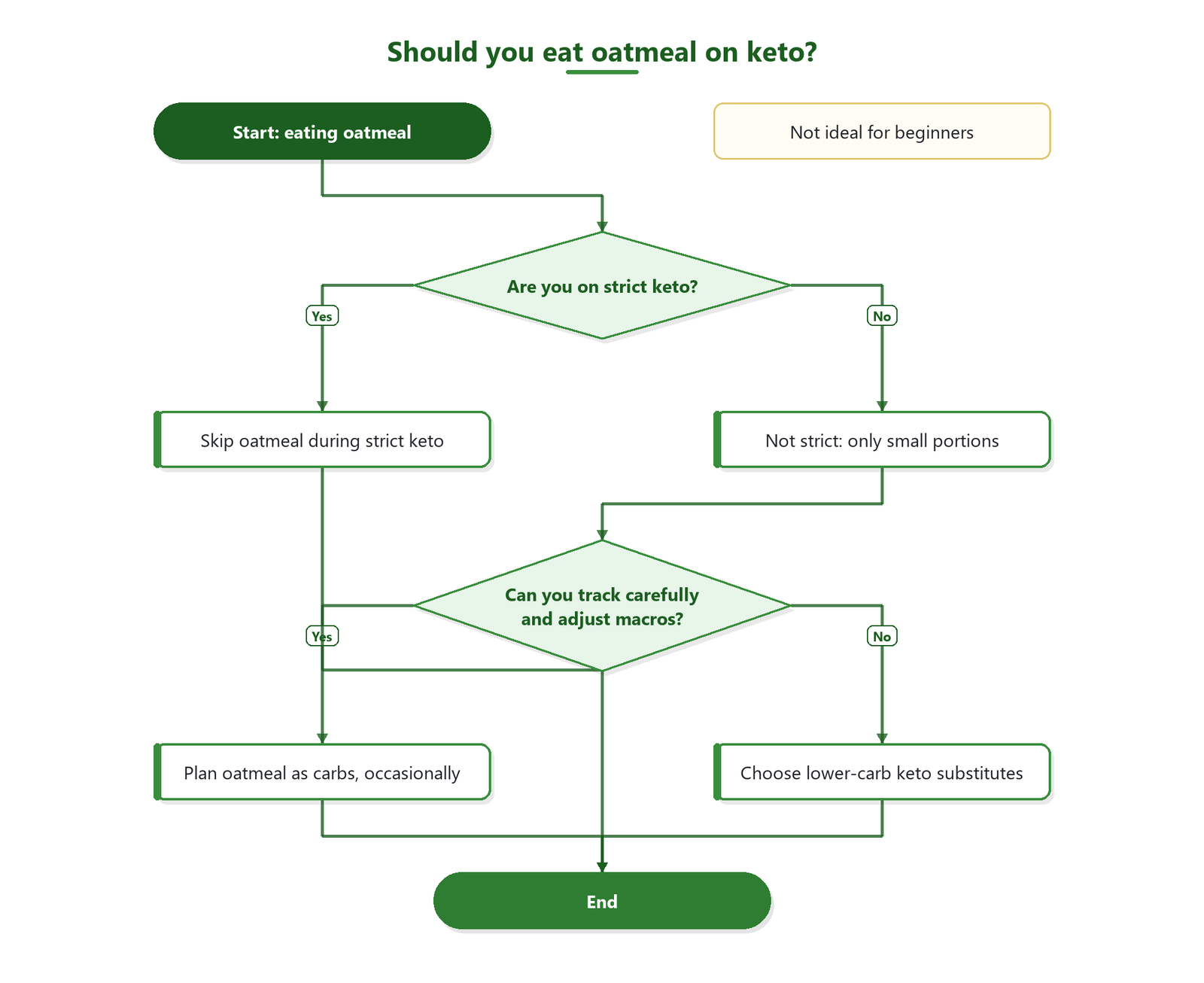
If your goal is weight loss or blood sugar stability, consistency matters. Oatmeal can be a high-leverage variable: one breakfast can change your total carbs for the day, which then changes your results.
Quick scan checklist (save this)
– ☐ Check nutrition facts for carbs per serving
– ☐ Calculate net carbs (and confirm how you’re doing it)
– ☐ Keep the total carbs within your keto daily limit
– ☐ Watch add-ins (milk, sweeteners, fruit, toppings)
– ☐ If you want “oatmeal feel,” choose a lower-carb substitute instead
Frequently Asked Questions
Is oatmeal on a keto diet considered keto-friendly?
Traditional oatmeal is usually not keto-friendly because it’s relatively high in carbohydrates, which can raise blood sugar and make it harder to stay in ketosis. Even when you choose plain or steel-cut oatmeal, most portions still contain more net carbs than typical keto targets allow. If you want keto-friendly eating, it’s better to limit oatmeal and consider low-carb alternatives like chia pudding or flax-based porridge.
How many carbs are in oatmeal, and can it fit into keto macros?
Oatmeal commonly contains about 20–30g of net carbs per cooked 1/2 cup serving (varies by type and brand), which often exceeds the carb allowance for many strict keto diets. Standard keto typically aims for 20–50g total carbs per day, with many people tracking net carbs. Because oatmeal can quickly add up, fitting it into keto usually requires careful portion control and carb tracking—otherwise it can knock you out of ketosis.
Why do some people claim “keto oatmeal” works, and is it really effective?
“Keto oatmeal” products are often marketed as low-carb, but the name can be misleading because they may be made with low-carb thickeners (like almond flour, chia seeds, or flax) rather than real oats. In general, oats themselves are the issue due to their carb content, not just the preparation style. If a product truly uses oats, it’s less likely to fit keto; if it substitutes oat-like ingredients, it may be a better option depending on its net carbs.
Which type of oatmeal is lowest in carbs for keto, quick oats or steel-cut?
Carb counts depend more on the serving size than the oat variety, but quick oats and rolled oats are often processed more, and they can still be high in carbs per serving. Steel-cut oats may have a slightly different texture and cooking time, yet they’re still primarily carbs from oats, so they’re not reliably low enough for keto. For keto, the better approach is typically avoiding oat-based oatmeal altogether rather than switching between oat types.
What are the best keto-friendly alternatives to oatmeal for breakfast?
If you want an oatmeal-like breakfast while staying in ketosis, try chia pudding, flaxseed porridge, Greek yogurt with chia, or a low-carb “oatmeal” made from almond flour and cinnamon. These options can provide fiber and thickness similar to oatmeal with far fewer carbs. Always check nutrition labels for net carbs and keep portions aligned with your keto target to support consistent ketosis.
📅 Last Updated: October 31, 2026 | Topic: is oatmeal on keto diet | Content verified for accuracy and freshness.
References
- https://www.mayoclinic.org/healthy-lifestyle/weight-loss/in-depth/ketogenic-diet/art-20043946
- https://www.health.harvard.edu/diet-and-weight-loss/what-is-the-keto-diet
- https://www.britannica.com/topic/keto-diet
- Ketogenic diet
- Oatmeal
- https://pubmed.ncbi.nlm.nih.gov/?term=ketogenic+diet+carbohydrate+intake
- https://pubmed.ncbi.nlm.nih.gov/?term=oats+glycemic+index
- https://scholar.google.com/scholar?q=ketogenic+diet+carbohydrate+limit Google Scholar
- https://scholar.google.com/scholar?q=keto+diet+oatmeal Google Scholar
- https://scholar.google.com/scholar?q=oats+glycemic+index+beta-glucan Google Scholar