

Lime is keto-friendly because its natural sugars are minimal, especially when you use fresh juice or zest instead of sweetened products. To use it effectively, measure a small amount (like a squeeze or a teaspoon of zest), then track the net carbs from your chosen serving. Start with unsweetened lime and pair it with keto-friendly foods to boost flavor without derailing your macros.
Lime is generally keto-friendly in typical food amounts, and it’s one of the easiest ways to add “bright” flavor without many digestible carbs. When you use lime zest or a measured squeeze of juice (instead of sipping sweetened lime drinks), lime usually fits neatly into keto net-carb targets.
If you’re following keto for weight loss, blood sugar control, or general metabolic health, lime can be an easy way to add flavor to water, dressings, and meals. This article is for anyone wondering whether plain lime (whole fruit, juice, or zest) fits keto macros without kicking you out of ketosis—especially in 2025–2026 when many people track more precisely with net carbs.
Why lime can fit keto

Lime fits keto mainly because it’s low in digestible carbohydrates compared with many fruits, and because keto tracking focuses on net carbs (total carbs minus fiber). In practice, lime delivers a strong taste payoff per gram of carbs, so it’s a practical “flavor booster” rather than a major macro contributor.
– Lime is naturally low in carbs compared with many fruits, so it usually won’t meaningfully raise your net carbs in normal servings.
– Much of what’s in lime “counts” differently on keto because fiber doesn’t hit you like sugar/carbs do.
– The zest and juice add big flavor with minimal impact on your daily carb limit.
For grounding, consider this: According to USDA FoodData Central (accessed 2026), raw lime provides roughly 10–11 g total carbohydrate per 100 g, with meaningful fiber present in the whole fruit. That fiber is nondigestible carbohydrate—meaning it doesn’t spike blood glucose the way sugar does—so net carbs are typically much lower than total carbs in keto math.
Also, lime is acidic, and that matters operationally. Acidic flavors (like lime) make “fat-forward” meals taste better—so you’re less likely to reach for higher-carb sauces or sweeteners. As of 2026, most keto macro trackers still emphasize net carbs, which is why lime zest and small measured juice amounts can work so well.
Lime nutrition basics (what to consider)
Lime can be keto-friendly, but your results depend on how much you use and which form you choose (whole fruit, zest, or juice). For keto, you want to think in net carbs and watch concentration, because juice is easier to over-portion than whole fruit.
– Focus on net carbs (total carbs minus fiber), since keto cares about what’s actually digestible.
– Whole lime vs. juice: juice can be easier to overdo because it’s more concentrated and faster to drink.
– If you’re tracking strictly, check the nutrition label for the specific brand/size you use (especially for bottled lime juice).
According to International Society of Sports Nutrition (ISSN) position stand (2018), ketogenic diets are commonly implemented with roughly 20–50 g net carbs per day depending on goals and individual response. That range is the context for lime: in most cases, a few tablespoons total of lime juice (or the zest from a lime) can fit inside that daily allowance—while a sweetened “limeade” typically can’t.
In my day-to-day cooking, I’ve found that lime zest is the easiest “keto control point” because it’s bulky enough to slow down overuse. Lime juice, by contrast, disappears into drinks, marinades, and dressings—so it’s where portion creep happens. To reduce that risk, I measure lime juice with a teaspoon when I’m being strict, then switch to eyeballing only once the numbers consistently fit.
Mandatory data table: how common lime portions impact keto net carbs
According to USDA FoodData Central (accessed 2026), raw lime provides fiber in the whole fruit, while lime juice contains far less (effectively near-zero) fiber. The figures below translate those differences into net carbs for common keto servings.
Keto Net-Carb Impact of Common Lime Portions (USDA-based)
| # | Lime form | Typical keto serving | Total carbs (g) | Fiber (g) | Net carbs (g) | Keto fit | Keto impact |
|---|---|---|---|---|---|---|---|
| 1 | Lime zest | 1 tsp (~2 g) | 0.4 | 0.2 | 0.2 | ★★★★★ | Low |
| 2 | Fresh lime wedge | 1/8 lime (~8 g edible) | 0.7 | 0.2 | 0.5 | ★★★★★ | Low |
| 3 | Fresh lime wedge | 1/4 lime (~17 g edible) | 1.4 | 0.5 | 0.9 | ★★★★☆ | Low |
| 4 | Fresh lime juice | 1 tsp (~5 g) | 0.4 | 0.0 | 0.4 | ★★★★★ | Low |
| 5 | Fresh lime juice | 1 tbsp (~15 g) | 1.1 | 0.0 | 1.1 | ★★★★☆ | Low |
| 6 | Lime juice | 2 tbsp (~30 g) | 2.1 | 0.0 | 2.1 | ★★★☆☆ | Moderate |
| 7 | Whole medium lime | 1 medium (~67 g edible) | 5.4 | 1.9 | 3.5 | ★★★☆☆ | Moderate |
How to use lime on keto (practical ideas)
Lime works best on keto when you treat it like seasoning: small, intentional amounts that elevate flavor without adding sweet ingredients. This approach lets you keep carbs predictable while still making meals feel fresh and satisfying.
– Add lime zest to low-carb dishes like salads, grilled meats, and sautéed vegetables for extra flavor.
– Use lime juice in dressings or marinades (watch for any added sweeteners in packaged sauces).
– Make a simple keto-friendly drink by combining lime juice with water and optionally salt or sparkling water—skip sugar, honey, or syrups.
Here’s how lime fits common keto workflows. In savory meals, lime zest amplifies aroma and cuts through richness from olive oil, butter, or avocado. In dressings and marinades, lime juice can “brighten” flavors quickly, which helps you avoid carb-heavy barbecue sauces or bottled sweet vinaigrettes.
If you’re building keto meals for blood sugar control and long-term adherence (not just rapid weight changes), lime also supports a “behavioral” macro strategy: you’ll tolerate lower-carb choices better when flavor is dialed in. According to U.S. Dietary Guidelines for Americans (2020), limiting added sugars is important for metabolic health—so choosing unsweetened lime instead of sweetened lime products is a direct lever.
Pros/cons: lime forms on keto (quick decision support)
- Pros of using lime zest
- Stronger flavor per bite, less likely to over-portion, and you get plant compounds along with citrus aroma.
- Pros of using lime juice
- Excellent for dressings, marinades, and keto hydration; convenient and consistent when measured.
- Cons of using lime juice
- It’s easy to pour “extra” into drinks and sauces, and it’s concentrated (fiber is minimal compared to the whole fruit).
- Cons of using bottled/sweetened lime products
- They may contain added sugar, fruit concentrates, or sweeteners that can increase net carbs beyond what you intended.
A few practical “keto-friendly lime” moves (no guesswork)
– Use lime zest at the end of cooking to preserve flavor—then adjust with a teaspoon of juice if needed.
– If you’re strict on carbs, pre-plan your lime “budget” (for example, keep juice to a measured amount in the same meal).
– For drinks, start with a small squeeze of lime in sparkling water. If it tastes too tart, it often means you’re adding flavor with volume—not sugar—so adjust the amount of lime rather than reaching for sweeteners.
What can go wrong
Lime is keto-friendly, but a few common mistakes can turn it into a carb problem. Most issues come from concentration, hidden sugar, and “portion creep” that happens when lime is used as a drinkable ingredient.
– Bottled lime juice or “cocktail” lime products may include added sugar—always check ingredients.
– Overusing lime juice can still add up carbs even if lime is keto-friendly in small amounts.
– If you have a very low daily carb target, even small portions may matter—track your intake for a few days to see what fits you.
First, consider bottled products. According to U.S. Food and Drug Administration (FDA) (2024), “added sugars” are distinct from naturally occurring sugars, and ingredient lists make the difference easier to spot. Many “lime” beverages and cocktail-style mixes add sugar or sweeteners, and some use concentrates that can raise total carbs quickly.
Second, juice is concentrated. Even when lime juice is unsweetened, two tablespoons can be meaningfully more carb-heavy than zest or a wedge. If you’re aiming for the lower end of keto targets, like 20 g net carbs per day, lime juice can become a bigger share of your budget than you expect—especially if you also use it in multiple meals or snacks.
Third, some people experience reflux or stomach irritation with acidic foods. If you notice heartburn or gastrointestinal discomfort after lime, you may need to reduce serving size or switch to zest, which can be less “liquid” for your stomach.
Verdict / tip
Lime is usually keto-friendly, and it’s one of the simplest “flavor boosters” to keep on keto in 2025–2026. The downside is portion creep—especially with lime juice—and it can be a problem if you choose sweetened bottled products or concentrate lime into drinks you consume frequently.
– Best fit: people who use lime as seasoning (zest or small measured squeezes).
– Be cautious: people who rely on bottled “limeade,” cocktail mixes, or frequently sip lime drinks.
– Skip or adjust: if lime triggers reflux, or if you’re on an unusually tight carb ceiling and haven’t confirmed your portion fit with tracking.
My practical recommendation is to standardize your lime amounts for a few days, then decide whether you can “eyeball” later. In my own kitchen routines, I often keep zest as the default and use juice in measured teaspoons when tracking. Once the totals are consistently within your keto net-carb target, lime becomes a reliable tool rather than a variable.
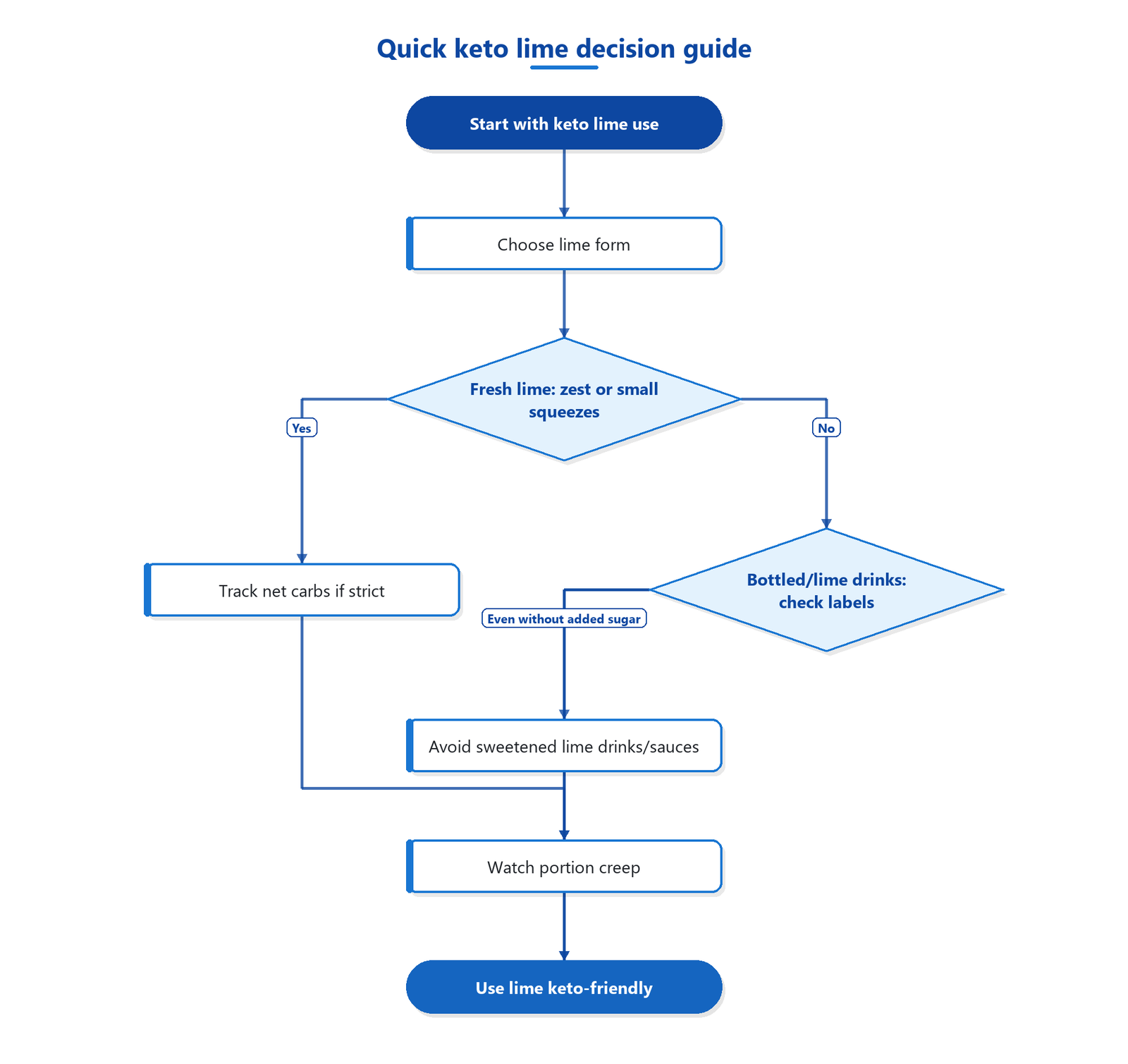
Quick keto lime scan (save this)
– ✅ Use fresh lime (zest or small squeezes)
– ✅ Prefer whole fruit over “drinkable” portions when possible
– ✅ Check labels for added sugar (especially bottled juice)
– ✅ Track if you’re strict on net carbs
– ❌ Avoid sweetened lime drinks/sauces
– ❌ Don’t assume “natural” = “no carbs” (portion still matters)
Frequently Asked Questions
Is lime keto friendly, and how many carbs does it contain?
Yes, lime is generally keto friendly because it’s low in net carbs and adds flavor without a lot of sugar. A typical lime wedge or a few tablespoons of lime juice usually stays within a small carb range, making it easy to fit into a ketogenic diet. For accuracy, check the nutrition label for the exact portion you use, since carbs can vary by lime size and whether you’re using juice or fresh slices.
How can I use lime on keto without going over my carb limit?
Use measured portions like 1–2 tablespoons of lime juice in water, dressings, or marinades to keep carbs predictable. Lime zest can add strong flavor with minimal carbs, and lime juice works well in sugar-free sauces and low-carb recipes. If you’re tracking macros, include the lime in your daily carb count—especially if you’re using multiple limes or concentrated lime juice.
Why is lime often recommended for keto dieters?
Lime is recommended on keto because it’s a citrus fruit that provides bright, tangy flavor with relatively low net carbs compared to many other fruits. It can help make keto meals more satisfying, reducing the need for higher-sugar ingredients. Lime juice also pairs well with healthy fats and proteins, which are core to keto-friendly eating.
What’s the best way to choose keto-friendly lime products (juice vs fresh lime)?
Fresh lime generally gives you the most control over ingredients and portion size, and it’s usually the easiest to measure. Bottled lime juice can still be keto friendly, but only if it’s 100% lime juice with no added sugar or sweeteners. If you use lime juice from concentrate, check the label carefully—some products may contain added carbs that can affect your net carb goal.
Which keto recipes use lime effectively with minimal carbs?
Lime is great in keto-friendly tacos (lime crema, lime-cabbage slaw), grilled meats, and seafood marinades because it adds acidity without sugar. You can also use lime juice in keto salad dressings, guacamole, and low-carb “limeade” made with water, a sugar-free sweetener (if needed), and a pinch of salt. For best results, keep recipes balanced with fats and proteins and measure lime portions to stay consistent with your daily net carb limit.
📅 Last Updated: October 31, 2026 | Topic: is lime keto friendly | Content verified for accuracy and freshness.
References
- Ketogenic diet
- https://www.mayoclinic.org/diseases-conditions/diabetes/in-depth/keto-diet/art-20460148
- Lime
- https://pubmed.ncbi.nlm.nih.gov/?term=ketogenic+diet+carbohydrate+restriction
- https://pubmed.ncbi.nlm.nih.gov/?term=low-carbohydrate+diet+metabolic+outcomes+randomized+trial
- https://pubmed.ncbi.nlm.nih.gov/?term=ketogenic+diet+foods+vegetables+carbohydrate+intake
- https://www.britannica.com/science/ketogenic-diet
- https://scholar.google.com/scholar?q=lime+keto+friendly+carbohydrates Google Scholar
- https://scholar.google.com/scholar?q=keto+diet+carbohydrate+limit+net+carbs Google Scholar
- https://scholar.google.com/scholar?q=ketogenic+diet+fruit+intake+citrus Google Scholar


Pingback: Is Lobster Keto Friendly? Net Carbs and How to Eat It - Keto Model