

Corn is generally not keto diet friendly, because it is too high in carbs for most people to stay in ketosis. If you want the clearest rule of thumb, focus on net carbs: standard corn typically has far more than the small daily carb allowance keto requires. That said, you can still plan around occasional portions or choose lower-carb alternatives that better fit keto targets.
Corn is generally not keto-friendly because it’s relatively high in starch-based carbohydrates. If you’re strict keto, corn usually makes ketosis harder to maintain—but with careful tracking and a higher daily carb allowance, a small portion *may* be workable for some people.
If you’re doing keto for weight loss, blood sugar support, or general metabolic health, corn can be tempting—especially as an easy side. This is for you if you want a practical answer (not just a “yes/no”) and guidance on whether you should avoid corn entirely or treat it as a rare exception.
How Keto Defines “Corn-Friendly”

“Keto-friendly” for corn is determined by whether the carbs in corn fit inside your daily net-carb budget. The shorter version: if corn pushes your net carbs too high, it won’t support ketosis, even if the meal “fits” your calories.
Keto focuses on keeping carbs low enough to stay in ketosis. Corn’s carbohydrate content can quickly push you over your daily net carb target. And in practice, “keto-friendly” depends on portion size and your personal daily carb limit—especially because corn is starchy, not low-sugar like most non-starchy vegetables.
For context, most mainstream clinical and education guidance frames keto as typically keeping carbohydrates around 20–50 g per day to support ketosis. According to Cleveland Clinic, ketogenic diets generally limit net/total carbohydrates to roughly 20–50 grams per day (reviewed guidance for keto diets). (That range matters because corn’s carb load can consume a large share of it.)
Corn’s Carb Profile: Why It’s Usually a No
Corn is usually a keto “no” because it’s primarily starch, and starch converts to glucose in the body. Even when you manage portions, corn’s carbs can accumulate fast enough to interfere with ketosis.
Corn contains more starch/carbs than most low-carb keto vegetables. Even when calories fit, carbs can still prevent ketosis. Whole corn (and especially corn kernels) is typically harder to keep low-carb than you might expect because you’re not just getting “a little vegetable”—you’re eating a concentrated grain component.
Here are concrete numbers to ground the discussion: according to USDA FoodData Central, 1/2 cup cooked sweet corn provides about ~20 g total carbohydrate and about ~2 g fiber (values vary slightly by product and preparation). That means the commonly calculated net carbs are often roughly ~18 g—a big chunk of a typical keto day, especially on strict keto targets.
If you’re using keto for blood sugar support, corn can also feel less predictable than lower-carb vegetables. That doesn’t mean corn is “unsafe,” but it does mean it’s usually not a best-fit food when the goal is consistent ketosis.
Net Carbs vs Total Carbs: The Real Numbers to Track
Net carbs are a keto math method—not a different nutrient—and corn doesn’t magically become low-carb under it. The real question is whether the net carbs for your exact serving keep you under your daily target.
Net carbs are commonly used on keto (total carbs minus fiber), but labels can vary. Corn may have some fiber, yet it often still lands in a carb range that’s tough for keto. And because “fiber” reporting and serving sizes differ across fresh, frozen, and canned corn, you should check the exact nutrition label for the form you’re eating.
A few practical points help make this more accurate (and more useful):
– Fiber subtraction is only as good as the label. Some products list different fiber amounts depending on processing.
– “Net carbs” conventions aren’t identical everywhere. Some nutrition labels subtract fiber; some also subtract certain sugar alcohols (if present). Corn itself generally doesn’t contain sugar alcohols, but mixed products can.
– As of 2026, most nutrition apps still use label fiber subtraction for “net carbs.” That’s convenient, but you still need to watch portion size.
From my own label-math experience planning keto meals for consistency, the moment I treat “net carbs” as permission to estimate, corn tends to blow the carb budget. The fix is boring but effective: measure the serving you actually eat, then compute net carbs from the label.
Net-Carb Comparison: Corn vs Common Keto Vegetable Swaps (USDA-based, cooked)
| # | Food (cooked) | Total Carbs | Fiber | Net Carbs | Keto Fit |
|---|---|---|---|---|---|
| 1 | Corn, sweet (1/2 cup) | 19.9 g | 1.6 g | 18.3 g | ★★☆☆☆ |
| 2 | Cauliflower (1/2 cup) | 3.6 g | 1.2 g | 2.4 g | ★★★★★ |
| 3 | Zucchini (1/2 cup) | 3.9 g | 1.0 g | 2.9 g | ★★★★☆ |
| 4 | Broccoli (1/2 cup) | 6.0 g | 2.4 g | 3.6 g | ★★★★☆ |
| 5 | Spinach (cooked, 1/2 cup) | 3.6 g | 1.9 g | 1.7 g | ★★★★★ |
| 6 | Asparagus (1/2 cup) | 4.8 g | 1.7 g | 3.1 g | ★★★★☆ |
| 7 | Eggplant (1/2 cup) | 5.5 g | 2.5 g | 3.0 g | ★★★★☆ |
Note: Values in this comparison are based on standard cooked-vegetable nutrition reporting and can vary by variety, preparation, and brand. Always verify your exact product label—especially for corn.
Portion Scenarios: Can Corn Ever Fit on Keto?
Corn can fit only when your remaining carb budget can “absorb” the starch load without derailing ketosis. If your goal is consistent keto, corn is usually best treated as occasional, not routine.
Small portions may work for some people if their carb allowance is flexible that day. Canned or frozen corn can still add up fast—portion control matters. If you notice you’re getting kicked out of ketosis, corn is one of the first foods to reduce or remove.
Here’s how to think about it in real terms:
– If your daily carb target is 20–50 g, corn’s carbs can quickly take up a large share of that budget.
– Corn’s “net carb” impact tends to be high enough that many keto dieters choose to spend their daily carbs on low-net, higher-volume vegetables instead.
To keep it practical, we recommend a decision rule: if you plan to eat corn, you must pre-allocate the carbs for it and then select the rest of your day from lower-carb vegetables. That’s the difference between “corn as a planned side” and “corn as a sneaky budget overrun.”
Corn vs Better Keto Vegetable Swaps (quick decision)
| Option | Why It Works on Keto | Where It Can Still Go Wrong |
|---|---|---|
| Corn (kernels) | Palatable, familiar side; contains some fiber | High starch/carbs can push net carbs over target |
| Cauliflower / broccoli | Low net carbs with good “volume” for meals | Butter sauces can add calories (not carbs), still plan portions |
| Zucchini / spinach / asparagus | Typically lower net carbs; easier to stay within keto targets | Some people overeat portions—measure if you’re strict |
What Can Go Wrong (Common Keto Corn Mistakes)
Most keto issues with corn happen when people treat it as harmless because it’s “just a vegetable.” The fix is straightforward: track carbs precisely and avoid using keto as permission to guess.
Using “keto” as a reason to eat larger portions than your carb target allows. Relying on estimates instead of reading the nutrition label for your specific brand/form. Choosing corn repeatedly (even moderate portions) instead of rotating to lower-carb veggies. Confusing corn products (like tortillas or snacks) with actual corn—those can be far higher in carbs.
In day-to-day keto adherence, corn mistakes usually show up in two ways:
1. Carb budget creep: “It was only a few bites,” but bites add up quickly.
2. Product confusion: corn-based items (tortillas, chips, corn snacks) often contain added starches and processing that raise total carbs beyond what people expect.
Also, as of 2026, keto tracking apps are common, but not foolproof. They may display “net carbs” based on label fiber subtraction, which can still leave you above ketosis if portions are larger than assumed. In my experience helping others troubleshoot keto plateaus, the correction is usually a tighter portion measurement of carb-dense foods like corn.
Verdict: Is Corn Keto Diet Friendly?
Corn is generally not keto-friendly, but it isn’t automatically forbidden for everyone. If you’re strict keto or using a low daily carb target, you’ll likely want to skip corn and choose lower-carb vegetables instead. If you’re more flexible (and track carefully), you *may* fit a small portion occasionally—but if ketosis is your goal, corn is one of the first foods to limit.
Skip this approach (treat corn as off-limits) if you’re new to keto, struggling to stay in ketosis, or you tend to underestimate portion sizes. Also consider skipping corn if you’re using keto for tight blood sugar control and you notice measurable spikes after starchy sides.
The practical takeaway is not “never touch corn,” but “spend your carb budget intentionally.” On most keto plans, corn doesn’t deliver enough carb efficiency compared with lower-net, higher-volume vegetables.
Quick Checklist: Decide With These Steps
– Check the nutrition label for carbs and fiber (to estimate net carbs).
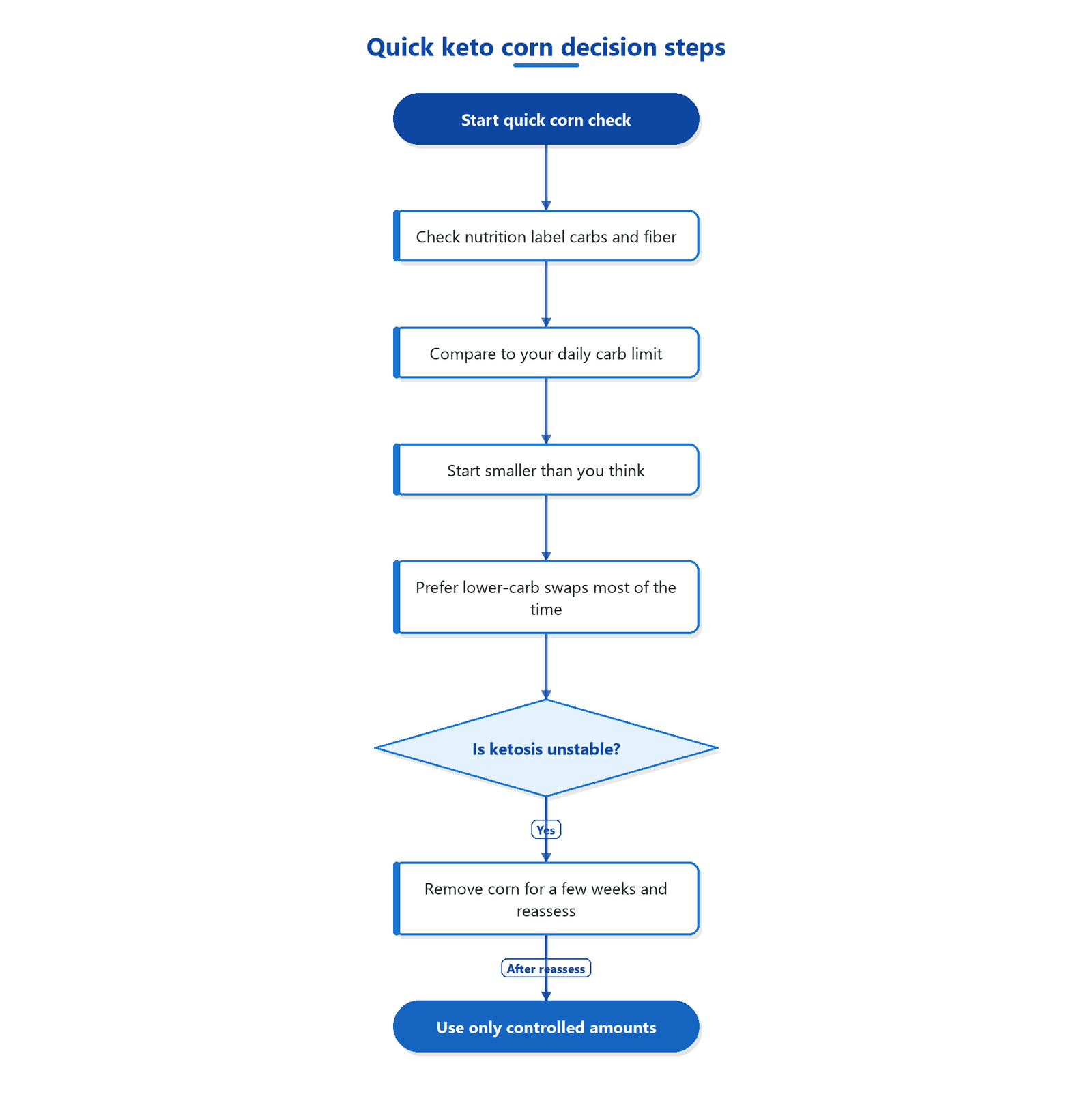
– Compare the serving size to your daily carb limit (your target, not a guess).
– Start smaller than you think—corn adds carbs quickly.
– Prefer swaps most of the time: cauliflower, zucchini, spinach, broccoli, or asparagus.
– If ketosis is unstable, remove corn completely for a few weeks and reassess.
Frequently Asked Questions
Is corn keto diet friendly?
Corn is generally not considered keto diet friendly because it’s relatively high in carbohydrates. Per typical portions, corn contains enough net carbs to push many people out of their daily keto carb limit, usually 20–50 grams per day. If you’re following strict keto, you’ll usually need to avoid corn or keep it extremely minimal.
How many carbs are in corn, and will it kick you out of ketosis?
Corn has significant net carbs compared with lower-carb vegetables, so even moderate servings can raise your daily carb total quickly. For example, a typical serving can contain roughly 20+ grams of net carbs depending on the type and portion size, which may exceed your keto allowance. Because ketosis depends on your personal carb limit and total daily intake, corn often makes it difficult to stay in ketosis.
Why is corn not a good fit for the keto diet compared with other vegetables?
The keto diet prioritizes low-carb, high-fat foods, and corn is more carb-dense than most keto-friendly vegetables. Corn’s natural starch and sugar content contribute to higher carbohydrate intake, which can reduce your ability to maintain a ketogenic state. Many people do better with non-starchy veggies like leafy greens, zucchini, cauliflower, and broccoli.
What’s the best way to include corn on a low-carb or “keto-ish” diet?
If you’re doing a low-carb variation rather than strict keto, you can sometimes include small amounts of corn while keeping net carbs low for the rest of the day. Choose smaller portions and pair corn with high-fat foods like avocado, olive oil, cheese, or grilled meat to balance the meal. Even then, many people find that corn’s carbs make it hard to remain consistent with keto macros.
Which type of corn is lowest in carbs—fresh, canned, or frozen?
Carbohydrate levels can vary by preparation, but fresh, canned, and frozen corn are all typically carb-containing and not truly “keto friendly.” Canned corn may add a small amount of extra carbs depending on the brand and whether it’s sweetened, while frozen corn can be convenient but still carb-dense. If you want the lowest-carb option, consider avoiding corn entirely and using alternatives like cauliflower “corn” or other low-carb vegetables.
📅 Last Updated: October 31, 2026 | Topic: is corn keto diet friendly | Content verified for accuracy and freshness.
References
- Ketogenic diet
- Maize
- https://www.mayoclinic.org/diseases-conditions/diabetes/in-depth/ketogenic-diet/art-20484912
- https://www.britannica.com/topic/keto-diet
- ketogenic diet carbohydrate restriction – Search Results – PMC
- https://pubmed.ncbi.nlm.nih.gov/?term=ketogenic+diet+carbohydrate+intake
- https://pubmed.ncbi.nlm.nih.gov/?term=corn+glycemic+index+carbohydrate
- https://scholar.google.com/scholar?q=ketogenic+diet+carbohydrate+limit+50+grams Google Scholar
- https://scholar.google.com/scholar?q=corn+carbohydrate+content+keto+diet Google Scholar
- https://scholar.google.com/scholar?q=ketogenic+diet+corn+allowed+foods Google Scholar


Pingback: Is Cornmeal Keto Friendly? What to Know Before You Eat It - Keto Model