
To successfully calculate your macros for the keto diet, you must first ascertain your daily calorie needs and establish the appropriate ratio of fats, proteins, and carbohydrates. Understanding these components is crucial for tailoring your macronutrient intake to your personal health goals. This guide will walk you through the process of breaking down your macros, ensuring you remain aligned with your keto objectives while promoting overall well-being.
Understanding Macronutrients

Macronutrients, commonly referred to as “macros,” consist of three primary categories: fats, proteins, and carbohydrates. Each plays a vital role in the context of the keto diet, which is characterized by a high-fat, low-carbohydrate approach aimed at inducing a state of ketosis.
– Fats: The cornerstone of the keto diet, fats should make up approximately 70% of your daily caloric intake. They provide energy, support cellular function, and help to absorb essential vitamins. Healthy fat sources include avocados, olive oil, nuts, and fatty fish, all of which contribute to satiety and sustained energy levels.
– Proteins: Comprising about 25% of your macros, proteins are essential for muscle repair and growth, hormone production, and immune function. Quality protein sources on a keto diet include grass-fed beef, poultry, eggs, and plant-based options like tofu and tempeh. Adequate protein intake helps prevent muscle loss while on a calorie deficit.
– Carbohydrates: Making up only about 5% of your daily intake, carbohydrates are limited in the keto diet to maintain ketosis. The small amount of carbs you do consume should come from non-starchy vegetables, nuts, and seeds, which provide fiber, vitamins, and minerals without spiking insulin levels.
Understanding the role of these macronutrients is fundamental to successfully implementing and maintaining a keto lifestyle.
Calculating Your Daily Caloric Needs
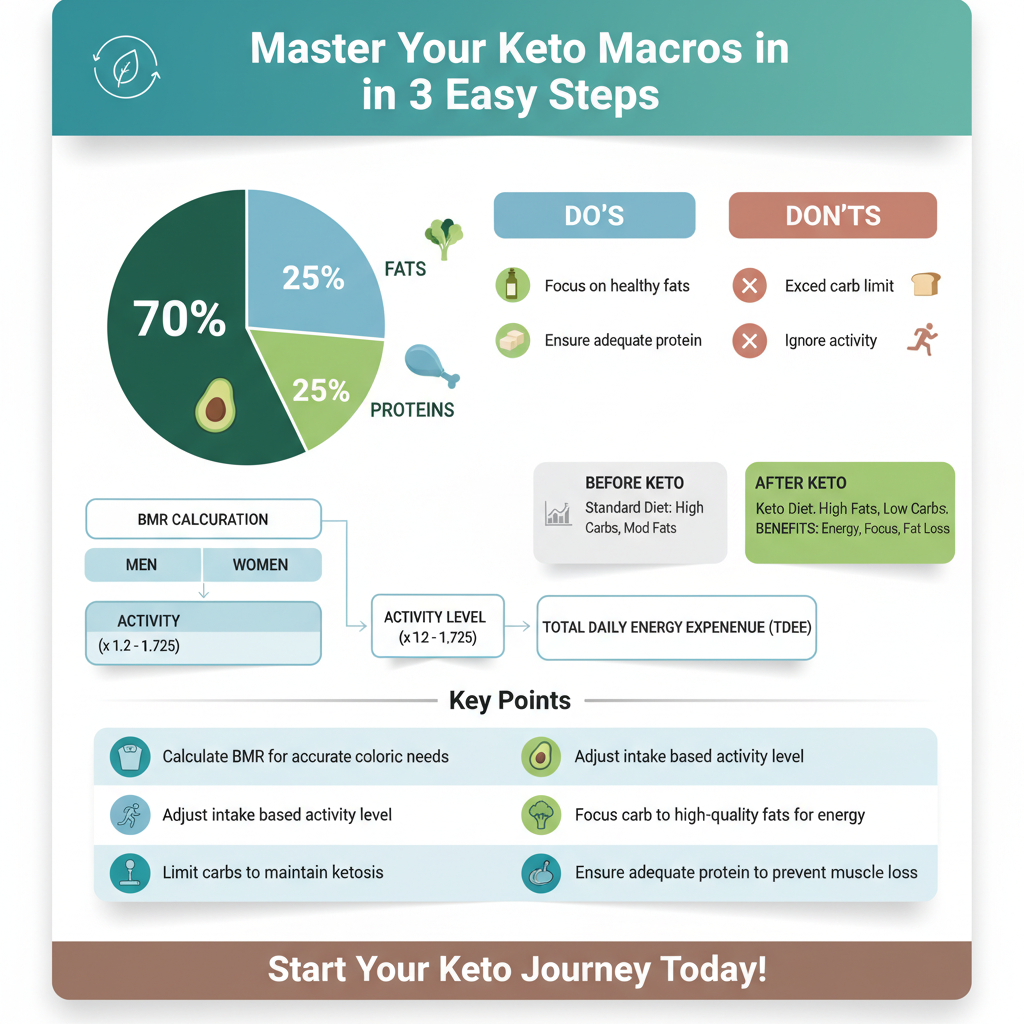

To determine your macros effectively, it is essential to first calculate your Total Daily Energy Expenditure (TDEE). TDEE represents the total number of calories you burn in a day, factoring in your basal metabolic rate (BMR) and your activity level.
The Mifflin-St Jeor equation is a commonly used method to estimate BMR:
– For men: BMR = 10 × weight (kg) + 6.25 × height (cm) – 5 × age (y) + 5
– For women: BMR = 10 × weight (kg) + 6.25 × height (cm) – 5 × age (y) – 161
Once you have calculated your BMR, multiply it by an activity factor to estimate your TDEE:
– Sedentary (little or no exercise): BMR × 1.2
– Lightly active (light exercise/sports 1-3 days/week): BMR × 1.375
– Moderately active (moderate exercise/sports 3-5 days/week): BMR × 1.55
– Very active (hard exercise/sports 6-7 days a week): BMR × 1.725
– Super active (very hard exercise/sports & a physical job): BMR × 1.9
This TDEE serves as a baseline to adjust your caloric intake based on your specific weight goals, such as maintenance, weight loss, or muscle gain.
Determining Your Macro Ratios
Once you have established your daily caloric needs, the next step is determining your macro ratios. The standard ketogenic macro ratio is approximately 70% fats, 25% proteins, and 5% carbohydrates. However, this ratio can be adjusted depending on your personal goals.
For instance, if your primary objective is weight loss, you may stick closely to this standard ratio. Conversely, if you are focusing on muscle gain or maintaining muscle while losing fat, you might increase your protein intake to about 30% and slightly decrease fat consumption while still keeping carbs low. Always consider individual factors such as age, gender, activity level, and metabolic health when tailoring these ratios.
To calculate your macros in grams, use the following formulas:
1. Fats: (Calories × 0.70) ÷ 9 = grams of fat
2. Proteins: (Calories × 0.25) ÷ 4 = grams of protein
3. Carbohydrates: (Calories × 0.05) ÷ 4 = grams of carbohydrates
Using these calculations ensures that your macronutrient distribution aligns with your dietary objectives.
Tools and Resources for Tracking Macros
Tracking your macros can be made simpler with the use of various apps and tools. Some popular choices include:– MyFitnessPal: This app allows users to log food intake, track calories, and monitor macro ratios effectively. Its extensive food database makes it easy to find and add various foods.
– Cronometer: This tool provides a detailed breakdown of not just macros but also vitamins and minerals, giving a fuller picture of your nutritional intake.
Additionally, understanding how to read nutrition labels is crucial. Learn to identify serving sizes, total calories, and the breakdown of fats, carbohydrates, and proteins. Familiarizing yourself with portion sizes through visual aids or measuring tools can further enhance your accuracy in macro tracking.
Adjusting Your Macros Over Time
The keto diet is not a one-size-fits-all approach; thus, monitoring your progress is essential for long-term success. As you follow the diet, keep an eye on your weight, energy levels, and overall health. If you encounter a weight loss plateau or feel fatigued, it may be time to reassess your macro ratios.
Signs that you might need to adjust your macros include persistent cravings, low energy levels, or stagnation in weight loss. In such cases, consider slightly increasing your fat intake or modifying your protein levels to better suit your body’s needs.
Overcoming Common Challenges
Starting the keto diet can present several obstacles, particularly for those new to macro counting. Common pitfalls include the presence of hidden carbohydrates in packaged foods or underestimating portion sizes.
To combat these challenges, educate yourself on common sources of hidden carbs and develop a habit of meal prepping. This way, you can ensure you have keto-friendly meals readily available, reducing the temptation to reach for non-compliant foods. Furthermore, joining a keto community, whether online or in-person, can provide the motivation and support necessary to stay committed to your macro goals.
In addition, maintaining a positive mindset and setting realistic goals can help you navigate the initial hurdles of the keto lifestyle.
By understanding your body’s needs and using the right tools, calculating macros for the keto diet can become a manageable and rewarding process. Begin tracking your macros today, whether by using a macro calculator or engaging with a supportive keto community. Embrace this journey toward better health, and watch as your dedication yields the results you desire.
Frequently Asked Questions
What are the basic macronutrient ratios for a keto diet?
The standard macronutrient ratios for a ketogenic diet typically consist of approximately 70-75% fats, 20-25% protein, and only about 5-10% carbohydrates. This high-fat, low-carb approach is designed to induce ketosis, a metabolic state where your body burns fat for fuel instead of carbohydrates. Understanding these ratios is crucial for successfully achieving and maintaining ketosis, allowing you to plan meals and snacks effectively.
How do I calculate my personal macro needs for a keto diet?
To calculate your personal macro needs for a keto diet, start by determining your daily caloric intake based on your age, weight, height, and activity level. Use an online calculator to estimate your total daily energy expenditure (TDEE), then set your calorie goal for the keto diet. From there, apply the standard macronutrient ratios—70% of your calories from fat, 25% from protein, and 5% from carbs—to find your specific grams of each macro per day.
Why is it important to track macros on a keto diet?
Tracking macros on a keto diet is essential because it helps ensure that you stay within the specific carbohydrate limits needed to maintain ketosis. By monitoring your intake of fats, proteins, and carbohydrates, you can optimize your diet for fat loss, energy levels, and overall health. Additionally, tracking allows you to identify patterns and make adjustments as necessary, which is vital for long-term success on the ketogenic journey.
What tools or apps are best for tracking macros on a keto diet?
Some of the best tools for tracking macros on a keto diet include apps like MyFitnessPal, Cronometer, and Carb Manager. These apps allow you to input foods, track your daily intake, and monitor your macro ratios effectively. Many of them also provide a database of keto-friendly foods, making it easier to stick to your dietary goals while ensuring you get the right nutrients.
Which foods are highest in healthy fats for a keto diet?
Foods that are high in healthy fats and suitable for a keto diet include avocados, olive oil, coconut oil, nuts (such as macadamia and pecans), seeds (like chia and flaxseeds), fatty fish (like salmon and mackerel), and full-fat dairy products (such as cheese and heavy cream). Incorporating these foods into your diet not only helps you meet your macro goals but also provides essential nutrients that support overall health while on a ketogenic diet.
References
- https://www.ncbi.nlm.nih.gov/pmc/articles/PMC6480554/
- https://www.healthline.com/nutrition/keto-diet-101
- https://www.mayoclinic.org/healthy-lifestyle/nutrition-and-healthy-eating/expert-answers/ketogenic-diet/faq-20404844
- https://www.webmd.com/diet/what-is-the-ketogenic-diet
- https://www.cdc.gov/healthyweight/assessing/bmi/adult_bmi/english_bmi_calculator/interactive_bmi_calculator.html
- https://www.nutrition.gov/topics/whats-your-nutritional-needs/keto-diet
- https://www.verywellfit.com/what-is-the-keto-diet-5115455