

Magic Spoon is usually keto-friendly for strict carb counters, provided you portion it and pick the flavor that stays low in carbs. Because keto success depends on hitting your daily net-carb limit, check the label for carbs per serving and subtract fiber when applicable. If a serving pushes you over your threshold, it is not keto-ready for your plan.
Magic Spoon may work for keto in some cases, but it’s not automatically keto—your fit depends on the exact net carbs per serving and your personal daily keto limit. The fastest way to tell is to read the nutrition label for the flavor you want, calculate net carbs (if you track that way), and compare that to your remaining carbs for the day—especially if you’re trying to stay in ketosis in 2026.
If you’re doing keto for weight loss, blood sugar control, or staying in ketosis, this is for you—especially if you’re considering Magic Spoon as a cereal or snack. It’s also useful if you’ve tried “low sugar” products before and found they still knocked you out of ketosis.
Keto basics: how to decide if it’s “keto”
Keto is mainly about keeping net carbs low enough to maintain ketosis, not about whether a product is marketed as “healthy” or “low sugar.” In 2026, more people are tracking consistently than ever, but the labels are still where keto success is won or lost.
– Keto is mainly about keeping net carbs low enough to maintain ketosis (your personal limit may vary). For many people, ketosis is commonly associated with carbohydrate restriction—often in the ballpark of 20–50 g of total carbs per day depending on the approach and the person. According to the International Society of Sports Nutrition (ISSN) position stand (2018), ketosis is typically achieved by restricting carbohydrate intake to roughly 20–50 g/day.
– The label matters: look for total carbs, fiber (so you can calculate net carbs), and serving size. The nutrition label also standardizes key macro components like total carbohydrate and dietary fiber by weight (grams per serving), which makes tracking feasible. According to FDA Nutrition Facts labeling rules finalized in 2016, dietary fiber is required to be declared on the label when present in meaningful amounts (2016).
– “Low sugar” doesn’t guarantee keto—many “diet” foods can still be carb-heavy. “Sugar” is only one portion of total carbohydrates; starches, even “bakery-style” ingredients, still contribute carbs and can stall ketosis.
Does Magic Spoon fit keto? Start with the label math
Magic Spoon can fit keto if—after you do the label math—net carbs per serving land below your daily target. Don’t guess based on the word “keto” or “low sugar”; use the nutrition facts you have in front of you.
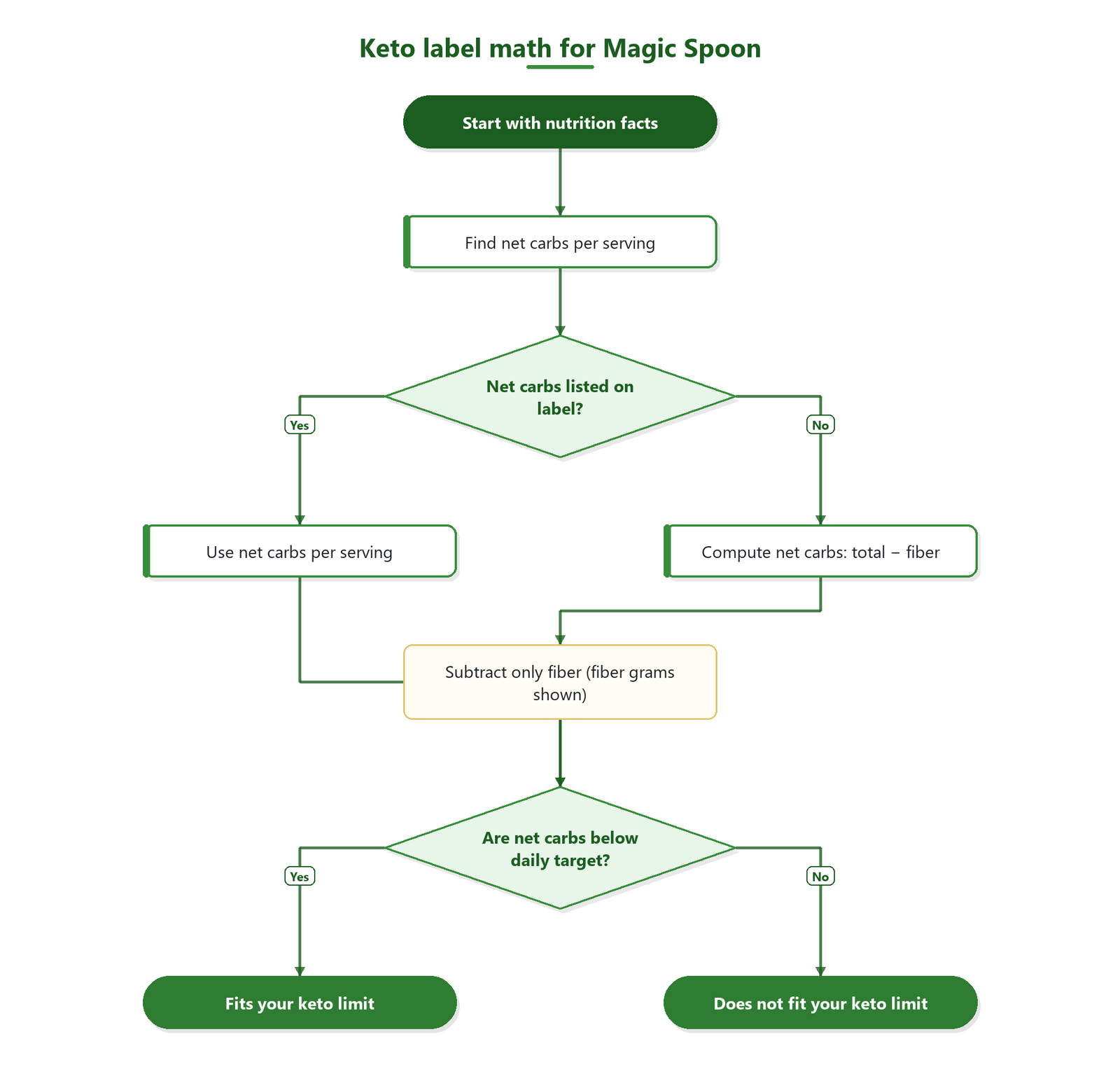
– Find the net carbs per serving on the Magic Spoon nutrition facts panel: .
– If the label doesn’t list “net carbs,” many keto trackers use: net carbs = total carbs − fiber (only subtract fiber, and only if fiber grams are clearly listed on the label).
– A reminder on calories: each gram of carbohydrate carries 4 kcal, which helps explain why carb creep matters across the day. According to the USDA FoodData Central nutrient documentation (2019), carbohydrate energy is 4 kcal per gram (2019).
– Compare that number to your daily net-carb target (example: ).
– Common net-carb targets for ketosis vary by person, but many people aim somewhere in the range of ~20–30 g net carbs/day for stricter adherence, while others experiment toward ~40–50 g net carbs/day depending on their response and goals. (Your best target is the one that keeps you in ketosis consistently—often confirmed with how you feel and/or by ketone testing.)
– Adjust servings if needed: if one serving is too high, some keto eaters reduce the portion and track totals carefully.
– This is where keto cereal can surprise people: “one serving” on a box can still be larger than what you’d naturally pour. If your goal is ketosis, your serving strategy matters as much as the product.
Keto-fit reality check: where “net carbs” can mislead
Net carbs aren’t an FDA-defined standard the way total carbohydrates are. That means two keto-friendly-looking foods can diverge depending on how fiber is handled, whether sugar alcohols are present, and how your body responds. If you want the most reliable approach, stick to the label math that you can reproduce consistently—especially in 2026 when many labels update formulations.
Ingredients to watch when you’re trying to stay keto
If Magic Spoon is keto-friendly for you, it’s usually because the total carb impact is controlled—not because individual ingredients are “keto.” Ingredient scrutiny is still worth it because certain add-ins can quietly raise carbs or trigger cravings.
– Watch for carbohydrate sources that can add up quickly (even “healthy” ingredients can be carb-dense). In cereals, pay attention to ingredients that function like grains or starches, because even small amounts can be meaningful once you eat multiple servings.
– Pay attention to sweeteners and starches listed on the ingredient panel; some products use ingredients that may raise carbs for keto. Even if sugar is low, starches and some sweeteners can contribute to total carbohydrate grams—so always use the nutrition facts, then evaluate the ingredient list for “why.”
– If the label lists sugar alcohols, note that some people still count them toward effective carbs depending on their sensitivity.
Practical reading tip (what I’d check before anyone eats)
From my day-to-day approach to carb tracking (and what I recommend to readers who want ketosis consistency), I first verify total carbs + fiber + serving size, then I look at ingredients only to explain why the numbers are what they are.
What can go wrong (and why keto people get surprised)
Most keto failures with “low sugar” foods come down to a few repeatable issues. The good news is they’re also fixable once you’re aware of them.
– Relying on marketing claims instead of net carbs per serving—this is the most common mistake. “Keto-friendly” language can be promotional, while nutrition math is objective.
– Not accounting for serving size: eating “half a serving” can still be too much if the carbs are high. If Magic Spoon’s carbs per serving are close to your limit, small portion differences can matter.
– Skipping tracking because “it’s just cereal”—small carb differences can add up across the day. Keto is a daily math problem, not a single-item decision.
– Assuming “low sugar” means “no impact on ketosis.” Keto responds primarily to carbohydrates (net carb math if you track that way), not to sugar alone.
Common keto missteps (quick comparison)
| Decision point | What people do | What usually happens on keto |
|---|---|---|
| Net-carb math | Ignore label; rely on “low sugar” | Carbs still land above your threshold |
| Portion control | Pour a typical bowl | You accidentally exceed your daily ceiling |
| Add-ons | Pair with fruit/milk “without counting” | Total carbs rise quickly |
| Consistency | Track once, then stop | You lose the feedback loop needed to stay in ketosis |
Verdict: should you try Magic Spoon on keto?
Magic Spoon can potentially work for keto if—and only if—the net carbs per serving are low enough for your personal daily limit. For many people, the practical use case is occasional: a measured portion that fits into the day’s remaining carbs.
– If the net carbs per serving are low enough for your keto target, Magic Spoon can potentially fit—especially as an occasional option rather than a daily default.
– Downsides: keto is strict for some people, and “almost keto” foods can stall progress if carbs creep up. If your body is sensitive, even foods that “seem low” can prevent full ketosis.
– Skip it (or be extra cautious) if you’re very carb-sensitive, you’re early in keto adaptation, or you can’t reliably track net carbs from the label.
To support realistic carb targets, here’s a quick planning view of common net-carb ceilings people use for keto-style eating—remember, your personal ceiling is the one that keeps you in ketosis consistently:
Common Net-Carb Ceilings Used in Keto Planning (2020–2026)
| # | Keto style (typical approach) | Daily net-carb ceiling | Expected strictness for ketosis | Fit flexibility (relative) |
|---|---|---|---|---|
| 1 | Therapeutic-style keto (stricter adherence) | 20 g | High | Low |
| 2 | Standard keto (tight macros) | 25 g | High | Low |
| 3 | Moderate keto (balanced tolerance) | 30 g | Moderate-high | Medium |
| 4 | Keto maintenance (some flexibility) | 35 g | Moderate | Medium |
| 5 | Upper-end keto for many adults | 40 g | Low-moderate | High |
| 6 | Keto-tolerant phase (after adaptation) | 45 g | Low-moderate | High |
| 7 | Upper boundary (ketosis less consistent) | 50 g | Low | Highest |
Quick keto-fit checklist (scan before you eat)
| Check | What to look for | Your result |
|---|---|---|
| Net carbs | Net carbs per serving from the exact flavor | |
| Serving size | Serving you actually plan to pour/eat | |
| Daily limit | Your personal net-carb target | |
| Add-ons | Milk, yogurt, berries, nut butters, etc. | |
| Tracking | You log it, not guess | Yes/No |
Frequently Asked Questions
Is Magic Spoon keto-friendly?
Magic Spoon can be keto-friendly depending on the specific variety and your daily carb limit. Many cereal flavors are made with low net carbs, but you’ll want to check the nutrition label for total carbs and fiber to confirm net carbs per serving. If the flavor you choose fits your macros, it can work well as part of a keto breakfast routine.
How many carbs are in Magic Spoon cereal on keto?
On keto, it’s the net carbs that matter most, so look at total carbohydrates and dietary fiber on the Magic Spoon label. Then calculate net carbs (typically total carbs minus fiber) to see if they fit your target of around 20–50 grams net carbs per day. Since servings can vary by flavor, always compare the exact nutrition facts of your chosen Magic Spoon product.
Why might Magic Spoon not work for some people on keto?
Some people find it doesn’t work because the carbs per serving may still be too high for their personal keto threshold, especially if they eat multiple servings. Others may be sensitive to ingredients like sugar alcohols or specific sweeteners used to keep carbs low, which can affect digestion or cravings. Checking net carbs and starting with a smaller portion can help you assess whether it’s a good fit.
Which Magic Spoon flavors are best for keto?
The best keto choice is the Magic Spoon flavor with the lowest net carbs per serving based on the current nutrition label. Because formulations can change, don’t rely only on older reviews—compare the nutrition facts for each flavor you’re considering. If you want the easiest keto fit, prioritize options that consistently show low net carbs and keep portions within your macro goals.
What’s the best way to eat Magic Spoon while staying keto?
For keto, enjoy Magic Spoon in a measured serving size and pair it with keto-friendly milk like unsweetened almond milk, coconut milk, or heavy cream to avoid added carbs. You can also mix in chia seeds or a scoop of low-carb protein to better align with keto macros while keeping net carbs controlled. If you’re tracking macros, log your exact serving and any add-ins to ensure Magic Spoon supports your keto plan.
📅 Last Updated: October 31, 2026 | Topic: is magic spoon keto | Content verified for accuracy and freshness.
References
- Ketogenic diet
- https://www.mayoclinic.org/healthy-lifestyle/weight-loss/in-depth/ketogenic-diet/art-20046968
- https://www.nccih.nih.gov/health/what-is-the-ketogenic-diet
- https://www.britannica.com/science/ketogenic-diet
- https://pubmed.ncbi.nlm.nih.gov/?term=ketogenic+diet+carbohydrate+limit
- https://pubmed.ncbi.nlm.nih.gov/?term=sugar+alcohols+glycemic+impact
- How to Understand and Use the Nutrition Facts Label | FDA
- https://scholar.google.com/scholar?q=Magic+Spoon+keto Google Scholar
- https://scholar.google.com/scholar?q=ketogenic+diet+net+carbs+fiber Google Scholar
- https://scholar.google.com/scholar?q=sugar+alcohols+glycemic+impact+ketogenic Google Scholar