

To successfully calculate macros on a keto diet, focus on determining your daily caloric needs and the appropriate ratio of fats, proteins, and carbohydrates. Mastering this calculation is crucial for achieving and maintaining a state of ketosis, which is the cornerstone of the ketogenic lifestyle. In this guide, we will break down the specific macro breakdown necessary for a keto diet, along with actionable steps to tailor it to your individual health and fitness goals.
Understanding Macros and Their Role in Keto

Macros, short for macronutrients, are the nutrients required in larger amounts that provide the energy necessary for our bodies to function. The three primary macro categories are fats, proteins, and carbohydrates. Each plays a unique role in our overall health, especially on a ketogenic diet, which emphasizes a high-fat, very low-carbohydrate intake.
On a traditional keto diet, your goal is to consume about 70-75% of your daily calories from fats, 20-25% from proteins, and a mere 5-10% from carbohydrates. This specific ratio allows your body to enter ketosis—a metabolic state where fat, rather than glucose, is used for energy. As a result, understanding how these macros function and interact is essential for anyone looking to successfully navigate the complexities of a keto lifestyle.
Calculating Your Daily Caloric Needs
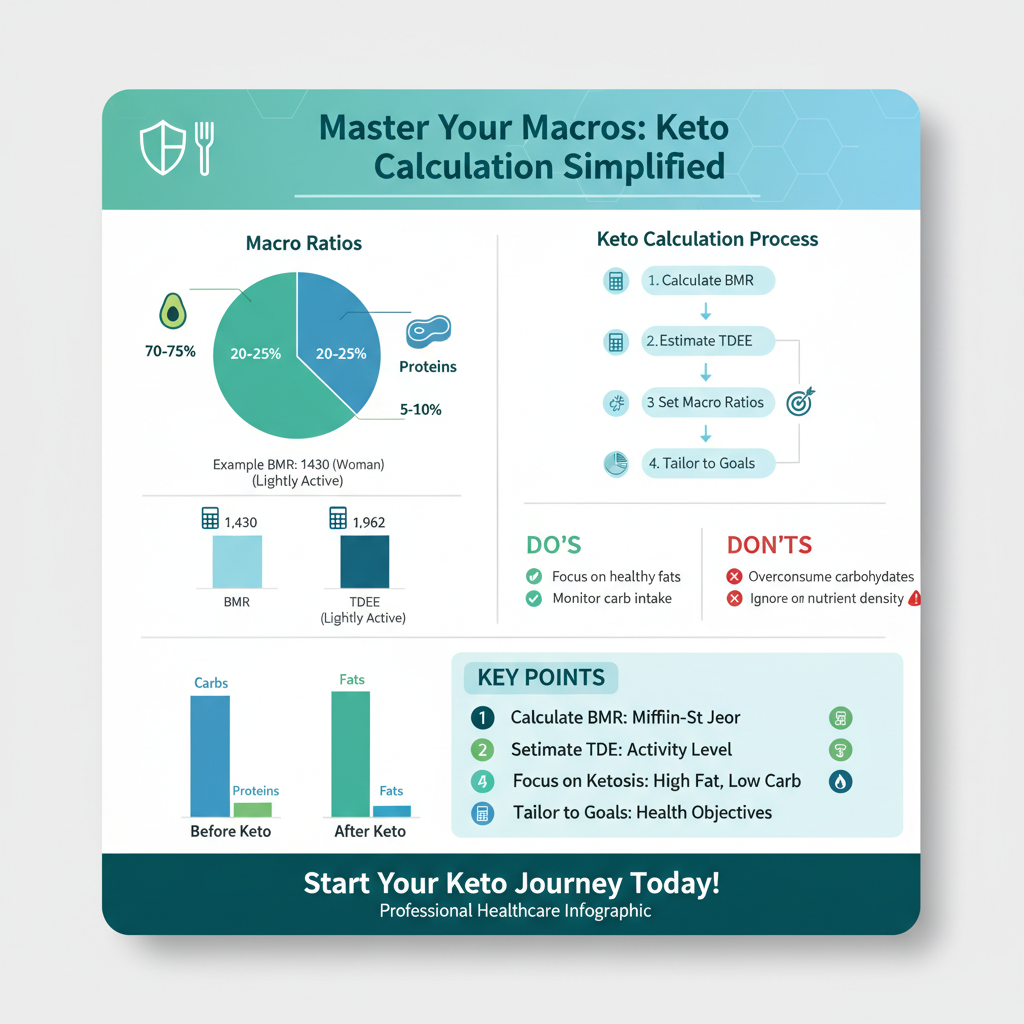

To determine your macronutrient needs, you first need to establish your daily caloric requirements. A widely accepted method for calculating your Basal Metabolic Rate (BMR)—the number of calories your body burns at rest—is the Mifflin-St Jeor equation. This equation is as follows:
For men:
BMR = 10 × weight (kg) + 6.25 × height (cm) – 5 × age (years) + 5
For women:
BMR = 10 × weight (kg) + 6.25 × height (cm) – 5 × age (years) – 161
Once you have calculated your BMR, you can estimate your Total Daily Energy Expenditure (TDEE) by multiplying your BMR by an activity factor that corresponds with your lifestyle:
– Sedentary (little or no exercise): BMR × 1.2
– Lightly active (light exercise/sports 1-3 days a week): BMR × 1.375
– Moderately active (moderate exercise/sports 3-5 days a week): BMR × 1.55
– Very active (hard exercise/sports 6-7 days a week): BMR × 1.725
– Extra active (very hard exercise/physical job): BMR × 1.9
For example, if a 30-year-old woman weighing 70 kg and standing 165 cm tall exercises lightly, her calculation would look like this:
BMR = 10 × 70 + 6.25 × 165 – 5 × 30 – 161 = 1,430 calories
TDEE = 1,430 × 1.375 = 1,962 calories
Understanding your caloric needs lays the groundwork for determining your macro ratios effectively.
Setting Your Macro Ratios
After establishing your daily caloric needs, the next step is to set your macro ratios. For a standard ketogenic diet, this typically translates to consuming 70-75% of your calories from fats, 20-25% from proteins, and only 5-10% from carbohydrates.
To calculate the specific grams for each macronutrient, use the following caloric values: fats provide 9 calories per gram, proteins provide 4 calories per gram, and carbohydrates also provide 4 calories per gram.
Using the previous example of a TDEE of 1,962 calories, if you aim for 70% of your calories from fats, the calculation looks like this:
1,962 calories × 0.70 (70%) = 1,373 calories from fats
1,373 calories ÷ 9 calories/gram = approximately 152 grams of fat per day
For proteins at 25%:
1,962 calories × 0.25 (25%) = 491 calories from protein
491 calories ÷ 4 calories/gram = approximately 123 grams of protein per day
And for carbohydrates at 5%:
1,962 calories × 0.05 (5%) = 98 calories from carbohydrates
98 calories ÷ 4 calories/gram = approximately 25 grams of carbohydrates per day
These calculations will provide you with a clear macro target to strive for daily.
Tracking Your Food Intake
Consistency is key to success on a ketogenic diet, which is why tracking your food intake is essential. Utilizing applications like MyFitnessPal or Cronometer can help you log your meals efficiently and keep tabs on your macro counts. These tools often provide a database of food items, including detailed nutritional information, which simplifies the tracking process.
When logging your meals, ensure you read nutrition labels carefully to account for all macronutrients. Remember that many processed foods contain hidden sugars and carbohydrates, which can sabotage your efforts if not accounted for. Aim to choose whole, unprocessed foods whenever possible, such as meats, fish, eggs, nuts, seeds, and low-carb vegetables.
Adjusting Macros for Progress
As you embark on your keto journey, it is essential to reassess your macro ratios every few weeks. Your body may adapt to the diet, and you might find that your initial setup no longer aligns with your goals. If you experience weight loss plateaus or fatigue, consider adjusting your macro ratios.
Listening to your body’s signals, such as energy levels and the presence of keto flu symptoms (e.g., headaches, fatigue, irritability), can provide insights into whether your current macros are working for you. You may want to increase your fat intake or reduce protein slightly to remain in ketosis effectively.
Common Mistakes to Avoid
While calculating macros can seem straightforward, several pitfalls can lead to inaccurate tracking. One common mistake is overlooking hidden carbohydrates found in sauces, dressings, and packaged foods. Always check ingredient lists and nutritional information to avoid exceeding your carb limits.
Another mistake is failing to account for all food consumed throughout the day, which can lead to inaccurate calorie and macro counts. Even small snacks or bites can add up, so ensure that everything you eat is logged to maintain an accurate picture of your intake.
Benefits of Proper Macro Calculation
Calculating macros correctly on a keto diet can yield significant benefits. Enhanced weight loss is often the most sought-after result, as the body efficiently utilizes fat for energy, leading to fat loss while preserving lean muscle mass. Moreover, a well-defined macro balance can lead to improved energy levels, sharper mental clarity, and better management of hunger and satiety cues.
By adhering to your macro goals, you may also experience fewer cravings and a more stable mood, as the ketogenic diet has been shown to stabilize blood sugar levels and reduce insulin spikes.
Summarizing the importance of calculating macros on a keto diet, achieving the right balance of fats, proteins, and carbs can lead to successful weight loss and improved health. Start by calculating your daily caloric needs, set your macro ratios, and track your intake diligently. For more tips and guidance, consider joining a keto community or consulting with a nutritionist. Taking this structured approach will empower you to optimize your dietary efforts and thrive on the ketogenic journey.
Frequently Asked Questions
What are macronutrients, and why are they important for the keto diet?
Macronutrients, or macros, are nutrients that provide energy and are essential for growth and development. They consist of three main categories: carbohydrates, proteins, and fats. In the context of the keto diet, understanding macros is crucial because the diet emphasizes high fat intake, moderate protein, and very low carbohydrates to induce ketosis, a metabolic state where the body burns fat for fuel. Properly calculating your macros helps ensure you’re meeting your dietary goals while maintaining nutritional balance.
How do I calculate my daily macro requirements for the keto diet?
To calculate your daily macro requirements for the keto diet, start by determining your total daily energy expenditure (TDEE) based on your age, weight, height, and activity level. Then, set your macro ratios typically around 70-75% fats, 20-25% protein, and 5-10% carbohydrates. For example, if your TDEE is 2000 calories, aim for approximately 1400-1500 calories from fats, 400-500 calories from protein, and 100-200 calories from carbohydrates. Utilizing a macro calculator can simplify this process and help ensure accuracy.
Why is it essential to track macros on a keto diet?
Tracking macros on a keto diet is essential because it helps you maintain the specific ratios required to achieve and sustain ketosis. Without proper tracking, you might inadvertently consume too many carbohydrates, which can kick you out of ketosis and hinder your weight loss or health goals. Additionally, tracking macros allows you to monitor your nutrient intake, ensuring you’re getting enough vitamins and minerals while following a high-fat diet.
What is the best way to track my macros on the keto diet?
The best way to track your macros on the keto diet is to use a food diary or a mobile app designed for this purpose, such as MyFitnessPal or Cronometer. These tools allow you to log your food intake easily and calculate your macronutrient breakdown automatically. Additionally, weighing your food and reading nutrition labels can improve accuracy in tracking, helping you stay on track with your keto goals effectively.
Which foods should I prioritize to meet my keto macro goals?
To meet your keto macro goals, prioritize foods that are high in healthy fats, moderate in protein, and low in carbohydrates. Focus on sources like avocados, nuts, seeds, olive oil, fatty fish (such as salmon), and grass-fed meats. Additionally, non-starchy vegetables like leafy greens, cauliflower, and zucchini can provide essential nutrients while keeping your carb intake low. Incorporating these foods will help you achieve the desired macronutrient ratios for a successful keto diet.
References
- Ketogenic diet
- https://www.ncbi.nlm.nih.gov/pmc/articles/PMC6831000/
- https://www.healthline.com/nutrition/keto-diet-macros
- https://www.cdc.gov/healthyweight/assessing/bmi/index.html
- https://www.verywellfit.com/macro-calculator-5185930
- https://www.dietitians.ca/Downloads/Public/Understanding-Macronutrients.aspx