

Calculating macronutrients for a ketogenic (keto) diet is crucial for achieving and maintaining ketosis, which is a metabolic state where your body burns fat for fuel instead of carbohydrates. This guide will provide you with a comprehensive framework to determine the ideal ratio of fats, proteins, and carbohydrates tailored to your individual needs, ensuring you maximize the benefits of the keto diet for weight loss and overall health.
Understanding Macronutrients and Their Roles

To succeed on a keto diet, it is essential to understand the roles of macronutrients—fats, proteins, and carbohydrates—in your meals.
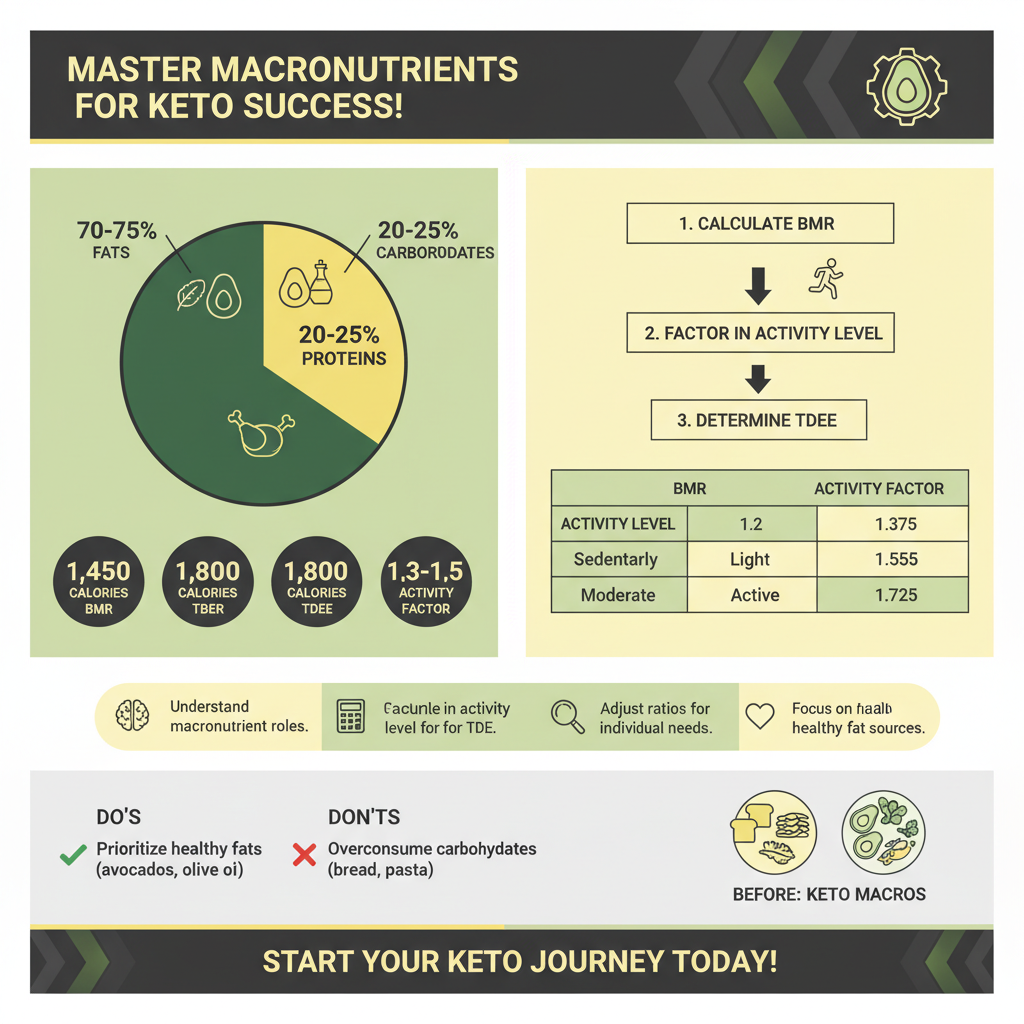
– Fats are the cornerstone of a ketogenic diet, providing the majority of your daily caloric intake, typically around 70-75%. Healthy fats, such as avocados, olive oil, nuts, and fatty fish, not only supply energy but also support hormone production and enhance satiety, making it easier to adhere to the diet.
– Proteins play a crucial role in muscle maintenance and repair, particularly important for those who are active or want to preserve lean muscle mass while losing weight. On a keto diet, protein usually accounts for 20-25% of your caloric intake. Sources of protein include meat, poultry, eggs, and low-carb dairy products.
– Carbohydrates are significantly restricted on a ketogenic diet, typically making up only 5-10% of your total caloric intake. This reduction is essential for entering and maintaining ketosis. It is vital to opt for low-glycemic vegetables, leafy greens, and select berries to minimize carbohydrate consumption while still obtaining necessary nutrients.
Determining Your Daily Caloric Needs

The first step in calculating your macronutrient needs is determining your daily caloric requirements.
– Calculate your Basal Metabolic Rate (BMR): This is the number of calories your body needs at rest to maintain vital functions. You can use online calculators or formulas such as the Mifflin-St Jeor equation, which considers your age, sex, height, and weight. For example, a 30-year-old female who is 5’5″ and weighs 150 pounds would have a BMR of approximately 1,450 calories.
– Factor in your activity level to find your Total Daily Energy Expenditure (TDEE). This represents the total number of calories needed to maintain your current weight, considering your physical activity. For instance, if the same woman engages in moderate exercise, her TDEE might be around 1,800 calories after multiplying her BMR by an activity factor of 1.3 to 1.5 depending on her exercise routine.
Understanding your caloric needs is foundational for setting appropriate macronutrient ratios.
Setting Your Macronutrient Ratios
Once you know your TDEE, you can set your macronutrient ratios based on standard ketogenic guidelines.
– Utilize the standard keto ratio: A common starting point is 70% fats, 25% protein, and 5% carbohydrates. However, these ratios can be adjusted based on individual health goals. For example, if your primary aim is weight loss, you might stick closely to these ratios. Conversely, if you are an athlete looking to build muscle, you may increase protein intake slightly, while keeping carbohydrates low enough to remain in ketosis.
Adjusting your macronutrient ratios can help you cater to your specific lifestyle and goals, allowing for flexibility without compromising the principles of a ketogenic diet.
Calculating Individual Macronutrient Needs
Now that you have established your TDEE and macronutrient ratios, it’s time to convert these into actual grams.
– Convert total daily calories into grams:
– For fats: Since fats contain 9 calories per gram, multiply your total daily calories by the percentage of calories from fats and then divide by 9.
– For proteins and carbohydrates: Both proteins and carbohydrates contain 4 calories per gram. Use a similar calculation for each.
For example, if your TDEE is 2,000 calories:
– Fats: 2000 x 0.70 ÷ 9 = ~156 grams
– Proteins: 2000 x 0.25 ÷ 4 = ~125 grams
– Carbs: 2000 x 0.05 ÷ 4 = ~25 grams
This breakdown gives you a clear target for each macronutrient, enabling you to plan your meals effectively.
Tracking Your Macronutrient Intake
To ensure you are meeting your macronutrient goals, tracking your intake is essential.
– Use apps like MyFitnessPal or Cronometer: These applications allow you to log your food intake and monitor your macronutrient ratios easily. They often have extensive food databases and can calculate the nutritional values for you, simplifying the tracking process.
– Regularly check your progress: As you follow your keto diet, periodically assess your macronutrient intake and adjust as needed. This is particularly important if you experience plateaus or changes in your weight loss progress.
By staying informed and proactive, you can maintain alignment with your dietary goals.
Common Mistakes to Avoid
While following a keto diet, there are several pitfalls to be aware of that can hinder your progress.
– Overestimating protein intake: Consuming too much protein can lead to gluconeogenesis, a process where excess protein is converted into glucose, potentially kicking you out of ketosis. It’s essential to balance protein consumption within the recommended range.
– Ignoring hidden carbs: Many processed foods and sauces contain unexpected carbohydrates that can disrupt your macronutrient balance. Always read labels carefully and opt for whole, unprocessed foods whenever possible.
Being mindful of these common mistakes can enhance your success on the keto diet.
Tips for Success on a Keto Diet
To thrive on a ketogenic diet, consider implementing the following strategies:
– Focus on whole, unprocessed foods: Prioritize foods that are high in healthy fats, such as avocados, nuts, seeds, and olive oil, while avoiding processed snacks and sugary items.
– Stay hydrated: Proper hydration is crucial, especially as your body adjusts to ketosis. Additionally, consider electrolyte supplementation to combat the keto flu—symptoms that may arise during the initial adaptation phase.
– Experiment with meal prepping: Planning and preparing your meals in advance can help you stick to your macronutrient goals and avoid impulsive eating decisions.
By adopting these practices, you can significantly enhance your experience on the keto diet and achieve your health goals more effectively.
Calculating macronutrients for a keto diet is essential for achieving effective results. By understanding your caloric needs, setting appropriate ratios, and diligently tracking your intake, you can create a tailored keto plan that fits your lifestyle. Start implementing these strategies today and take your keto journey to the next level!
Frequently Asked Questions
What are the ideal macronutrient ratios for a ketogenic diet?
The ideal macronutrient ratios for a ketogenic diet typically consist of approximately 70-75% of total daily calories from fats, 20-25% from protein, and only about 5-10% from carbohydrates. These ratios help the body enter a state of ketosis, where it burns fat for fuel instead of carbohydrates. To effectively calculate these ratios, you’ll need to determine your daily caloric intake based on your weight, activity level, and weight loss goals.
How do I calculate my daily caloric needs for keto?
To calculate your daily caloric needs for a ketogenic diet, you can use the Mifflin-St Jeor Equation, which estimates your Basal Metabolic Rate (BMR). Once you have your BMR, multiply it by your activity level using a Total Daily Energy Expenditure (TDEE) multiplier. This total gives you the number of calories you should consume daily to maintain weight, from which you can adjust according to your weight loss or maintenance goals while adhering to keto macronutrient ratios.
Why is tracking macronutrients important on a ketogenic diet?
Tracking macronutrients is crucial on a ketogenic diet because it ensures that you stay within the necessary limits of carbohydrates while meeting your fat and protein needs. Consuming too many carbs can prevent ketosis and hinder weight loss progress. Additionally, precise tracking helps you make informed food choices, ensuring you obtain sufficient nutrients while maintaining energy levels and overall health on a keto diet.
What tools can I use to calculate my macronutrients for keto?
There are several effective tools available to calculate macronutrients for a ketogenic diet. Popular options include smartphone apps like MyFitnessPal or Cronometer, which allow you to log food intake and automatically compute macronutrient ratios. Additionally, online calculators can provide a quick estimate of your caloric needs and macronutrient breakdown based on your personal information and dietary preferences.
Which foods are best for hitting my macronutrient goals on keto?
To hit your macronutrient goals on a ketogenic diet, focus on high-fat foods such as avocados, nuts, seeds, olive oil, and fatty fish like salmon. For protein, choose grass-fed meats, poultry, and eggs, while low-carb vegetables like spinach, kale, and cauliflower can help you stay within your carb limits. Incorporating these foods into your meals can help you achieve the ideal macronutrient balance necessary for effective ketosis and overall health.
References
- Ketogenic diet
- https://www.ncbi.nlm.nih.gov/pmc/articles/PMC6837360/
- https://www.healthline.com/nutrition/keto-diet-macros
- https://www.dietaryguidelines.gov/
- https://www.cdc.gov/healthyweight/healthy_eating/index.html
- https://www.journalofnutrition.org/content/early/recent
- https://www.webmd.com/diet/what-is-the-ketogenic-diet