Mayonnaise can be keto-friendly, but some brands sneak in sugar or starch that changes the carb count. It can feel discouraging when a simple condiment seems to require detective work. You will learn how to check the ingredient list for hidden carbs, read the nutrition label correctly, and quickly decide whether the mayonnaise you buy stays within your keto carb limit.
Yes—most mayonnaise is keto because it’s primarily fat from eggs, with little to no net carbs. The catch is that not every brand is the same: some “light,” “mayo-like,” or flavored versions add sugar or other carb-containing ingredients. In this guide, you’ll learn how to check the label fast so you can stay keto without overthinking it.
If you’re doing keto for weight loss, blood-sugar control, or simply cutting carbs, this matters when you grab mayo for dressings, sandwiches, or quick sauces. This is especially relevant if you’ve noticed some brands “fit” your keto macros while others seem to stall you out.
How to tell if mayonnaise is keto (ingredient-first)
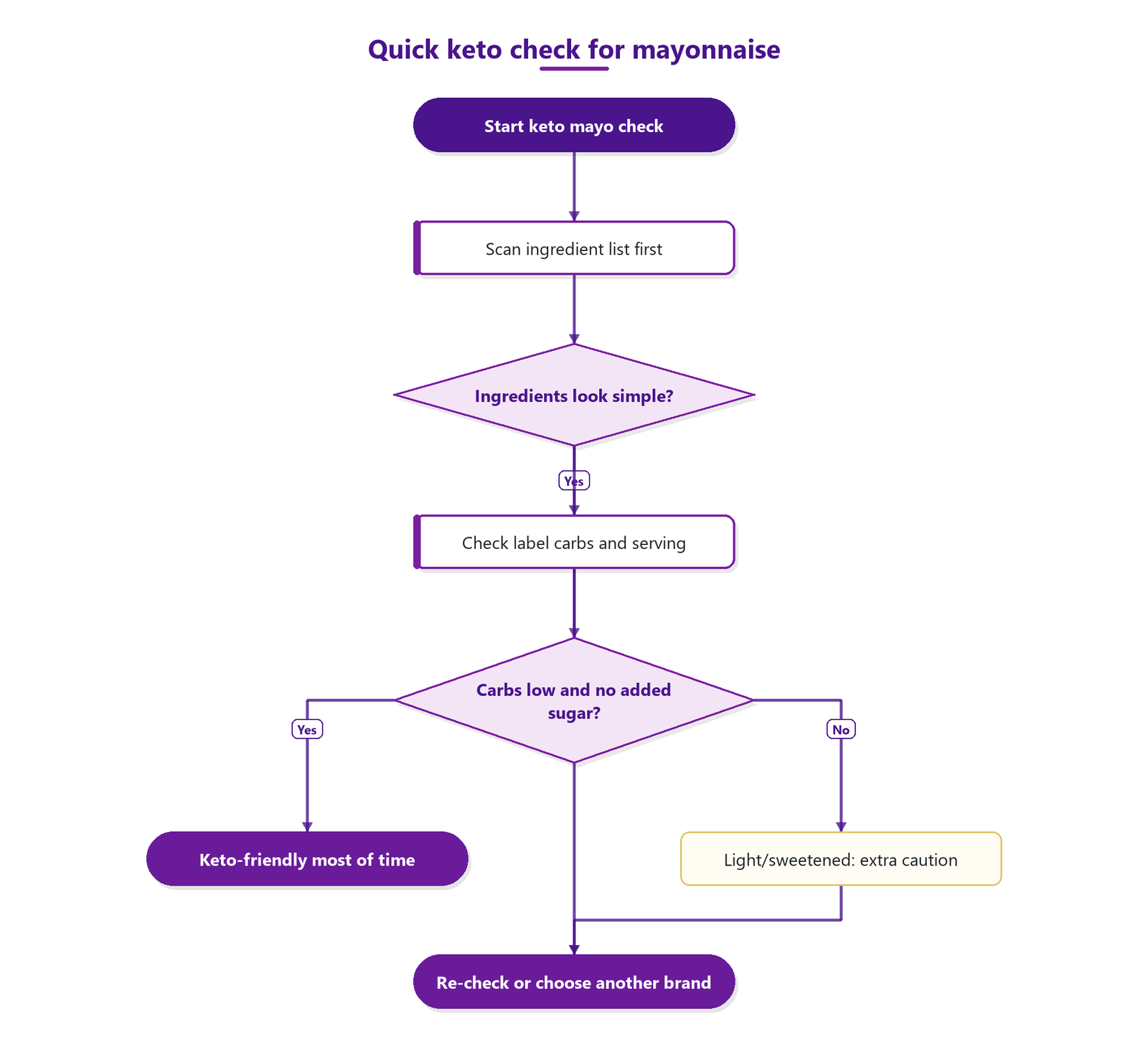
The quickest way to determine whether mayonnaise fits keto is to scan the ingredient list before you even look at carbs. The “keto-safe” version typically relies on eggs, oil, and acid for thickness and flavor—ingredients that don’t meaningfully raise carbohydrate intake.
Start with this practical rule: if the ingredient list looks simple, the carbs are usually minimal. As of 2026, ingredient transparency on Nutrition Facts labels and ingredient panels makes this easier than guessing based on taste alone, especially when you’re buying for meal prep or daily use.
Here’s what you’re aiming for:
– Look for a simple ingredient list: eggs, oil, vinegar/lemon juice, salt (and maybe spices).
– Avoid versions that include added sugar or sweeteners (words like sugar, syrup, honey, dextrose, maltose).
– If you see “modified starch” or other thickening agents, check the nutrition panel closely—some can add carbs.
Why this works: on keto, your goal is to keep net carbs (carbs minus fiber) low enough to maintain ketosis. According to Mayo Clinic (2026), many people following a ketogenic diet aim for roughly 20–50 grams of net carbs per day. Mayo can be “carb-light,” but a single added ingredient can change the math.
Check carbs the quick way on the nutrition label
Checking mayo’s carbs is faster than re-reading the ingredient list every time—because the nutrition panel is where you confirm whether those “safe-looking” ingredients still add up to carbs. Use the serving size too, because keto-friendly portions can become carb-heavy if you over-scoop.
When you review the label, focus on these steps:
– Use the nutrition label’s total carbs (and net carbs, if your keto approach tracks those specifically).
– Prioritize per serving and per tablespoon info—labels differ on serving size.
– If the label shows “0g sugars” but still lists carbs, those carbs may come from trace ingredients, so confirm you’re still within your daily keto carb limit.
Two label details matter more than most people realize:
1) “Carbs” and “sugars” are not the same. Some mayos contain small amounts of carbohydrates from thickeners or partial substitutes even when sugars are listed as zero.
2) Food label rounding can hide tiny carb amounts. According to FDA Nutrition Facts label guidance (2024), “0 g” can represent up to 0.5 g per serving because of rounding rules. That’s usually still keto-friendly in small amounts—but if you consume mayo multiple times daily, the “invisible” rounding can accumulate.
To make that accumulation more intuitive, here’s a reference table you can use when you spot added sweeteners on a mayo label.
Carb math for common sweetener keywords that can appear in “mayo-like” products
| # | Added-sugar keyword | Typical measure | Carbs per measure (g) | What it means for keto | Keto score |
|---|---|---|---|---|---|
| 1 | Granulated sugar | 1 tsp (about 4 g) | 4.0 | Often shows up as “sugar” on labels | ★★★☆☆ |
| 2 | Dextrose | 1 tsp | 4.0 | Common in “sweetened” emulsions | ★★★☆☆ |
| 3 | Maltose | 1 tsp | 4.0 | Frequently appears in “stabilized” blends | ★★★☆☆ |
| 4 | Honey | 1 tsp | 4.5 | Shows up in some “natural” flavored variants | ★★☆☆☆ |
| 5 | Maple syrup | 1 tsp | 3.0 | Can raise carbs even when flavor sounds “small” | ★★★☆☆ |
| 6 | Agave syrup | 1 tsp | 5.0 | Frequently used for “sweet/tangy” profiles | ★☆☆☆☆ |
| 7 | Corn syrup | 1 tbsp | 14.0 | A small “sauce tweak” can move carbs quickly | ★☆☆☆☆ |
Even without memorizing every sweetener, the pattern is consistent: any added sugar ingredient tends to contribute carbs directly. For example, according to USDA FoodData Central (2026), granulated sugar provides about 4.0 g carbohydrate per teaspoon (about 4 g).
Regular mayo vs “light” or flavored mayo on keto
Regular mayonnaise is usually the most reliable keto choice because it more often keeps the ingredient list focused on eggs, oil, and acid. Light or flavored mayo may still fit keto, but it’s more likely to include sweeteners or carb-containing stabilizers that affect your daily total.
As of 2026, “light” branding often reflects altered fat, added thickeners, or flavor balancing—any of which can change carbs even when the product still tastes rich. This is why many people experience a frustrating pattern: one mayo works great, then a switch to a “lighter” or “chipotle” version makes macros harder to hit.
To keep it practical, compare the typical tradeoffs:
| Product type | Pros on keto | Cons / watch-outs |
|---|---|---|
| Regular mayo | Simpler ingredient lists; commonly very low carb per tablespoon | Still verify for any added sugar or modified starch |
| Light mayo | May reduce calories if that’s a goal | Often relies on different emulsifiers/thickeners; may increase carbs |
| Flavored mayo (garlic, chipotle, “sweet” blends) | Convenient flavor without needing extra ingredients | Hidden sugar is more common in “tangy” or sweet profiles; check each label even within the same brand |
Use the layout’s guidance as your baseline:
– Regular mayonnaise is usually the easiest keto pick because it tends to have fewer added ingredients.
– “Light” mayonnaise can be keto or not—often it’s adjusted with ingredients that may raise carbs.
– Flavored varieties (garlic, chipotle, sweet/“tangy” blends) are where hidden sugars sometimes show up—check each label, even within the same brand.
What can go wrong (and why you might feel “off”)
Most “mayo problems” on keto come from misreading the label or changing portion sizes—rather than mayonnaise being inherently non-keto. When carbs rise slightly but repeatedly, your daily total can creep up without you noticing.
Here are the most common issues:
– Assuming all mayo is the same: brands and product lines vary a lot, even if they look identical on the shelf.
– Ignoring serving size: keto-friendly mayo can become carb-heavy if you pour/dip more than the label serving.
– Relying only on marketing: “sugar-free” doesn’t always mean carb-free—always verify carbs from the nutrition facts.
This is especially noticeable when mayo becomes a “daily multiplier.” For example, if you use mayo in three meals, even a small change—say, an extra 1–2 g carbs per tablespoon—can matter by the end of the day. The fix is straightforward: portion to the label serving while you’re dialing in your keto targets, then reassess.
Also watch for categories that aren’t “true mayo.” Some grocery shelves mix terms like “mayo,” “mayo spread,” “dressing,” or “mayo-based sauce.” Each may have different thickening systems, sweeteners, or buffering agents.
Verdict: keto-friendly most of the time—check the label every time
Mayonnaise is generally keto-friendly, but you shouldn’t treat it as automatically carb-free across brands and product types. Choose products with no added sugar/sweeteners and confirm the carbs per tablespoon are low enough for your keto targets. Skip this (or be extra cautious) if you’re using “light,” sweetened, or heavily flavored mayo consistently without checking the nutrition facts—those are the most common places carbs sneak in.
Quick scan checklist (save this)
| What to check | Keto-friendly sign | Red flag |
|---|---|---|
| Ingredients | Eggs + oil + vinegar/lemon + salt/spices | Added sugar/syrup/honey/sweeteners |
| Nutrition panel | Very low **total carbs** per serving | Carbs that noticeably raise your daily total |
| Serving size | You can portion to the label serving | You regularly exceed the serving without tracking |
Frequently Asked Questions
Is mayonnaise keto-friendly?
Yes, most plain mayonnaise is keto-friendly because it’s typically made with eggs and oil and contains very few net carbs. However, you should still check the nutrition label for added sugars or carbohydrate-containing ingredients, since some “light” or flavored mayonnaises can be higher in carbs. Look for mayonnaise with close to 0g total carbs and 0g added sugar per serving to stay within keto goals.
How many carbs are in mayonnaise on a keto diet?
Most standard mayonnaise contains about 0–1 gram of carbs per tablespoon, making it generally compatible with a keto diet. The exact amount varies by brand, so confirm the carb count on the label and calculate net carbs if you follow a strict keto plan. If a product lists sugar or “modified” ingredients, those can increase carbs and make it less ideal for keto.
What mayonnaise brands are best for keto?
The best keto mayonnaise options are those with minimal ingredients and no added sugar, often listing 0g carbs per serving. Popular plain varieties from well-known brands are usually keto-friendly, but “light,” “whipped,” or “sandwich spread” versions may contain more carbs. For the most reliable choice, select a product that states low total carbs, low net carbs, and no added sugar.
Why can some mayonnaise products be not keto?
Some mayonnaise products aren’t keto because they include added sugar, sweeteners, or starch-based thickeners that raise carb content. Flavored varieties like sweet or “burger” styles can also include additional ingredients that affect ketosis. Always verify the nutrition facts—if carbs are more than you can fit into your daily net carb limit, choose a plain keto-friendly mayonnaise instead.
Which type of mayo should you choose for keto—regular, olive oil, or light?
For keto, regular or olive-oil-based mayonnaise is usually the safest choice because it typically has very low carbs. “Light” mayonnaise can still work, but it’s more likely to contain additional ingredients or sweeteners that increase carbs. If you want the simplest keto option, pick plain mayonnaise and verify the label for low total carbs and no added sugar.
📅 Last Updated: October 31, 2026 | Topic: is mayonaise keto | Content verified for accuracy and freshness.
References
- Ketogenic diet
- Mayonnaise
- https://fdc.nal.usda.gov/fdc-app.html#/food-search?query=mayonnaise
- https://www.nccih.nih.gov/health/ketogenic-diet
- https://www.niddk.nih.gov/health-information/diet-nutrition/low-carbohydrate-diets
- https://pubmed.ncbi.nlm.nih.gov/?term=ketogenic+diet+carbohydrate+intake
- https://pubmed.ncbi.nlm.nih.gov/?term=mayonnaise+nutrition+carbohydrates
- https://scholar.google.com/scholar?q=mayonnaise+keto+carbs Google Scholar
- https://scholar.google.com/scholar?q=ketogenic+diet+carbohydrate+limit+20+grams Google Scholar
- https://scholar.google.com/scholar?q=mayonnaise+nutrition+carbohydrates Google Scholar