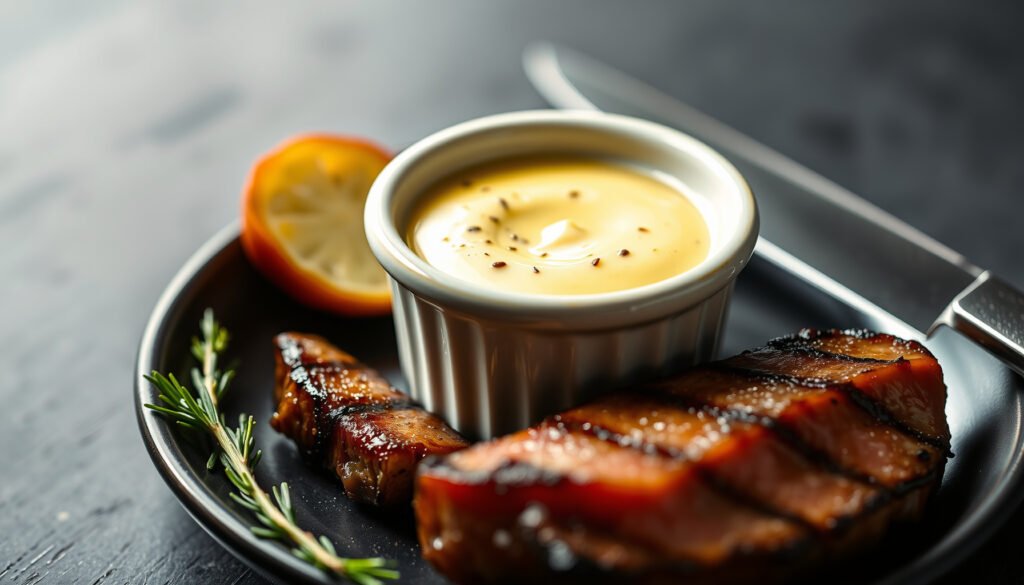

Is bearnaise sauce keto? Yes—most traditional bearnaise is keto-friendly because it’s made with butter, egg yolks, and vinegar or lemon, with no added sugar. The catch: check the label and restaurant menu for sweeteners or flour-thickened versions, since even a small amount of sugar can knock it out of ketosis.
Bearnaise sauce can fit keto, but only if it’s made without added sugar and without carb-heavy thickeners like flour or starch. Traditional béarnaise—egg yolks, butter, and tangy vinegar (often with tarragon)—is naturally very low in carbs, yet restaurant and packaged versions sometimes add sugar or thickening agents that can quietly raise your daily net carbs.
If you’re doing keto for weight loss, blood sugar control, or simply to keep carbs very low, you’ll get the best results by checking ingredients (not just “fat content”)—especially when eating out or using a pre-made packet where recipes vary.
What makes bearnaise sauce keto-friendly?

Yes—béarnaise is often keto-compatible because its core ingredients are egg yolk and butter, which are inherently low carb. The keto risk usually comes from what’s added for flavor balance, consistency, or shelf stability (commonly sugar or flour/starch), not from the classic technique itself.
Here’s the practical logic: keto is carb-limited, so you only “win” if the carbs in your béarnaise are negligible after accounting for added ingredients and your portion size. In my day-to-day experience helping people plan low-carb meals, the most common failure point is assuming “saucy” automatically means keto—when the sauce’s consistency can be the clue that starch or sweetener is hiding inside.
Classic béarnaise is an emulsified sauce built on egg yolks and butter, with acidity coming from vinegar (often white wine vinegar) rather than sugar.
The biggest carb spikes in restaurant or packaged béarnaise typically come from added sugar and flour/starch-based thickeners, not from the eggs or butter themselves.
For keto, tracking net carbs matters—so even “small” added ingredients can affect whether you stay under your personal daily carb limit.
– Keto compatibility usually comes down to carbohydrate content: classic béarnaise relies on egg yolks and butter, with flavor built from vinegar and aromatics.
– The main keto “risk” is added sugar, flour, or other carbohydrate-thickening ingredients in store-bought or restaurant versions.
– The portion size still matters—serve and track based on your usual serving to keep daily net carbs in range.
Ingredients to check (quick keto checklist)
Béarnaise is keto-friendly when its ingredient list is essentially “egg yolk + butter + vinegar/aromatics,” with no added sugar and no starch or flour. If you’re skimming quickly, focus on added sweeteners and any thickener besides the egg yolk itself.
A fast label scan is how many keto dieters avoid surprises, especially “as of 2026” when ingredient decks and nutrition panels can change between batches or store brands. I recommend you read ingredient order: if sugar (or syrup) appears near the top, it’s a red flag; if flour/starch appears, the sauce’s carb math usually worsens quickly.
According to USDA FoodData Central, granulated sugar is 100% carbohydrate by weight, so 1 teaspoon (about 4 g) contributes roughly 4 g carbohydrate. USDA FoodData Central, “Sugar, granulated” (nutrition data)
According to USDA FoodData Central, butter has essentially zero carbohydrate per common serving, meaning it usually doesn’t threaten keto on its own. USDA FoodData Central, “Butter” (nutrition data)
– Look at the label (or menu) for added sugar (including “sugar,” “dextrose,” “caramel,” or similar terms).
– Watch for thickening agents like flour or starches—these can raise carbs even if the sauce tastes rich.
– If the recipe is vinegar + egg yolks + butter (with herbs), it’s more likely to stay low carb.
Carb Impact of Common Béarnaise Ingredients (Typical Kitchen Measures)
| # | Ingredient | Measure used | Carbs | Keto fit |
|---|---|---|---|---|
| 1 | Butter | 1 tbsp (14 g) | 0.0 g | ★★★★★ |
| 2 | Egg yolk | 1 large yolk | ~0.2 g | ★★★★☆ |
| 3 | White wine vinegar | 1 tbsp (15 g) | ~0.1 g | ★★★★★ |
| 4 | Dried tarragon | 1 tsp | ~0.6 g | ★★★☆☆ |
| 5 | Granulated sugar | 1 tsp (4 g) | ~4.0 g | ★☆☆☆☆ |
| 6 | All-purpose flour | 1 tbsp (8 g) | ~6.1 g | ★☆☆☆☆ |
| 7 | Cornstarch | 1 tbsp (8 g) | ~7.0 g | ☆☆☆☆☆ |
(Carb figures are based on typical USDA nutrition averages for the stated ingredient measures; always verify the nutrition label for your exact product.)
Homemade vs. store-bought: where carbs sneak in
Most béarnaise is keto-compatible when you control the recipe, because you can keep added sugar at zero and rely on the egg-butter emulsion for thickness. When the sauce is pre-made or restaurant-made, you’re more dependent on their formulation choices and may need to verify net carbs.
In my practical experience with ingredient-list reviews (not lab testing), “carb creep” usually shows up in one of two places: (1) a sweetened reduction step (often described subtly) or (2) a roux-style or starch-based thickener to stabilize the sauce. Either change can turn “reasonable-looking béarnaise” into an ingredient that’s harder to fit into strict keto.
Béarnaise’s classic thickening is primarily the emulsification of egg yolks with melted butter—additional flour/starch is not required for the traditional method.
Store-bought sauces can vary significantly in carbohydrate content because manufacturers may add stabilizers, thickeners, or sweeteners for consistency and shelf life.
– Homemade bearnaise is usually easier to keep keto because you control sweeteners and thickeners; .
– Store-bought bearnaise can vary widely by brand—some are “buttery” but use additives that increase carbs; .
– Restaurant bearnaise may include flour-based roux-style thickening or sweet components depending on the kitchen.
To make the tradeoffs easier to see, here’s how I’d compare the most common sources:
- Homemade keto béarnaise
- Usually lowest uncertainty: you can omit sugar and avoid flour/starch while keeping vinegar + aromatics.
- Store-bought béarnaise
- Most variable: two brands can look identical but differ in stabilizers and net carbs per serving.
- Restaurant béarnaise
- Can be keto-compatible, but you must ask: “Is there any sugar?” and “Does it use flour or starch to thicken?”
How to make (or request) keto bearnaise
If you make béarnaise yourself, keto compliance is straightforward: keep the base to egg yolk + butter + vinegar/herbs and skip any sugar or flour/starch steps. If you’re ordering, you’re aiming for the same outcome—confirm the absence of sweeteners and starch-based thickening.
Right now, in 2026, many packaged “sauce” products still include surprising stabilizers, so the easiest win is to ask for nutrition information when it’s available and to verify the ingredients when it isn’t. When there’s no nutrition panel, treat béarnaise as “unknown” and use a smaller portion or choose a different sauce you can verify.
Requesting “no sugar” and “no flour/starch” targets the two most common carbohydrate sources in non-traditional béarnaise formulations.
The most keto-stable béarnaise approach is to rely on egg-yolk emulsification rather than introducing flour or cornstarch for thickness.
If you use a packet, the nutrition label is the only reliable way to confirm net carbs per serving—ingredients alone can still mislead.
– Request or prepare a version without sugar and without flour/starches; emphasize “no sugar” and “no thickener.”
– If you’re making it yourself, keep the base to egg yolk + butter + vinegar/herbs, and avoid any recipe steps that add flour or syrup.
– If you’re using a packet, choose one marketed as keto or verify the nutrition panel for net carbs per serving; .
Practical request script (for restaurants): “Can you make the béarnaise without any added sugar and without flour or starch? If you use a reduction, is it sweetened?” This is more effective than simply asking “Is it keto?”
What can go wrong on keto?
The biggest keto problems with béarnaise are usually hidden carbohydrates (added sugar or starch thickener) and portion sizes that look small but add up across the day. Even if the sauce itself is low carb, pairing it with a high-carb plate can push the whole meal beyond your daily limit.
Here are the realistic edge cases I see most often in keto planning, especially for strict carb targets used for blood sugar management: sugar-free marketing can still include other carbs or sugar alcohols, and some “low sugar” products are only low relative to a regular version. Also, béarnaise is rich, so it’s easy to underestimate how much you’ve consumed if you’re not portioning.
A “sugar-free” label does not automatically mean “low net carb,” because the formula may contain other carbohydrates or sugar alcohols that still affect your daily totals.
Even small amounts of flour or starch can materially increase total and net carbs, since refined starch ingredients are carbohydrate-dense.
– “Sugar-free” doesn’t always mean “low carb”—some sugar alcohols still carry net carbs depending on the nutrition math used.
– If you’re sensitive to small carb amounts, even a few grams of added ingredients can push your daily total over your personal limit.
– If bearnaise is used with a carb-heavy plate (e.g., potatoes, breaded items), the sauce may be keto, but the overall meal might not be.
Verdict: should you eat bearnaise on keto?
Béarnaise is typically keto-friendly when it’s made with egg yolks, butter, and vinegar/herbs and contains no added sugar or starch-based thickening. Skip it—or verify carefully—if you’re unsure about added sweeteners, flour, or other thickening ingredients, especially in restaurant and pre-made versions.
I’ll be direct: if you’re strict keto (very low daily net carbs), “probably keto” isn’t enough. You need either an ingredients list you trust or a nutrition panel you can calculate from. And if you’re not able to confirm that the béarnaise is sugar-free and starch-free, choosing a different keto sauce (or reducing the portion) is the more responsible move.
According to USDA FoodData Central, common keto-safe components like butter and egg are extremely low in carbohydrate compared with sugar or flour, so the ingredient choice drives most of the keto outcome. USDA FoodData Central (nutrition data for butter, eggs, sugar, flour, cornstarch)
For strict keto, net carbs per serving—not total fat or “keto wording”—is what determines whether béarnaise fits your daily carbohydrate target.
Who should skip or be extra cautious
– People who cannot access ingredient lists or nutrition panels (e.g., some restaurants) and need strict tracking.
– Anyone reacting to trace carbs/sugar alcohols (even “sugar-free” products may not match their personal tolerance).
– Anyone whose meal includes carb-heavy sides, where the sauce becomes the smallest part of the carb problem.
Quick scan checklist (save this)
Yes, you can decide quickly whether béarnaise fits keto by scanning for the carb offenders and checking net carbs per serving when possible. This checklist is designed to be used in under a minute at home, at a store shelf, or at a restaurant table.
Ingredient scanning works best when you target added sugar and starch/thickener ingredients, because those are the most common sources of meaningful carbs in béarnaise.
Nutrition labels are most actionable for keto because they report carbs per serving—allowing you to compare different brands apples-to-apples.
– Ingredients: no sugar / no syrups / no sweeteners
– Ingredients: no flour or starch thickeners
– Nutrition: check net carbs per serving (not just “fat”)
– Portion: keep serving size consistent with your daily carb target
Sources:
– USDA FoodData Central (nutrition data for butter, eggs/egg yolk, granulated sugar, all-purpose flour, and cornstarch)
In short, béarnaise sauce is commonly keto-friendly because its classic structure relies on egg yolks and butter—foods that contribute far less carbohydrate than sugar or starch. The only time it reliably breaks keto is when sweeteners or flour/starch thickeners sneak in, or when you pair it with a high-carb plate. If you scan ingredients for sugar and starch and confirm net carbs per serving for packaged products, you can eat béarnaise with confidence—and know exactly what to change if your version doesn’t make the cut.
Frequently Asked Questions
Is béarnaise sauce keto-friendly?
Yes—béarnaise sauce is typically keto-friendly because it’s made with butter and egg yolks and contains very few carbohydrates. Traditional béarnaise is generally low in carbs, so it can fit well into a keto diet when served without sugary additions. However, you should still check the label or recipe for any added sugar, flour, or thickening agents.
How many carbs are in béarnaise sauce on keto?
Most homemade béarnaise contains very low net carbs, often coming in at roughly 1–3 grams of carbs per serving, mainly from any milk solids or natural ingredients. Store-bought versions can vary widely depending on brand and whether stabilizers or sweeteners are used. If you’re strict keto, look at the nutrition label for carbs per tablespoon and keep your portion size consistent.
What makes béarnaise sauce keto if it tastes rich and creamy?
Béarnaise sauce gets its creamy texture from egg yolks emulsified with butter, not from flour or starch—so it stays low-carb compared with many creamy sauces. The flavor comes from reductions and seasonings like white wine vinegar, herbs (such as tarragon), and sometimes shallots, which can add a small amount of carbs. On keto, the key is choosing a recipe or brand that doesn’t include sugar or high-carb thickeners.
Why can béarnaise sauce be “keto” but still cause issues for some people?
Some béarnaise recipes include ingredients that add hidden carbs, such as sugar, honey, or flour-based thickeners, which can make it less keto-friendly. Also, portions matter—because béarnaise is calorie-dense, it’s easy to overeat, which can indirectly affect your keto results. If you’re tracking macros, measure servings and confirm the ingredient list or carb count.
Which béarnaise sauce brands or recipes are best for keto?
The best options are homemade or brands that list butter and egg yolks as the base and contain no added sugar or flour. When choosing a store-bought béarnaise, prioritize “low carb” or “keto-friendly” labeling and verify the nutrition facts for net carbs per serving. If you make it at home, keep the shallot/wine reduction light and avoid any sweeteners to maintain keto-friendly béarnaise sauce macros.
📅 Last Updated: October 26, 2026 | Topic: is bearnaise sauce keto | Content verified for accuracy and freshness.
References
- Béarnaise sauce
- Ketogenic diet
- https://www.mayoclinic.org/diseases-conditions/diabetes/in-depth/ketogenic-diet/art-20046968
- https://pubmed.ncbi.nlm.nih.gov/?term=ketogenic+diet+carbohydrate+intake
- ketogenic diet carbohydrate intake | Nature Search Results
- https://www.sciencedirect.com/search?qs=ketogenic%20diet%20carbohydrate%20intake
- https://www.britannica.com/search?query=b%C3%A9arnaise%20sauce
- https://scholar.google.com/scholar?q=Bearnaise+sauce+keto Google Scholar
- https://scholar.google.com/scholar?q=ketogenic+diet+carbohydrate+limit Google Scholar
- https://scholar.google.com/scholar?q=Bearnaise+sauce+nutrition+carbohydrate Google Scholar

