

Calculating macros on a keto diet is essential for achieving and maintaining ketosis, which is a metabolic state where your body uses fat for fuel instead of carbohydrates. By understanding your daily caloric needs and the appropriate macro ratios—primarily high fats, moderate proteins, and low carbohydrates—you can effectively tailor your meals to meet your keto goals. This guide will walk you through the step-by-step process of accurately calculating your macros and keeping your diet on track.
Understanding Macros and Their Importance in Keto

Macros, short for macronutrients, consist of three primary components: fats, proteins, and carbohydrates. Each macronutrient plays a crucial role in our diets and directly affects our energy levels, metabolic health, and overall well-being. On a keto diet, the macro ratio is typically skewed heavily towards fat consumption; the recommended distribution is approximately 70-75% fats, 20-25% proteins, and only 5-10% carbohydrates. This unique macro balance is vital as it encourages the body to enter ketosis, where it becomes efficient at burning fat for energy rather than relying on glucose from carbohydrates. Understanding these ratios is essential for anyone aiming to follow the keto diet effectively.
Step 1: Determine Your Daily Caloric Needs
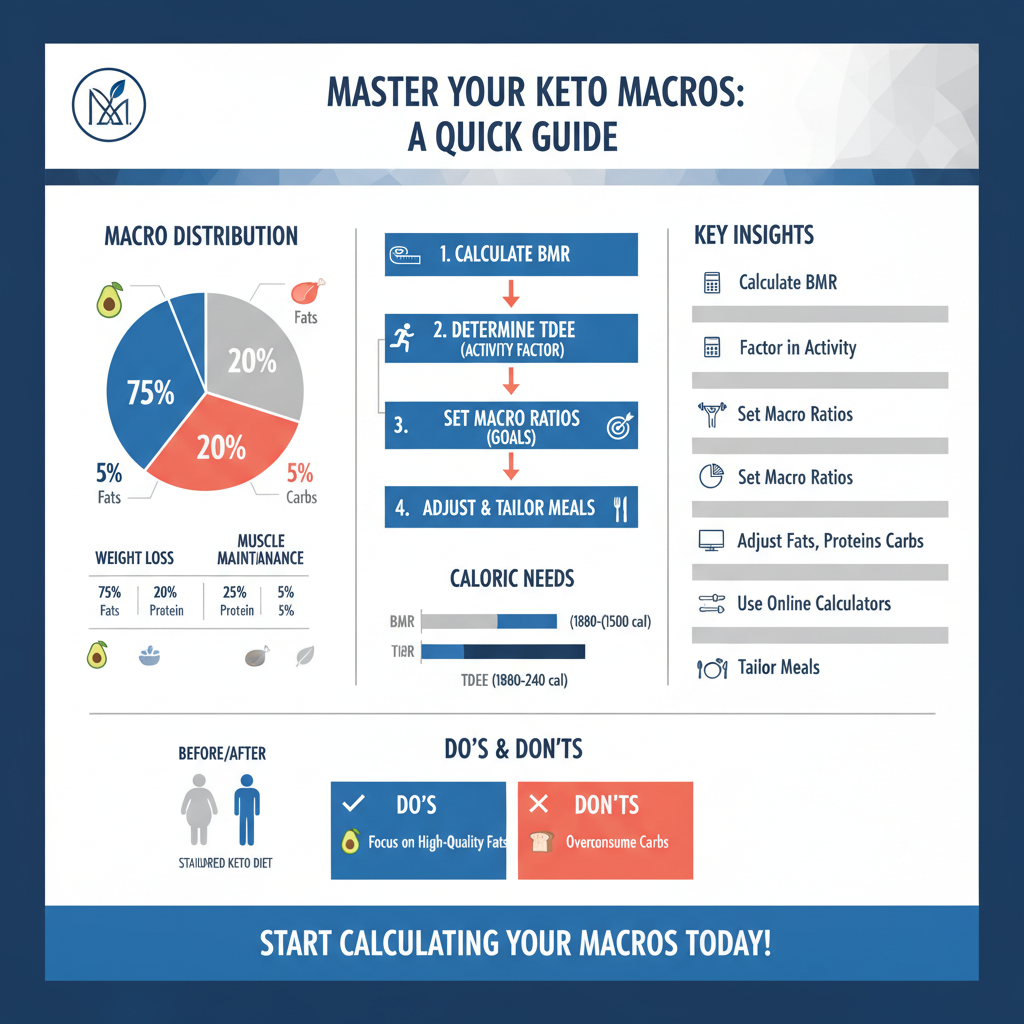

The first step in calculating your macros is determining your daily caloric needs. This can be done using the Harris-Benedict equation, which estimates your Basal Metabolic Rate (BMR)—the number of calories your body needs to maintain basic physiological functions at rest. To get a more accurate figure, you should also factor in your physical activity level to calculate your Total Daily Energy Expenditure (TDEE). For instance, if your BMR is 1,500 calories and you have a sedentary lifestyle, your TDEE might be around 1,800 calories. On the other hand, if you’re very active, your TDEE could rise to 2,400 calories or more. Online calculators can simplify this process, providing an estimate of your caloric needs based on age, gender, weight, height, and activity levels.
Step 2: Set Your Macro Ratios
Once you’ve established your caloric needs, the next step is to set your macro ratios based on your specific keto goals. If your aim is weight loss, you might opt for a slightly higher fat intake while keeping proteins moderate and carbohydrates at a minimum. Conversely, if you’re looking to maintain your current weight or build muscle, you may want to adjust your macros to include a higher protein percentage. Typical ratios for weight loss on keto might be 75% fats, 20% protein, and 5% carbohydrates, whereas for muscle maintenance, you could adjust to 70% fats, 25% protein, and 5% carbohydrates. Remember, these ratios can be fine-tuned based on individual preferences, dietary restrictions, and how your body responds to the keto diet.
Step 3: Calculate Your Macros
With your caloric needs and macro ratios established, it’s time to calculate the specific grams of each macro you should consume daily. The conversion rates for each macronutrient are as follows: fats contain 9 calories per gram, while proteins and carbohydrates contain 4 calories per gram.
For example, if your target is 2,000 calories with a macro ratio of 75% fats, 20% protein, and 5% carbohydrates, you would first calculate the caloric intake from each macro:
– Fats: 0.75 x 2000 = 1500 calories from fats
– Proteins: 0.20 x 2000 = 400 calories from protein
– Carbohydrates: 0.05 x 2000 = 100 calories from carbs
Next, convert these caloric values into grams:
– Fats: 1500 ÷ 9 = approximately 167 grams of fat
– Proteins: 400 ÷ 4 = 100 grams of protein
– Carbohydrates: 100 ÷ 4 = 25 grams of carbs
This means you should aim for roughly 167 grams of fat, 100 grams of protein, and 25 grams of carbohydrates daily.
Step 4: Use a Food Diary or App
To effectively manage your macro intake, tracking your food consumption is essential. Utilizing a food diary or an app can help ensure you’re reaching your macro targets consistently. Popular applications like MyFitnessPal or Cronometer allow you to log your meals, scan barcodes for easy entry, and provide nutritional breakdowns of the foods you consume. By recording everything you eat, you can monitor your progress towards your macro goals, making it easier to adjust your diet as necessary. Regular tracking also helps you identify patterns in your eating habits, which can be beneficial for long-term adherence to the keto lifestyle.
Step 5: Adjust as Needed
As you embark on your keto journey, it’s crucial to monitor your progress regularly. If you find that you’re not achieving your desired results—whether that be weight loss or improved energy levels—consider adjusting your macros. For example, you may need to lower your carbohydrate intake further or increase your protein to help curb cravings and improve satiety. Additionally, consulting with a nutritionist can provide valuable insights tailored specifically to your needs, ensuring you get the most out of your keto diet while maintaining nutritional balance.
Potential Challenges and Solutions
While following a keto diet can yield significant benefits, it comes with its share of challenges. Common hurdles include the difficulty of tracking macro intake accurately and managing cravings for carbohydrates. To overcome these challenges, meal prepping can be a game-changer. Preparing meals in advance allows you to control your ingredients and portion sizes, making it easier to stick to your macros. Furthermore, developing strategies to deal with cravings, such as finding keto-friendly alternatives to your favorite snacks, can help maintain motivation. Surrounding yourself with a supportive community, whether online or offline, can also provide encouragement and accountability as you navigate your keto journey.
Staying on top of your macro calculations is key to succeeding on a keto diet. By following these steps—determining your caloric needs, setting your macro ratios, calculating your macros, tracking your intake, and adjusting as needed—you’ll be well-equipped to tailor your nutritional intake to meet your ketosis goals. Begin today by assessing your caloric needs and establishing your macro ratios, and remember to track your progress for the best results!
Frequently Asked Questions
What are macros, and why are they important for a ketogenic diet?
Macros, short for macronutrients, refer to the three main components of our diet: carbohydrates, proteins, and fats. In a ketogenic diet, the focus is on high fat, moderate protein, and very low carbohydrates to encourage the body to enter a state of ketosis, where it burns fat for fuel instead of glucose. Understanding macros is crucial for maintaining this balance and achieving weight loss or other health goals while following a keto lifestyle.
How do I calculate my daily macro needs for a ketogenic diet?
To calculate your daily macro needs for a ketogenic diet, start by determining your total daily energy expenditure (TDEE) based on your age, weight, height, and activity level. Once you have your TDEE, you can allocate your macros typically as 70-75% fats, 20-25% protein, and 5-10% carbohydrates. Use a macro calculator or a spreadsheet to convert these percentages into grams, keeping in mind that fats have 9 calories per gram, while proteins and carbohydrates have 4 calories per gram.
Why is it important to track macros on a keto diet?
Tracking macros on a keto diet is essential for ensuring you stay within the specific carbohydrate limits necessary to maintain ketosis. By monitoring your intake of fats, proteins, and carbohydrates, you can make informed dietary choices, avoid hidden carbs, and ultimately optimize your weight loss or health goals. Additionally, tracking can help you identify which foods work best for your body, leading to a more sustainable and enjoyable keto journey.
What is the best way to track my macros while on keto?
The best way to track your macros on keto is to use a combination of mobile apps and food diaries. Popular apps like MyFitnessPal or Cronometer allow you to input your meals easily and provide detailed macro breakdowns. Additionally, keeping a food diary can help you stay accountable and recognize patterns in your eating habits, making it easier to adjust your macros as needed for optimal results on your keto diet.
Which foods should I prioritize to meet my keto macros?
To meet your keto macros effectively, prioritize high-quality sources of fats such as avocados, nuts, seeds, olive oil, and fatty fish. For protein, focus on grass-fed meats, poultry, eggs, and low-carb dairy products. When it comes to carbohydrates, choose low-carb vegetables like leafy greens, broccoli, and cauliflower. This combination will help you achieve your macro targets while also providing essential nutrients to support overall health on a ketogenic diet.
References
- https://www.healthline.com/nutrition/keto-diet-macros
- https://www.ncbi.nlm.nih.gov/pmc/articles/PMC6077111/
- https://www.webmd.com/diet/what-is-the-keto-diet
- https://www.mayoclinic.org/healthy-lifestyle/nutrition-and-healthy-eating/expert-answers/keto-diet/faq-20404607
- https://www.cdc.gov/healthyweight/healthy_eating/index.html
- https://www.dietitians.ca/Your-Health/Nutrition-Resources/Articles/Understanding-Macronutrients.aspx