

To successfully calculate your keto diet macros, you need to determine the right balance of fats, proteins, and carbohydrates that align with your dietary goals. This balance is essential for entering and maintaining ketosis, the metabolic state where your body efficiently burns fat for fuel. In this article, you’ll learn how to calculate your keto macros effectively, ensuring that you stay in ketosis and meet your health objectives.
Understanding Macronutrients
Macronutrients, commonly referred to as macros, are the nutrients that provide us with energy and are critical for our biological functions. They are divided into three categories: fats, proteins, and carbohydrates. Each of these macronutrients plays a unique role in our bodies and contributes differently to our caloric intake.
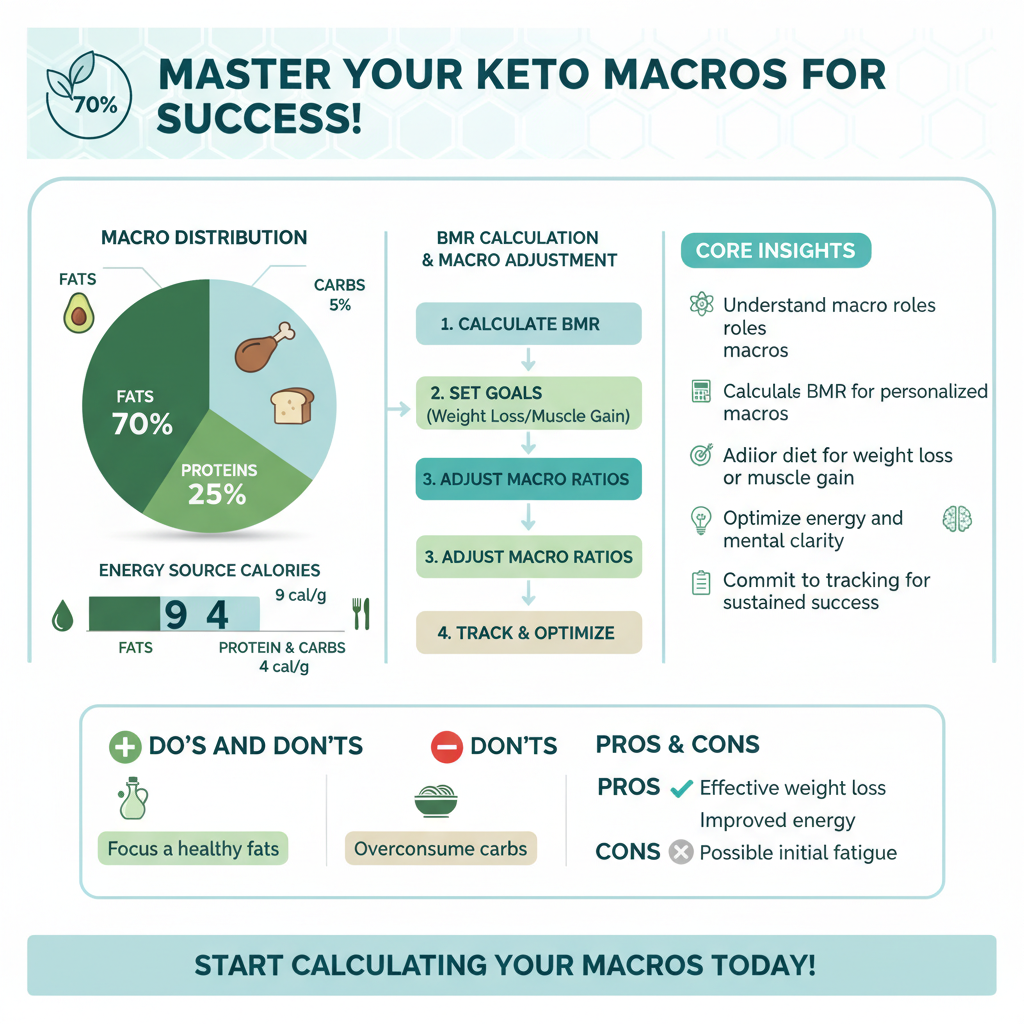
Fats are the primary source of energy on a ketogenic diet, providing a substantial 9 calories per gram. This high caloric value makes fats an effective fuel source, especially when the body is in ketosis. Proteins and carbohydrates, on the other hand, provide 4 calories per gram. While protein is essential for muscle repair and growth, carbohydrates are typically minimized in a keto diet to facilitate ketosis. Understanding how these macronutrients function and their caloric contributions is the first step to effectively managing your keto diet.
The Importance of Keto Macros

Proper macro balance is not just a recommendation; it is crucial for entering and maintaining ketosis. The ketogenic diet’s success hinges on a specific ratio of macronutrients that propels the body into a state where it burns fat instead of glucose for energy. This metabolic shift can lead to various health benefits, including weight loss, improved mental clarity, and sustained energy levels throughout the day.
Calculating your macros helps you tailor your diet according to your personal health goals. For instance, if weight loss is your objective, you may need a different ratio compared to someone focused on muscle gain or overall wellness. By understanding and adjusting your macros, you can optimize your diet for better results, making it easier to stay committed and achieve your desired outcomes.How to Calculate Your Daily Caloric Needs
Calculating your daily caloric needs is essential for determining your keto macros. One of the most reliable methods to estimate your Basal Metabolic Rate (BMR) is the Mifflin-St Jeor equation, which accounts for your age, gender, height, and weight. The formula for men is:
\[ BMR = 10 \times \text{weight (kg)} + 6.25 \times \text{height (cm)} – 5 \times \text{age (y)} + 5 \]
For women, the formula is:
\[ BMR = 10 \times \text{weight (kg)} + 6.25 \times \text{height (cm)} – 5 \times \text{age (y)} – 161 \]
Once you have your BMR, you can adjust your caloric intake based on your activity level. Use the following multipliers:
– Sedentary (little or no exercise): BMR x 1.2
– Lightly active (light exercise/sports 1-3 days/week): BMR x 1.375
– Moderately active (moderate exercise/sports 3-5 days/week): BMR x 1.55
– Very active (hard exercise/sports 6-7 days a week): BMR x 1.725
This adjusted caloric need serves as the foundation for determining your macro ratios.
Determining Your Keto Macro Ratios
On a standard ketogenic diet, the macro ratios typically consist of approximately 70% fats, 25% proteins, and 5% carbohydrates. However, these ratios can vary depending on individual preferences and health goals. For example, someone seeking to build muscle might increase their protein intake to 30%, while someone focused on weight loss might stick closely to the traditional ratio.
To find your specific macro needs, use an online keto macro calculator. Input your daily caloric requirements along with your desired macro ratios. The calculator will provide you with the grams of each macronutrient you should aim for each day. For instance, if your daily caloric need is 2000 calories, a 70/25/5 ratio would result in approximately 155 grams of fat, 125 grams of protein, and 25 grams of carbohydrates.
Tracking Your Intake
One of the most effective ways to ensure you stay within your calculated macros is to utilize food tracking apps such as MyFitnessPal or Cronometer. These platforms allow you to log your meals, making it easier to monitor your daily intake. By keeping track of what you eat, you can ensure that you are meeting your macro goals and adhering to the ketogenic diet.
Additionally, regularly monitoring your weight and energy levels can help you make necessary adjustments to your macros. If you find that you are not losing weight as expected or feel fatigued, it could be a sign that you need to tweak your intake or ratio. Remember, tracking is not just about numbers; it’s about finding what works best for your body.
Tips for Successful Macro Calculation
To ensure the successful calculation and adherence to your keto macros, consider the following tips:
1. Meal Prep in Advance: Planning your meals ahead of time can minimize last-minute decisions that may lead to poor macro choices. Prepare meals that align with your macros and have them ready to go.
2. Educate Yourself on Food Labels: Familiarizing yourself with food labels and the nutritional content of various foods can empower you to make informed decisions. This understanding is vital for accurately monitoring your carb intake, particularly hidden carbs often found in sauces and processed foods.
3. Experiment and Adjust: Don’t hesitate to experiment with different foods and recipes. As you learn how your body responds, you may find that certain foods work better for you than others.
Common Mistakes to Avoid
Even with the best intentions, there are common pitfalls that can skew your macro calculations. Here are a few to watch out for:
– Overlooking Hidden Carbs: Sauces, dressings, and even some seemingly healthy snacks can contain hidden sugars and carbs that can affect your macro ratios. Always check the labels and consider making your own condiments.
– Neglecting to Adjust Macros: As your weight and activity levels change, it’s essential to reassess your macros. Failing to do so can hinder your progress, particularly if you are not seeing the desired results.
– Relying Solely on Processed Keto Foods: While there are many convenient keto products available, they can be misleading. Always check the nutritional information and focus on whole, nutrient-dense foods for optimal health.
Summarizing the process of calculating keto diet macros involves understanding your caloric needs, determining your macro ratios, and tracking your food intake. By applying these principles, you can maintain a successful keto lifestyle. Start today by assessing your current diet and utilizing the tips provided to effectively manage your macronutrients for better health outcomes. With careful planning and consistent tracking, you can achieve your health and fitness goals on the keto diet.
Frequently Asked Questions
What are the ideal macronutrient ratios for a keto diet?
The ideal macronutrient ratios for a ketogenic diet typically consist of about 70-75% of your total daily calories coming from fats, 20-25% from protein, and only 5-10% from carbohydrates. This high-fat, low-carb approach helps your body enter a state of ketosis, where it burns fat for fuel instead of glucose. Adjusting these ratios may be necessary based on individual goals, activity levels, and metabolic responses.
How do I calculate my daily calorie needs for the keto diet?
To calculate your daily calorie needs for the keto diet, start by determining your Basal Metabolic Rate (BMR) using a formula like the Mifflin-St Jeor equation. Then, multiply your BMR by an activity factor that corresponds to your lifestyle (sedentary, lightly active, moderately active, etc.). This total will give you the number of calories you should consume daily, which you can then use to set your macronutrient goals based on the ketogenic ratios.
Why is tracking macros important on a keto diet?
Tracking macros is crucial on a keto diet because it ensures you stay within the specific carbohydrate limits required to maintain ketosis. When you monitor your intake of fats, proteins, and carbohydrates, it helps you make informed food choices that align with your dietary goals. Additionally, tracking can assist in preventing common pitfalls, such as unintentionally consuming too many carbs, which can hinder weight loss and overall health benefits.
What is the best way to track my keto macros?
The best way to track your keto macros is to use a reliable app or food diary that allows you to log your meals and analyze your nutrient intake. Popular apps like MyFitnessPal, Cronometer, or Carb Manager can simplify this process by providing extensive food databases and macro calculators. Additionally, keeping a written journal can enhance your awareness of eating habits and help you adjust your macro intake as needed for optimal results.
Which foods should I prioritize to meet my keto macros?
To meet your keto macros, prioritize high-fat, low-carb foods such as avocados, nuts, seeds, olive oil, fatty fish, and grass-fed meats. Low-carb vegetables like leafy greens, broccoli, and cauliflower are also essential for providing nutrients without exceeding your carb limits. Incorporating dairy products like cheese and heavy cream can further help you reach your fat macro goals while keeping your carbohydrate intake minimal.
References
- Ketogenic diet
- https://www.ncbi.nlm.nih.gov/pmc/articles/PMC6836406/
- https://www.health.harvard.edu/staying-healthy/the-ketogenic-diet
- https://www.cdc.gov/healthyweight/healthy_eating/dietary_guidelines.html
- https://www.nutrition.gov/topics/whats-food/nutrition-basics/macronutrients
- https://www.ncbi.nlm.nih.gov/pmc/articles/PMC6520673/
- https://www.webmd.com/diet/what-is-the-keto-diet