

The ideal calorie intake on the keto diet typically ranges from 1,500 to 2,500 calories per day, depending on individual factors such as age, gender, activity level, and weight loss goals. This flexibility allows individuals to tailor their dietary approach to their unique body composition and lifestyle, making it essential to understand how to calculate your specific calorie needs while following a ketogenic lifestyle. This article will guide you through the intricacies of caloric requirements on the keto diet, helping you to optimize your dietary regimen for better health outcomes.
Understanding the Keto Diet Basics

The ketogenic diet is fundamentally a high-fat, moderate-protein, and low-carbohydrate dietary plan that aims to induce a metabolic state known as ketosis. In this state, the body shifts its primary energy source from glucose derived from carbohydrates to ketones produced from fat. This metabolic shift can lead to various benefits, including weight loss, improved insulin sensitivity, and enhanced mental clarity. The standard macronutrient ratios for a ketogenic diet typically include approximately 70-75% of calories from fats, 20-25% from protein, and only 5-10% from carbohydrates. Understanding these basic principles is crucial for anyone considering the keto diet, as they form the foundation for meal planning and calorie management.
Factors Influencing Caloric Needs
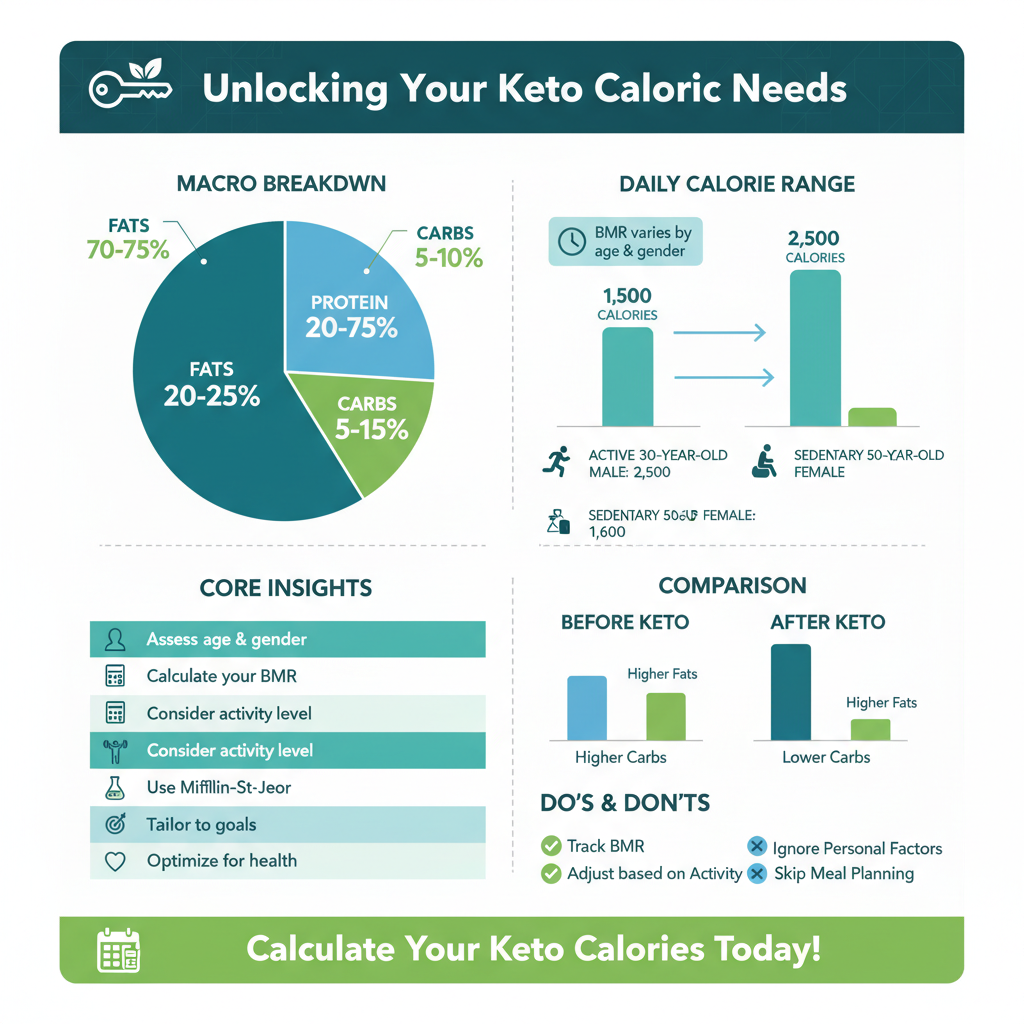

Several factors significantly influence how many calories you should consume on the keto diet. Age and gender are primary determinants; for instance, younger individuals and men often require more calories than older adults and women due to variations in metabolic rates. Your basal metabolic rate (BMR), which is the number of calories your body requires at rest, also plays a crucial role.
Additionally, your activity level cannot be overlooked. Sedentary individuals will naturally need fewer calories than those who are highly active. For example, a 30-year-old male who exercises regularly may require around 2,500 calories daily, while a 50-year-old sedentary female may only need about 1,600 calories. Understanding these factors is essential when determining your personalized caloric needs on the keto diet.
Calculating Your Daily Caloric Needs
To accurately calculate your daily caloric needs, you can utilize equations such as the Harris-Benedict equation or the Mifflin-St Jeor equation. The Mifflin-St Jeor equation is particularly favored for its accuracy and is calculated as follows:
– For men: BMR = 10 weight (kg) + 6.25 height (cm) – 5 age (years) + 5
– For women: BMR = 10 weight (kg) + 6.25 height (cm) – 5 age (years) – 161
Once you have your BMR, multiply it by an activity factor to account for daily physical activity. For instance, the multiplier for a sedentary lifestyle is 1.2, while a very active lifestyle (intense exercise/sports) may require a multiplier of 1.725.
After determining your caloric needs, adjust your intake based on your goals. If you’re aiming for weight loss, a calorie deficit of 500-1,000 calories per day is generally recommended for safe weight loss, translating to about 1-2 pounds lost per week. Conversely, if maintenance or muscle gain is your goal, adjust your caloric intake accordingly.
Macronutrient Ratios for Keto
Achieving the correct macronutrient ratios is vital for success on the keto diet. Aiming for approximately 70-75% of your total caloric intake from fats ensures that your body remains in ketosis, while 20-25% from protein supports muscle maintenance and repair. Lastly, keeping carbohydrates to 5-10% helps to limit glucose availability, further encouraging fat utilization for energy.
For example, if your daily caloric intake is 2,000 calories, you would aim for roughly 140-150 grams of fat, 100-125 grams of protein, and 25-50 grams of carbohydrates. This precise distribution aids in meal planning, enabling you to select foods that align with your dietary goals. Foods such as avocados, nuts, seeds, fatty fish, and low-carb vegetables become staples in a well-structured keto diet.
Monitoring Your Progress
To ensure that you remain on track with your caloric intake and dietary goals, regular monitoring is crucial. Tracking your weight, body measurements, and energy levels can provide insight into whether your current caloric intake is effective. Consider using mobile applications like MyFitnessPal or Cronometer, which allow for easy logging of food intake and macronutrient tracking.
Additionally, keeping a food diary can enhance accountability and highlight patterns in your eating habits. Regularly assessing your progress allows for timely adjustments to your caloric intake, ensuring that you remain aligned with your weight loss or maintenance objectives.
Common Mistakes on the Keto Diet
Despite its popularity, many individuals make common mistakes on the keto diet that can impede progress. One of the most significant pitfalls is either under-eating or over-eating. Consuming too few calories can lead to nutritional deficiencies and a slowdown in metabolism, while excessive calorie intake may result in unwanted weight gain.
Another issue arises from hidden carbohydrates found in processed foods, even those labeled as “keto-friendly.” Always scrutinize food labels for total carbohydrate content and avoid products that contain added sugars or refined carbs.
Tips for Sticking to Your Caloric Goals
Staying within your caloric goals on the keto diet can be challenging but manageable with a few strategic approaches. Meal prep is one of the most effective strategies for controlling portions and reducing impulsive eating. By preparing meals in advance, you can ensure that you have healthy, keto-compliant options readily available.
Incorporating nutrient-dense foods can also help satisfy hunger while keeping you within your calorie range. Foods such as eggs, leafy greens, and avocados provide essential nutrients without excessive calories, aiding in satiety. Planning your meals around these nutrient-rich options can make it easier to stick to your caloric goals.
Staying hydrated and listening to your body’s hunger cues are additional aspects that can contribute to your overall success on the keto diet.
Staying within the right calorie range is crucial for success on the keto diet. By understanding your individual needs and adjusting your intake accordingly, you can effectively achieve your health and weight loss goals. Start tracking your calories today and make informed choices to enhance your keto journey!
Frequently Asked Questions
How many calories should I eat on the keto diet to lose weight?
The number of calories you should consume on the keto diet for weight loss typically depends on your individual factors such as age, gender, weight, activity level, and metabolic rate. However, a common guideline is to aim for a caloric deficit of about 500 to 1,000 calories per day, which can lead to a safe weight loss of about 1 to 2 pounds per week. It’s essential to focus on high-fat, moderate-protein, and low-carbohydrate foods to stay in ketosis while adhering to your calorie goals.
What is the ideal macronutrient ratio for calories on the keto diet?
On the keto diet, the ideal macronutrient ratio for calories is generally around 70% fat, 25% protein, and 5% carbohydrates. This ratio helps your body enter and maintain ketosis, a metabolic state where fat is used as the primary energy source instead of carbohydrates. Monitoring your macronutrient intake can be crucial for achieving and sustaining weight loss and health benefits while on the keto diet.
Why do I need to track my calories on the keto diet?
Tracking your calories on the keto diet is essential to ensure you’re consuming the right amount of energy to maintain ketosis while promoting weight loss or weight maintenance goals. Many people assume they can eat unlimited fats, but excess calorie consumption can lead to weight gain. By keeping track, you can better manage portion sizes and make informed food choices that align with your dietary objectives.
How do I calculate my daily calorie needs for the keto diet?
To calculate your daily calorie needs for the keto diet, you can use the Mifflin-St Jeor equation, which factors in your age, gender, weight, and height to determine your Basal Metabolic Rate (BMR). Once you have your BMR, multiply it by an activity factor (ranging from sedentary to very active) to estimate your Total Daily Energy Expenditure (TDEE). From there, adjust your calorie intake by creating a deficit for weight loss or a surplus for muscle gain while keeping your macronutrient ratios in check.
Which foods are best for meeting my calorie goals on the keto diet?
To meet your calorie goals on the keto diet, focus on high-fat foods that are also nutrient-dense. Avocados, olive oil, coconut oil, and fatty cuts of meat are excellent choices that provide healthy fats and calories. Additionally, nuts, seeds, and low-carb dairy products like cheese can help you reach your calorie target while keeping your carbohydrate intake low and supporting your overall health on the keto diet.
References
- https://www.ncbi.nlm.nih.gov/pmc/articles/PMC6832039/
- https://www.healthline.com/nutrition/keto-diet-calories
- https://www.cdc.gov/healthyweight/calories/index.html
- https://www.webmd.com/diet/obesity/ss/slideshow-ketogenic-diet
- https://www.mayoclinic.org/healthy-lifestyle/nutrition-and-healthy-eating/expert-answers/keto-diet/faq-20458958
- What causes anxiety? Environmental factors, genetics, and more
- https://www.hsph.harvard.edu/nutritionsource/healthy-weight/calories/
- https://www.webmd.com/diet/what-is-the-keto-diet